Cement Sand Calculator
Estimate cement bags, sand volume, dry mix allowance, water, and waste for mortar, plaster, screed, render, and bedding mixes.
Full Breakdown
| Application | Typical Ratio | Finished Thickness | Dry Factor | Usual Allowance |
|---|---|---|---|---|
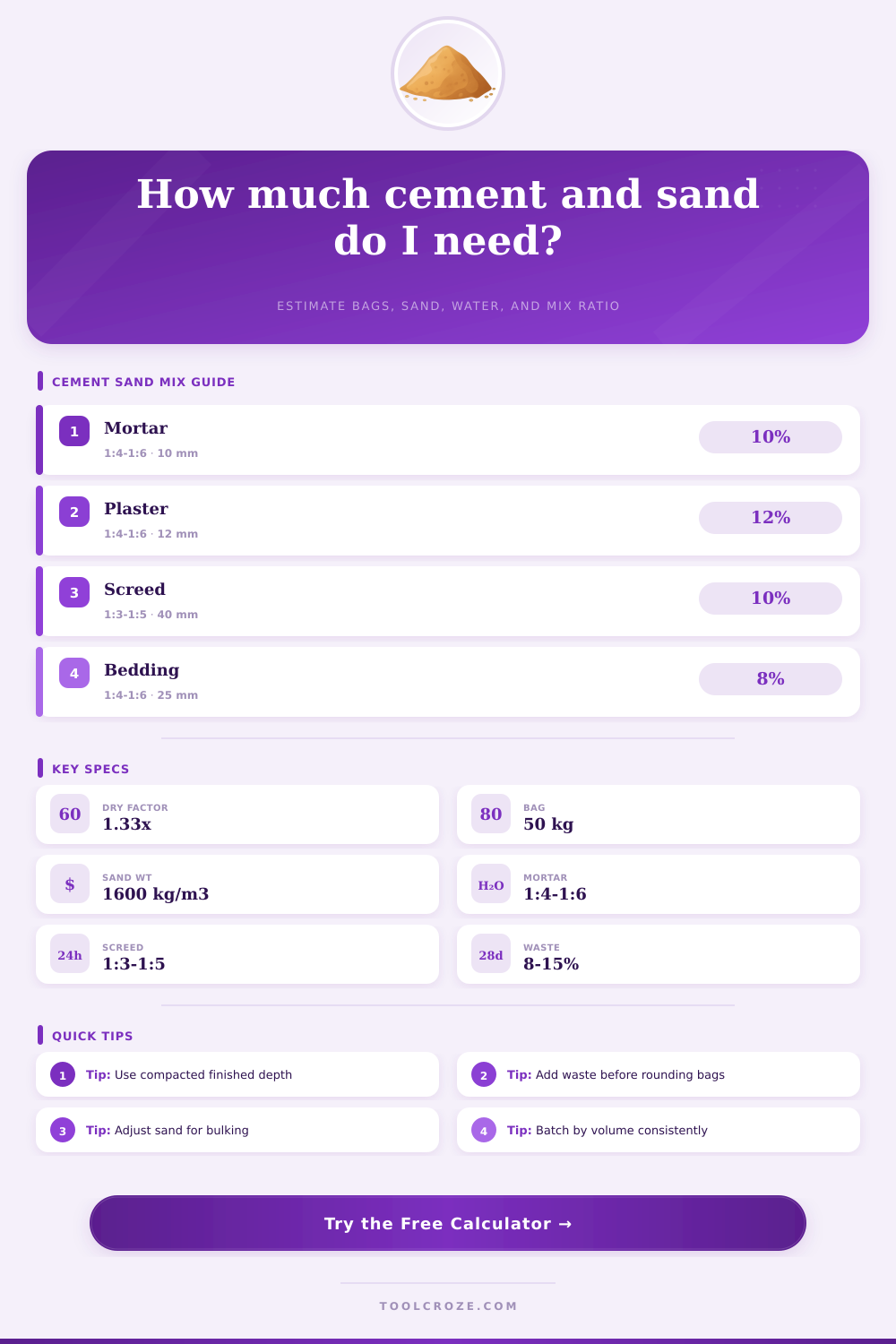
| Brickwork mortar | 1:5 or 1:6 | 10 mm joints | 1.33 | 8% to 12% |
| Blockwork mortar | 1:4 or 1:5 | 10 mm joints | 1.33 | 10% to 15% |
| Internal plaster | 1:4 to 1:6 | 10 to 15 mm | 1.40 | 10% to 15% |
| External render | 1:4 to 1:5 | 12 to 20 mm | 1.40 | 12% to 20% |
| Floor screed | 1:3 to 1:5 | 25 to 75 mm | 1.27 | 8% to 12% |
| Bag Size | Cement Volume | 1:4 Sand Volume | Dry Mix Volume | Typical Use |
|---|---|---|---|---|
| 25 kg | 0.017 m³ | 0.069 m³ | 0.087 m³ | Small patches |
| 40 kg | 0.028 m³ | 0.111 m³ | 0.139 m³ | Plaster batches |
| 50 kg | 0.035 m³ | 0.139 m³ | 0.174 m³ | Site mortar |
| 94 lb | 1.0 ft³ | 4.0 ft³ | 5.0 ft³ | Imperial batch |
| Sand Condition | Volume Adjustment | Water Handling | Best Measurement | Calculator Setting |
|---|---|---|---|---|
| Oven dry or very dry | 0% | Add full water gradually | Weight or struck box | 0% dry |
| Slightly damp sand | 10% | Hold back some water | Loose volume box | 10% damp |
| Damp fine sand | 20% | Reduce water by feel | Loose volume box | 20% damp |
| Wet fine sand | 30% | Add water last | Weight preferred | 30% wet |
| Project | Typical Size | Ratio | Depth | Planning Note |
|---|---|---|---|---|
| Room wall plaster | 12 m² | 1:6 | 12 mm | Subtract large openings |
| Bathroom tile bed | 5 m² | 1:5 | 25 mm | Keep consistent thickness |
| Patio paver bed | 18 m² | 1:6 | 30 mm | Compact base first |
| Small screed bay | 10 m² | 1:4 | 40 mm | Use levels and rails |
If you’ve ever bought too many bags of cement, then you know what happens… You’re stuck holding all this gray stuff in buckets and bags of dusty cement. You have to double the time it should has taken. Even then, it isn’t enough. Despite your best efforts, you can’t make it stretch any further.
Now… maybe you didn’t do something wrong during the mixing phase. It was probably when you estimated how much you needed before starting. People typically just estimate by area. They don’t consider wastage, mix ratio and thickness. These things adds up fast! When you miscalculate these variables, you end up running out of concrete halfway through the pour, OR having to buy more than you need which just solidifies into a useless hunk of cement.
Why You Need This Calculator
Once you know what you’re doing, it’s the easy part: defining your scope and then letting the calculator do the work. Specifically, it figure out how much sand you need and how many bags of cement. It converts those abstractions (dimensions) into numbers (bag count, volume of sand). The key here is to force you to consider the ratio early on because that’s where most DIYers go wrong.
In general, a stronger mix use more cement. So a 1:4 mix for screeding floors is far stronger than a 1:6 plaster mix for wall plaster. But that means more heat as it cures and also more expense. There is no point specifying some willy nilly number. Match the strength to the needs of the job.
That is where the tool helps. By allowing you to choose the type of application, it sets sensible defaults for thickness and mix ratio. That will help avoid the typical mistake of undermixing for something like structural blockwork or overdoing the rich mortar for plastering.
The other tricky input is the dry volume factor. For most mortars, that number is roughly 1.33. Why? Because gaps between grains of sand (the voids) must be filled by cement! That’s just how cement works, right? I know, it sounds like one small technical detail, but think about it: Sand isn’t solid stuff. It has plenty of voids, air pockets, that get eliminated when you combine it with water and cement. Since they aren’t present any more the overall volume decreases. Your final mix won’t have as much binder to do its binding job. This means the finished product will be weaker than planned. The calculator takes that into account automatically. You don’t need to worry about it… You’re getting the right amount of bags for the real-world volume of dry ingredients before they’re mixed.
The other way optimism wrecks your budget is through waste. There are ways to minimize it but no matter how good you are at mixing, some sand gets spilled on the floor. No matter what you do, there’s some material lost in the blades of the mixer. And then there are patches here and there where surface isn’t exactly flat. Ten percent waste is not being pessimistic; it’s realistic. Because external walls have all kinds of oddities to them, you need to allow even more plaster. This is clearly stated in the reference table on the page. It explains why certain applications require greater safety margins than others. Not making allowances means running back to the hardware store for two extra bags of cement and then wasting half a day getting there.
There’s one more small detail (and complication) about sand: it’s moist, and most people don’t think about that until its too late. Because there’s water between the sand grains, the grains push away from each other and become bulky; that is, one bucket of wet sand doesn’t hold as much sand as an equal-sized bucket of dry sand. It is bulky. So if your sand is moist and you’re measuring by volume, you’ll be shorting yourself on sand. That’s why the calculator has a bulking adjustment to account for the physical oddity. It keeps reminding us that things don’t work like they do in theory when working with materials in the real world.
Water management is equally important. Excess water will evaporate and leave behind pores that weaken your final product dramaticly. The tool takes account of the weight of the cement and calculates water so you won’t be tempted to add some to make it easier to work with. Diluting doesn’t give good workability; correct mixing does. This is a small thing, but it is very important for durability.
In conclusion: This calculator’s not so much about math as it is about control. Defining your parameters exactly eliminates guesswork from the equation. You know exactly what you need and what you’ve got when you walk onto the site. And having that confidence lets you do what you came here for, focus on the craft. Smooth some plaster. Lay some bricks. You can do this without having to stress out over inventory. It transforms a chaotic pile of raw materials into a managed process, saving time, money, and sanity. Remember though, one thing: measure twice, mix once. Once that water hits the concrete, there’s no going back.