Paver Gravel Calculator
Estimate compacted base gravel, bedding sand, paver count, edge restraint, fabric coverage, tonnage, cubic yards, lifts, and waste for patios, walkways, driveways, and permeable paver sections.
⛏Project presets
📏Project measurements
Paver gravel estimate
🧱Material and specification grid
📋Paver base depth reference
| Paver area | Compacted gravel base | Bedding layer | Best base aggregate | Waste range |
|---|---|---|---|---|
| Garden path on firm soil | 3 to 4 in | 1 in sand | Dense graded base | 6% to 8% |
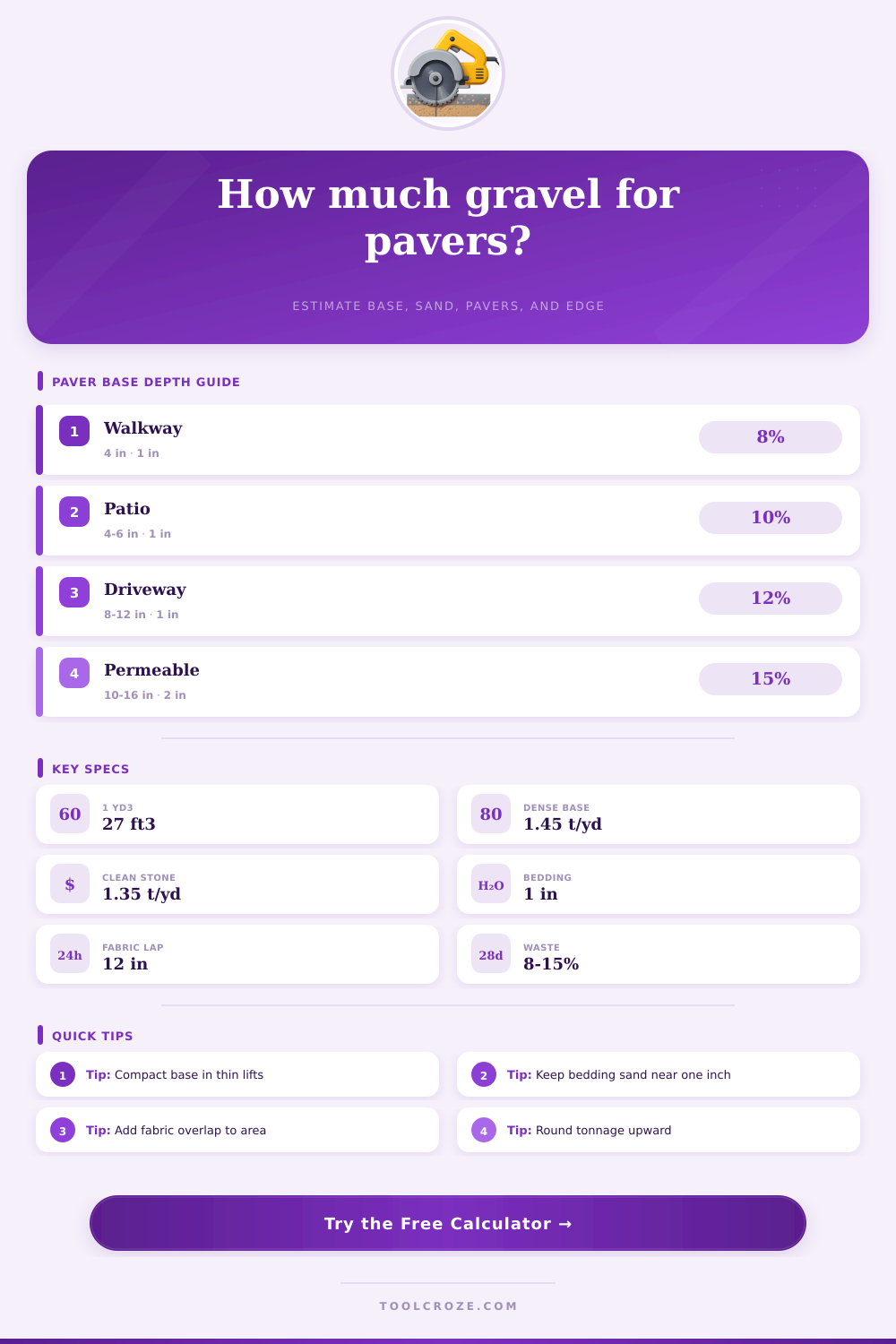
| Residential walkway | 4 in | 1 in sand | 3/4 in minus | 8% to 10% |
| Patio or courtyard | 4 to 6 in | 1 in sand | Dense graded base | 10% to 12% |
| Residential driveway | 8 to 12 in | 1 in sand | Dense graded base | 10% to 15% |
| Permeable parking bay | 10 to 16 in | 2 in No. 8 stone | No. 57 and No. 2 stone | 12% to 15% |
⚖Aggregate density and compaction table
| Aggregate | Typical use | Tons per yd³ | Loose allowance | Drainage behavior |
|---|---|---|---|---|
| Dense graded paver base | Patios, walks, driveways | 1.45 | 15% | Moderate with fines |
| 3/4 in minus crushed stone | Standard compacted base | 1.42 | 14% | Moderate with fines |
| No. 57 clean stone | Drainage or open base | 1.35 | 8% | High drainage |
| Open graded permeable base | Permeable paver systems | 1.32 | 7% | Very high drainage |
| Recycled concrete aggregate | Economical compacted base | 1.50 | 16% | Moderate, verify gradation |
| Stone screenings | Thin bedding only | 1.38 | 10% | Low to moderate |
🔧Paver and edge planning table
| Paver size | Area each | Pieces per ft² | Common pattern | Cut waste guide |
|---|---|---|---|---|
| 4 in x 8 in | 0.222 ft² | 4.5 | Running bond or herringbone | 8% to 12% |
| 6 in x 6 in | 0.250 ft² | 4.0 | Stack bond or mixed field | 8% to 10% |
| 6 in x 9 in | 0.375 ft² | 2.7 | Random modular | 10% to 12% |
| 12 in x 12 in | 1.000 ft² | 1.0 | Grid or large format | 6% to 10% |
| Plank paver | Varies | Use actual size | Linear or basket weave | 10% to 15% |
📐Common paver project quantities
| Project | Typical size | Base depth | Base yd³ | Edge length |
|---|---|---|---|---|
| Front walkway | 4 ft x 30 ft | 4 in | 1.48 yd³ | 68 ft |
| Back patio | 16 ft x 20 ft | 6 in | 5.93 yd³ | 72 ft |
| Round fire pit pad | 14 ft diameter | 6 in | 2.85 yd³ | 44 ft |
| Driveway bay | 18 ft x 32 ft | 10 in | 17.78 yd³ | 100 ft |
| Pool edge strip | 5 ft x 40 ft | 5 in | 3.09 yd³ | 90 ft |
💡Calculation tips
Before you pictured your patio, I bet you thought about what was under there, the dirt! What we can’t see is rock foundation needed for level brick or stone. Once built, the foundation dissapears from view. Why does that matter? Because a poor base crack in as little as two years; a strong base trumps color of pavers any day.
Input your dimensions into a calculator to save time converting and make sure your order is right based off how the materials pack down. Don’t confuse loose volume with compacted depth because gravel shrink when you compact it. For example, some folks think if they order six inches of stone, it will arrive on the truck and look like six inches. Gravel is not as dense than concrete or pavers; when vibrated, it shrinks. For example, dense grade base material shrinks fifteen percent or more from compaction due to loss of air pockets. If you don’t account for that, your final surface end up four inches deep instead of six, so now your subgrade is doing work it cannot handle! The tool takes that into consideration by asking for your desired compacted depth and adding an allowance to ensure you reach that thickness.
The Secret to a Strong Patio Foundation
Cost and drainage matter when choosing type of aggregate. For typical backyard patios (where water just needs to move sideways in the soil), pricey clean stone is unnecessary. A dense graded paver base will do just fine; the large pieces plus some fines is locked together when compacted, so it forms a solid footing that doesn’t shift easily. Use a less dense clean stone (like number fifty seven) on sites where water needs to flow through or where drainage are needed; it won’t hold as well but drains faster.
Although less important than gravel, don’t ignore sand. That inch between the hard stone edges and lumpy subbase lets you tap each paver into place. In a freeze-thaw climate, too much sand holds moisture against the bottom of units. Most pros recommend just an inch, since more gets squeezed out unevenly as time passes creating bumps underfoot.
If using geotextile separation fabric, do your math so it overlap properly. The fabric must keep soil from creeping up into clean base to prevent mud from oozing onto the walkway and blocking drainage; a twelve-inch overlap will do the trick.
Adding ten to twelve percent over your paver count guarantees against running out of materials or leaving you with patches in the middle. This extra amount looks like padding, but it protect against poor cuts. Full units must be broken into fragments when curving edges and corners or along other curved courses, producing dust and unusable bits. It is better to have some on hand for repairs going forward and order more later if the color varies from batch to batch or prices is higher.
A pro job compacts in thin layers. An amateur job use big layers, where a foot or so of gravel is dumped on top and compacted only once. This leaves gaps underneath that will settle down later and make a mess. Do the opposite: Spread 3 inches deep, then compact, then spread another layer, etc. Each layer gets compacted independently before adding next one. It’s slower this way, but you’ll have uniformly dense gravel all the way across the depth, strong enough to bear weight (of heavy furnitures, or cars).
Plan your steps to control equipment time. This helps you get the compactor onto the bottom of the trench without it bouncing back up through an uneven surface caused by dumping several inches of gravel at once. You should of planned for this.
A properly installed paver system is beautiful because you can’t even tell there is a rock foundation underneath. Everything is solid to walk on; you don’t give a second thought to the gravel it’s perched upon. Building a foundation that considers drainage needs, density and depth pays off with a surface that lasts for at least a decade. And, it’s that secret strength that ensures your investment holds firm well beyond the initial rains.