
Or perhaps you’ve cranked up your tungsten ball and seen it shoot to life, only to immediately go dim as its contact becomes loose. Ugh. Not a great beginning to your weld. Unfortunatley, it’s not usually something wrong with your settings on the machine. More often than not, it’s your tungsten electrode that doesn’t match your tiny copper collet who is holding it in place.
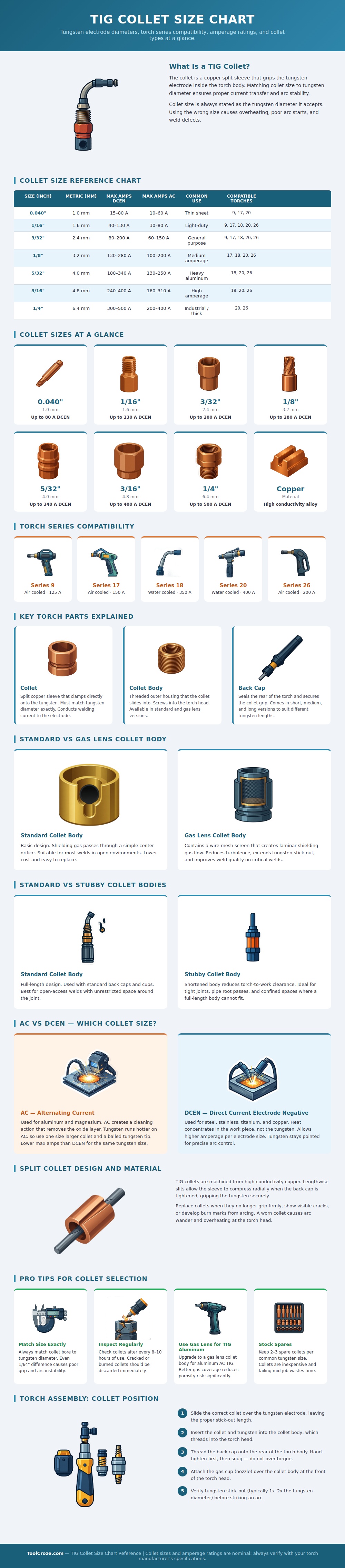
The most neglected part of your TIG welding set-up are this little split sleeve within your torch head. It’s what transmits current, provides stability for your arc and limits the amount of heat you can sends down the wire. To that end, here’s a chart (above) detailing all of the different diameters available, what they’re used for, and which size work with which application. The range goes from heavy industrial plate to thin sheet metal. As you’ll notice, little guys are for dainty work, while big boys deal with some serious amperage.
Why Tungsten Collets Matter for Good Welds
But it doesn’t stop there. Half the battle is knowing why the limits is where they are. Sure, copper conducts electricity really really well, but it also heats up when it encounters resistance. You create a bottleneck if your collet is too small for amount of amperage you’re trying to push through it. Instead of transferring heat into the workpiece, it remains trapped inside the torch body. This results in erratic arcs, melted collets, and overheating.
To select the electrode size, you must consider material thickness and type of current. For instance, if you’re melting stainless or steel, stick with Direct Current Electrode Negative; it focus the heat onto the material instead of the electrode. So you can get away with a smaller tungsten and still pump out high amps because the electrode remains relatively cool.
For something like magnesium and aluminum, you’d switch over to alternating current. Because the current reverses, the tungsten gets realy hot. According to the infographic, you’ll have less amp capability using the same diameter electrode on AC compared to DCEN. Why? It means you’ve got to bump up to a bigger collet to avoid melting down the electrode before welding are complete.
A lot of welders overlook the body of their collets until they becomes an issue. Gas lens vs. Standard collet bodies makes a noticeable difference. Standard collets simply have a hole drilled in them so gas can pass through and turbulence occur. Gas lenses use a mesh screen that smooths the gas into a laminar stream.
Sounds like a big deal? Turbulent gas allow air contamination into the weld. That causes porosity in the weld. For things like aluminum where getting clean coverage is not negotiable, the additional expense of a gas lens pay for itself in reduced rejections.
Part selection isn’t everything; how you assemble also make a difference. Tungsten should of be slid onto collet before sliding that assembly into the body. Thread the back cap on snug, but do not crush it. Too tight and it deforms the copper sleeve so it doesn’t have a good grip. Too loose and there’s arc inside the torch.
Every now and then, visually inspect the collets for signs of wear. If cracks start forming or if you see any burn marks, toss it in the trash and get a new one. A spare or two won’t cost more than wasting time and money fixing it in the middle of a job.
Another point to note may be that there is stubby versions of certain collets. What this does is reduces the length between the torch head and the workpiece. This can make all the difference in tight corners or when trying to do pipe root passes where there just isn’t room for standard body. So it keeps access while allowing you to hold an electrode at the same angle.
The guide includes a visual reference. It shows how the pieces nest together to provide gas coverage and manage heat. TIG welding is ultimately a matter of control. You must control your travel speed, addition of filler metal, and your arc length. If your foundation is weak however, you don’t have any control at all.
Introducing variables like a mismatched collet will not be fixed by experience. It’ll add frustration, instability, and even noise. Just take a second to check your tungsten diameter against the bore of your collet, it should be an exact match. Is there wear? Do you need to adjust anything on your collet? Does your standard body or lens fit the conditions you’re working in?
These little things make the difference between a patchy looking weld and a nice professional-looking weld. With a solid mechanical connection, you can direct the arc exactly as you want to. That’s when true skill sets in.
