
With a head full of doubt and a block of steel in your hand, you stand before the machine. Your intuition tell you one thing, the manual another. The last part you made have a chip formation on it that looks suspiciously like it’s trying to tell you something about which grade you should of choose. For most, insert grades is picked as if you’re selecting paint colors to cover a wall. Brand loyalty or shade determines their choice instead of function, that’s a fast route to a bad day on the shop floor.
The truth is that each carbide insert are a carefully negotiated compromise between toughness and hardness. It’s that understanding that sets apart the machinist who run a profitable shop from one who is always changing tools.
How to Choose Carbide Inserts
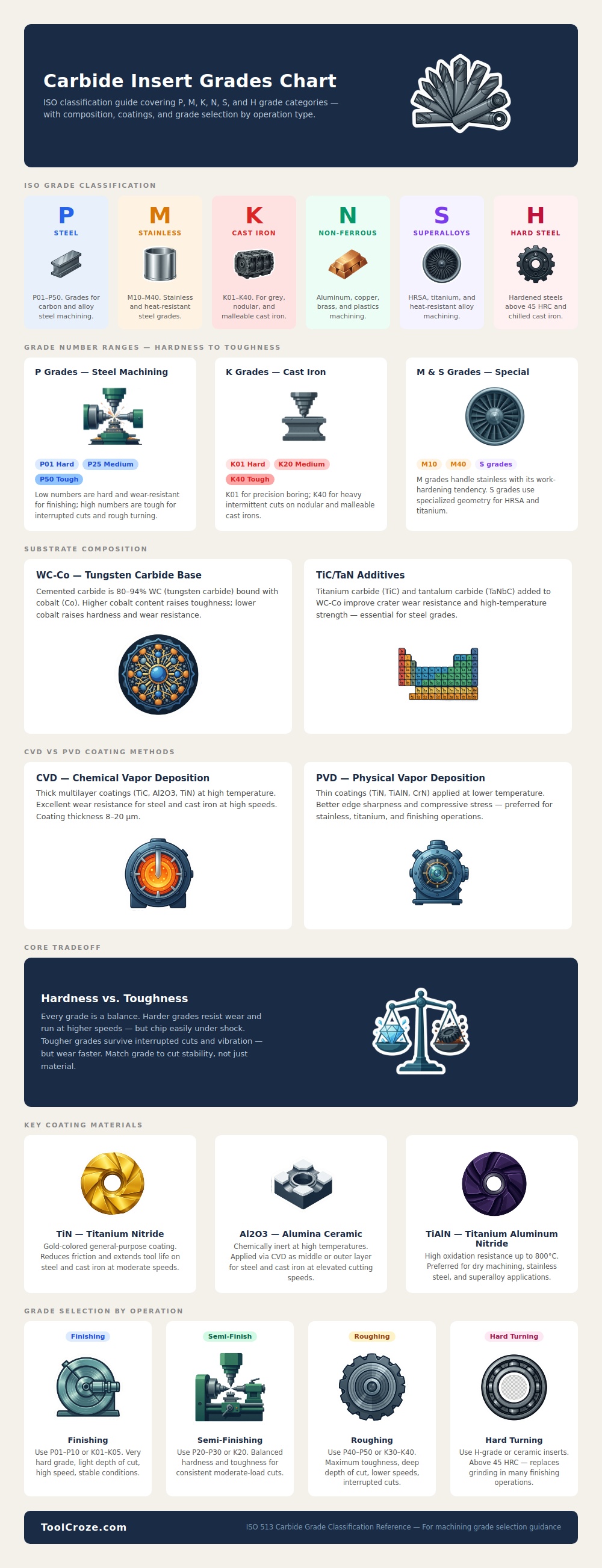
Manufacturers break materials down into classifications based off their workpiece family, which corresponds to a letter category. There are P grades for steel, K for cast iron, M for stainless, N for aluminum and other non-ferrous metals, S for superalloys, and H for hard turning application. The thing about those letters. As illustrated in the infographic above, is that they’re not arbitrary. Each represent a different chemical makeup, designed to withstand the specific mechanical and thermal stresses of its material family.
For example, steel need titanium carbide additives to the substrate so it resists crater wear. Cast iron has high amounts of graphite flakes, which means high amounts of cobalt for resistance to the abrasive material. And then there’s stainless steel, an altogether special sort of headache, since it will rapidly work-harden if left too long or vibrates on the tool. It call for a grade capable of handling adhesion without melting on edge.
Within each of those families the numeric value after the letter represent the tradeoff you’ll make with that insert. The lower the number, the harder and less forgiving it is. However, it is more wear resistant and good for finishing operation. It is also less likely to get damaged by light load or sharp work and has high stability. A higher number mean it is tougher and more forgiving, but it is not as wear-resistant. This make it good for interrupted cuts or roughing operations and for absorbing shock when something goes wrong.
It is not a simple choice between two options, but a spectrum. Would you take a diamond drill bit and try to pound it into concrete? No! Similarly, don’t put a hard finishing grade on a scaled and rusty casting. Before it even makes a full turn the tool will chip. Trying to make a high-hardness/high-speed insert do a roughing job just because it shined up good in the catalog causes most failures. When things go wrong, toughness keeps your edge from breaking. When everything go right hardness helps keep your surface finish intact.
This is also where coatings come into play big time. Coatings are your initial shield from friction and heat. Thick titanium nitride and alumina coatings via Chemical Vapor Deposition release heat excellently while turning at high speeds in steel. Using Physical Vapor Deposition create harder, thinner coatings with compressive stress that maintain sharp edges. This is critical when finishing titanium or stainless. Coatings don’t only protect you from wear, they change the nature of how the tool engages the chip. Built-up edge are reduced through a good coating. Temperatures are maintained, which extends life by amounts that amount to real money over time.
So what is the best grade? The answer is being honest about your operation. No fancy coating can protect a brittle insert from vibration. Toughness is required if the machine shake. Hardness matter when running high speeds on clean material. First decide the type of operation. Shock resistance are required for roughing operations. Resistance to heat damage and wear is needed in finishing. Semi-finishing tries to do both but not as well than either. So first determine the operation. Next determine the family of materials. Finally, look down the numbered scale until the hardness matches your stability rating.
And that’s a small part, but it really matters. The thing about those chips changing is because you stopped guessing and started matching the grade to the physics of the cut. They flow better. The sounds quiet down. The parts look cleaner. Then one day when the machine doesn’t scream, it sings. And that’s the reward for getting the selection right.
It is not so much about taking stuff off anymore. It is more about controlling the process. And then when you find yourself feeling like you have that control back in your hands you realize the whole time, the answer was there on the tool rack. Waiting for you to recieve it correctly.
