
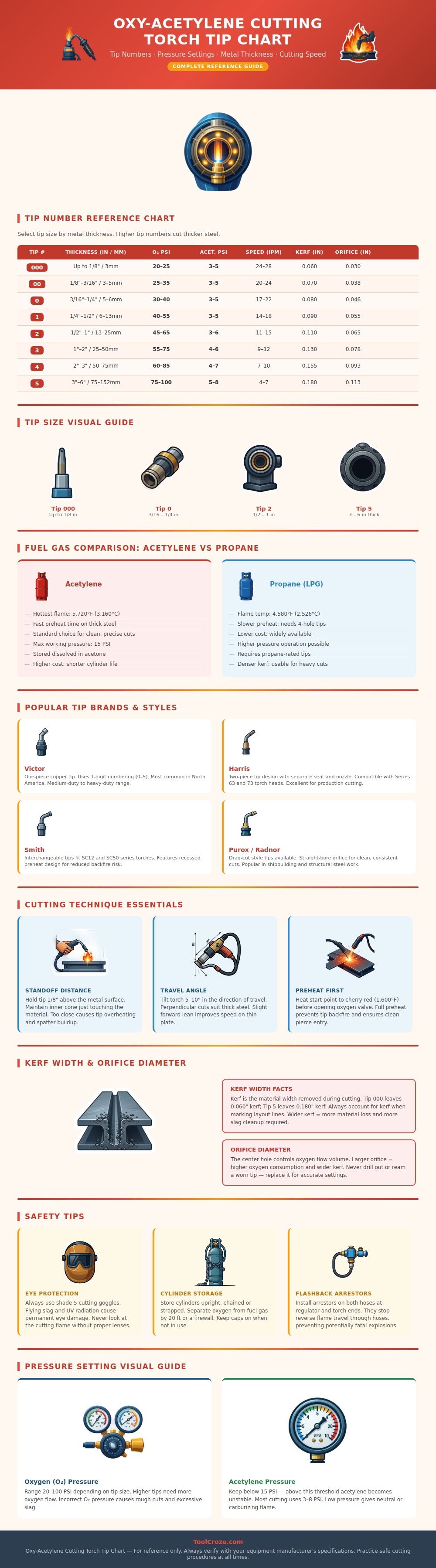
The quality of your cut begins with choosing the right nozzle. Do not think you can use nozzles interchangeably. They’re each precisely engineered to work with certain amounts of gas and specific levels of material thickness. If you use wrong one, your tip will be destroyed or worse yet, you’ll get a bad edge on whatever you are trying to cut.
To eliminate guesswork, look at the chart above relating tip size to material thickness. For thicker metal, higher oxygen pressure and more volume of preheating flame is needed to maintain the cutting reaction. Use tiny tips for sheets and large tips for heavy stuff. A size 5 tip deals with blocks several inches in thicknes. An 000 cuts material up to an eighth of an inch. In other words, it matches the thermal energy with mass of what you’re attempting to cut out.
## How to Choose the Right Nozzle
You can’t get a little tip to cut through something really thick steel fast enough and still heat all the way through the piece. It will either stall out the cut or burn bevels which take forever to grind off. Speed is irrelevant here, consistency is key.
It’s not forgiving of sloppy settings, particularly pressure. Keeping the acetylene pressure down (three to five PSI typically) ensure a stable fuel mixture. Oxygen pressure is where it gets interesting. The thickness of your material determine how much power pushes the cutting jet away. For thicker pieces, the cutting jet need more oomph to push away the slag. Oxygen pressure increases from twenty PSI at the skinny end to a solid one-hundred at the heavy-plate end of the chart. Enough to blow right through that chunk of iron oxide. Not enough and you’re left with a rough edge and some clingy dross.
Performance depends off your choice of fuel gas as well. The go-to fuel, acetylene, burns hottest and concentrates its energy in a tight space. Acetylene gets the metal hot fast and keeps thing humming along. On the other hand, propane is safe and cheap, but it’s not as hot and will spread out the heat over a greater distance. To counteract that with propane, you have to get special four-hole tips. Don’t expect to be swapping canisters around; you’d of had to change up the hardware accordingly.
With the tip just over an 8th of an inch from metal, allow the internal cone to come near but not touch the metal. When cherry-red hot, engage the oxygen and pre-heat. Failure to do so result in waste heat, and opening the valve prematurely will burn out the tip holes. To remove slag, use a slight forward tilt of the torch. This is more important with thinner plate because speed becomes more critical than on thicker plate. On thicker plate, maintain a near-vertical torch to force the jet deep into the material.
With each step you take safety precautions are required. Keep flashback arresters on those hoses so that if it goes backwards there is no blowback. Wear good eye protection to protect yourself from UV radiation and hot sparks. Keep the fuel and oxygen cylinders apart using a firewall or by keeping them physically separated, and always store them upright and chained down. It means you can get back out there safely.
With care for the tool and respect for the task, the torch becomes an extension of your hand. You make clean cuts in the steel. The slag drops off easy, and the lines go straight. You gain confidence by choosing the right nozzle before lighting the match.
