Weight Calculator for Steel Beams
Estimate total beam weight from catalog W-shapes or custom I-beam dimensions, then include quantity, length, grade density, web holes, coating allowance, and cut waste.
📌 Steel Beam Presets
⚙ Beam Details
Total Weight
0
Weight Per Beam
0
Linear Weight
0
Planning Weight
0
Full Breakdown
📊 Material / Spec Grid
📘 W-Beam Reference Weights
| Section | Nominal weight | Area | Typical use |
|---|---|---|---|
| W6 x 12 | 12 lb/ft / 17.9 kg/m | 3.55 in² | Light supports, small frames |
| W8 x 10 | 10 lb/ft / 14.9 kg/m | 2.94 in² | Shop headers, lintels |
| W10 x 22 | 22 lb/ft / 32.7 kg/m | 6.49 in² | Floor beams, short girders |
| W12 x 26 | 26 lb/ft / 38.7 kg/m | 7.65 in² | Mezzanine beams |
| W14 x 30 | 30 lb/ft / 44.6 kg/m | 8.85 in² | Frame girders, canopies |
| W18 x 50 | 50 lb/ft / 74.4 kg/m | 14.70 in² | Heavy girders, lifts |
🧪 Steel Grade Density Reference
| Material | Density | Yield guide | Weight note |
|---|---|---|---|
| ASTM A36 | 490 lb/ft³ / 7850 kg/m³ | 36 ksi | Common structural steel density |
| ASTM A572 Gr 50 | 490 lb/ft³ / 7850 kg/m³ | 50 ksi | Same practical density as carbon steel |
| ASTM A992 | 490 lb/ft³ / 7850 kg/m³ | 50 ksi | Standard wide flange building steel |
| ASTM A588 | 490 lb/ft³ / 7850 kg/m³ | 50 ksi | Weathering steel, similar weight |
| 304 stainless | 499 lb/ft³ / 7990 kg/m³ | 30 ksi | About 1.8% heavier than carbon steel |
| 316 stainless | 500 lb/ft³ / 8000 kg/m³ | 30 ksi | Use alloy density for lift planning |
📏 Custom I-Beam Formula Checks
| Shape example | Area formula | Weight formula | Best use |
|---|---|---|---|
| Symmetric I-beam | 2bf tf + tw(d - 2tf) | Area in² x density / 144 | Built-up beams with equal flanges |
| Plate girder | Top + bottom + web area | Area in² x 3.4028 for steel | Fabricated welded girders |
| Hole deduction | pi r² x web thickness | Volume in³ x density / 1728 | Large web penetrations |
| Added plates | Plate volume or known weight | Add per beam before waste | Stiffeners, caps, splice plates |
🚚 Handling And Bundle Planning
| Weight range | Typical beam example | Planning check | Field note |
|---|---|---|---|
| Under 500 lb | W8 x 10 at 20 ft, pair | Shop hoist or small lift | Check rigging angle and balance |
| 500 to 2,000 lb | W14 x 30 at 30 ft, two beams | Forklift or telehandler planning | Confirm forks cover load center |
| 2,000 to 6,000 lb | W18 x 50 bundles | Crane, spreader bar, dunnage | Use tag lines and clear lift path |
| Over 6,000 lb | Long girders or many pieces | Engineered lift plan | Verify truck, crane, and site limits |
💡 Calculation Tips
Ever pick up a steel beam? Yeah, they weighs more than you think they should. In the workshop. They is on the job site. All the time you grab something that seems reasonable and then you throw your weight behind it and realize there’s no negotiating with density. The wrong weight isn’t just inconvenient. It can overload a trailer or bend connection. It can also cause rig to fail when you’re picking up and putting down material to get it in position.
Most folks won’t tell you how critical the guesswork in estimating load out of yard can be. Weight calculators for Steel Beams bridge the gap between imagination and hard numbers. Once you enter length, shape, and quantity into the calculator (above) then it do the math for you. No need to guess at unit conversion and coefficients.
Why You Need a Steel Beam Weight Calculator
The beauty of these tools isn’t even in the result. The beauty is knowing how that number is arrived at. Knowing why allow you to be confident in the number as you work with more complex situation. Generally speaking most common types of structural steel has densities around 490 pounds per cubic foot. Whether using a typical carbon steel or one of the higher strength versions, that number doesn’t vary all that much. Add-ons and other geometric factor are where the differences arise.
The calculator relies on nominal weight values from standards organizations when you choose a catalog shape. Those are reasonable places to start but also theoretical average weights. In the real world, beams has mill tolerances. How does the rolling mill produce that batch? It may be a little heavier or lighter then the stamped number implies. And it makes sense to include a small percentage for tolerance and/or coating. You can’t see paint and primer and galvanizing adding mass but they do.
Your lift plan isn’t based off the ideal world, but the one where you’re standing. It’s all about fabrication. Ducts and pipes go through the web. Make allowances for the lost material. Massive holes eliminate much weight where there used to be a solid cross-section. On the other hand, add cap plates, shear tabs and other stiffener to gain weight back in. The calculator allows you to input those modifications individually and view their impact on the total. That way you won’t make the typical assumption that once the purchase order is made, the weight of the beam is set. It isn’t. You’re fabricating a custom piece of infrastructure, not shipping stock shapes.
Finally, think about the logistics of handling the material itself. While it may all fit in the back of a truck by volume, does it meet axle weight limitations? The distinction between linear weight vs. Total weight becomes important here. How much do you have per foot? How can you best balance the load on the truck? Which type of lifting gear will be needed? What looks like a good center of gravity may be too heavy for a 3 ton forklift, while a 5-ton is no problem… Until you put that 5 tons inside a small footprint.
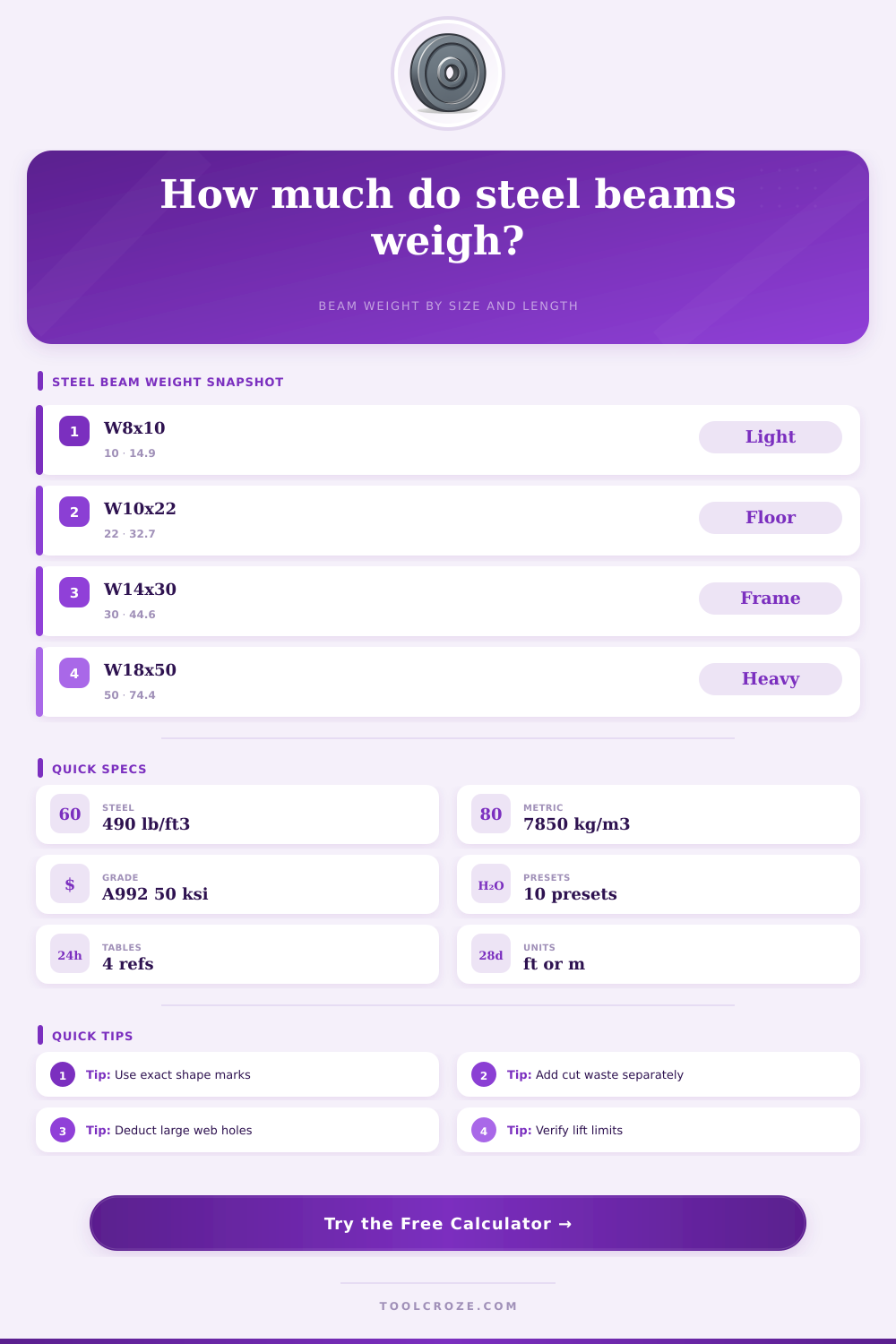
There’s another piece of the equation: what about waste? If you’re cutting beams to size then you’ll have scrap. Factor in a contingency % so that your shipment estimate accounts for not only the usable steel but also the excess you would of had to haul out. And I think that’s the beauty of the calculator. The accompanying reference tables give you a fast glance at relative size. For example, a W8x10 is light enough for small headers. And a W18x50 carries serious mass suitable for heavy girders. When you see those side by side it helps set reasonable expectations. You begin to grasp why specific sizes is used for particular structural purposes.
And you realize just how rapidly weight increases with length. Doubling the span doubles the load on your rigging points. Bottom line: Estimating weights accurately boils down to being efficient and safe. Not having a clear picture on the load chart makes for a uncomfortable conversation with the crane operator. You need to know that stackable loads won’t bend or cause problems in the floor structure.
And the calculator above does the math but then you have to make the judgment call. If you’re working in precision, check those mill certificates. Rely on the highest possible scenario versus some theoretical minimum. And never forget that steel is always going to weigh more than what you recall. Over preparing beats surprise. Measure twice. Trust the process. Let the physics take the wheel. Don’t lay a finger on that hook until it’s time.