Fence Post Hole Depth Calculator
Estimate the post embedment, total post length, auger diameter, concrete fill, gravel base, and stability margin for wood, vinyl, metal, farm, and gate posts.
⚒Fence presets
📏Post and site inputs
Full calculation breakdown
🧱Material and specification grid
📊Fence depth reference
| Fence type | Typical height | Depth starting point | Adjustment trigger |
|---|---|---|---|
| Picket or decorative wood | 3 to 4 ft | 18 to 24 in | Use deeper end for loose soil |
| Solid privacy fence | 6 ft | 30 to 36 in | Add depth for open wind exposure |
| Chain link or open mesh | 4 to 6 ft | 24 to 30 in | Terminals and corners need more |
| Gate hinge post | 4 to 6 ft | 36 to 48 in | Use larger post and wider hole |
| Farm woven wire | 4 to 5 ft | 30 to 42 in | Brace ends and corners deeply |
🌎Soil and exposure factors
| Condition | Depth factor | Hole width factor | Field note |
|---|---|---|---|
| Dense gravel or hardpan | 0.95 | 3.0x post | Hard digging, good bearing |
| Firm clay | 1.00 | 3.0x post | Good support when drained |
| Average loam | 1.08 | 3.0x post | Use normal design reserve |
| Loose sand | 1.18 | 3.5x post | Needs wider concrete mass |
| Wet soil or fill | 1.25 | 3.5x post | May need drainage or redesign |
❄Frost and climate reference
| Climate condition | Common frost input | Recommended bottom | Why it matters |
|---|---|---|---|
| No freeze / warm region | 0 in | Depth rule controls | No frost heave allowance |
| Mild winter zone | 12 to 18 in | Frost plus 4 to 6 in | Reduces seasonal movement |
| Cold residential zone | 24 to 36 in | Frost plus 6 in | Often controls post depth |
| Severe freeze zone | 42 to 60 in | Local code depth | Verify before digging |
📝Concrete and hole sizing reference
| Post size | Typical hole | 30 in deep concrete | Common use |
|---|---|---|---|
| 2 in metal pipe | 6 to 8 in | 0.5 to 0.9 ft3 | Chain link line post |
| 4x4 wood or vinyl | 10 to 12 in | 1.4 to 2.0 ft3 | Most yard fences |
| 5x5 vinyl | 12 to 15 in | 1.9 to 3.0 ft3 | Tall vinyl panels |
| 6x6 gate post | 16 to 18 in | 4.0 to 5.3 ft3 | Gates and corners |
Hole. Every fence begins with one. How deep is yours? Is it going to sag in a few seasons…or last decades? People tend to treat depth dimension as afterthought, not realizing how important it is to strength of their structure.
With the tool above, you enter just a few things: your local frost data, your soil type, and your fence height. The calculator do the rest, avoiding guesswork on conversions and coefficients that can be easyy to mess up.
How to Plan Your Fence Foundation
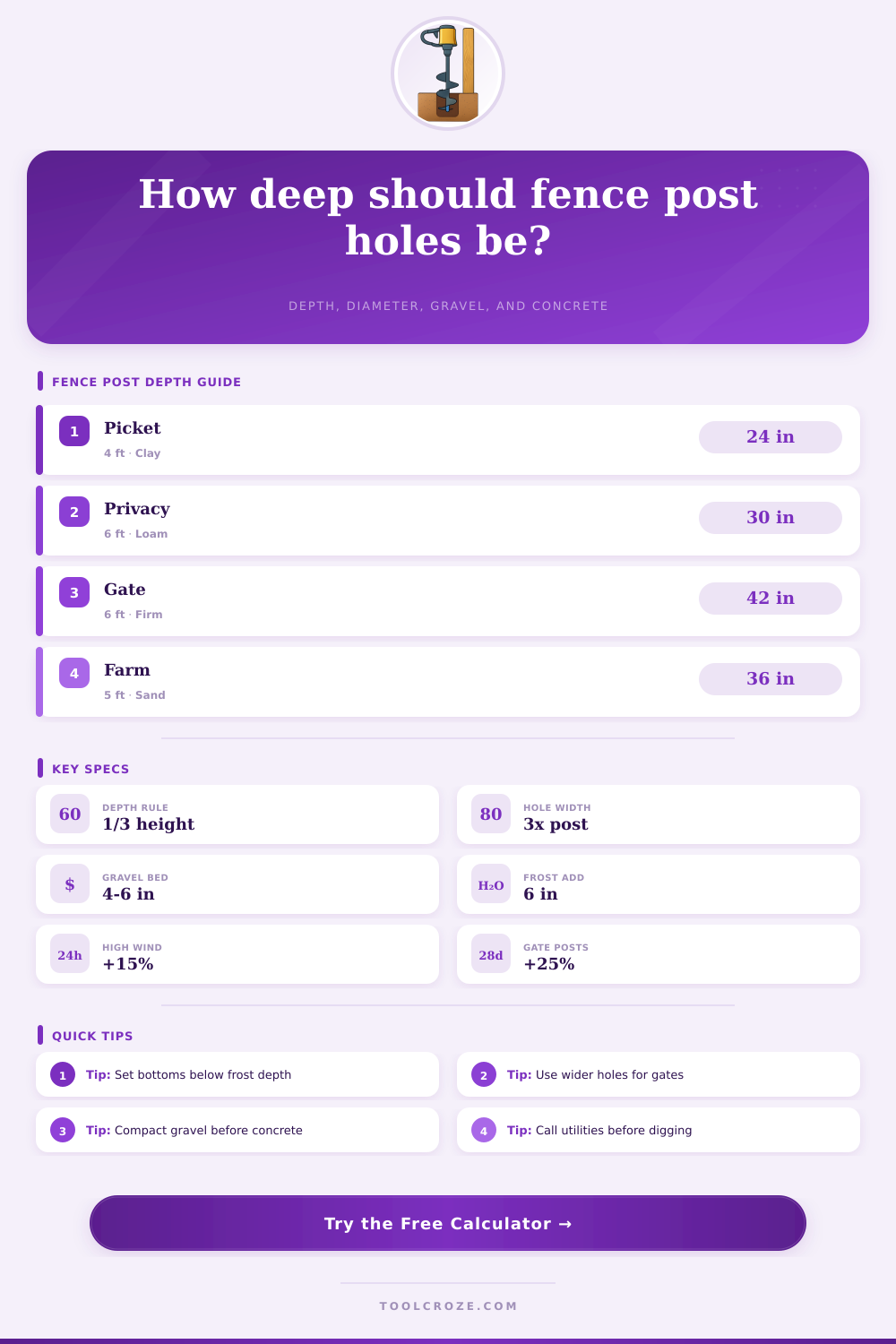
One-third of the post down is the usual “rule of thumb,” but it’s the first guess, not the last word, soil has different properties depending on its condition in your yard. Is it clay? It won’t collapse, but it won’t drain which rots the wood from within. Is it sand? There is no resistance to side-to-side motion, which would make post wiggle free in a strong wind, so you’ll want to add a lot more concrete weight here.
Enter this tool: It considers all those things and shows you how far deep and wide you should of dig based off the condition of your soil. You must also consider how deep the frost is. Because ice expands when frozen, it can pushes a post upward out of its hole, a condition called frost heave. If your post are above the frost line, it’s going to bounce around each winter and eventually break down foundation. To prevent that, you need to plant it below that line; allow extra clearance (a few inches at least) to play it safe. The calculator cites those climate zones for you (rather than making you run to find your local codes).
The material makes all the difference. Because gate posts support hanging doors and face ongoing mechanical force, they must be embedded much deeper then other line posts, in some cases double-deep compared to normal. Concrete fills those vinyl posts very differently, both inside the hollow portion and as it distribute load into the earth. And metal T-posts behave different yet again by depending on friction in the soil instead of solid footing. Knowing this means you won’t make one of the most popular mistakes, assuming that any post is like a standard four-by-four wood post.
This is where project frequently goes over budget: Concrete volume. We all greatly underestimate how much mix we need; we run out in the middle of a project, or we don’t use enough to fill hole, causing them to crumble under pressure. For holes, the estimator gives bag quantities based on depth and diameter of the hole (always include gravel as your base, to drain it). The gravel base ensure moisture doesn’t come into contact with the end of the post, significantly extending its life compared to concrete only.
If you have windy conditions, that will factor into things as well. Standard sizing applies if your garden sits behind a sheltering fence. However, a garden running alongside an open stretch of coast or field behave like a sail. This increases side pressure quickly, so you need more stiffness to prevent leaning. For such situations, the calculator may recommends an additional 15 percent on either dimension, perhaps width or depth. There is no guesswork. The math react to greater air velocity and surface area.
Half of the job is getting it dug out, and this is before you even grab that spade. Straight lines are key to laying out, and braces hold things in place till the cement sets. Hit a gas line and not only does your weekend go down the tube, but it’s much more than just a ruined weekend.
You put your heart into building the fence, but the tools gives you the measurements. A poor dig equals a weak foundation…no matter how shallow or deep. Cheap effort won’t last any longer then an expensive one.