Concrete Block Weight Calculator
Estimate the weight of CMU, hollow concrete blocks, cap blocks, and palletized loads using block dimensions, hollow core percentage, density, moisture, quantity, and pallet count.
🧱Real CMU and Block Presets
⚙Block and Load Inputs
Calculation Breakdown
The estimate updates from the entered dimensions, hollow percentage, density, moisture factor, quantity, pallet count, and pallet tare.
📊Current Block Spec Grid
📏Common CMU and Block Reference
| Block type | Nominal size | Typical actual size | Common hollow core | Typical dry weight |
|---|---|---|---|---|
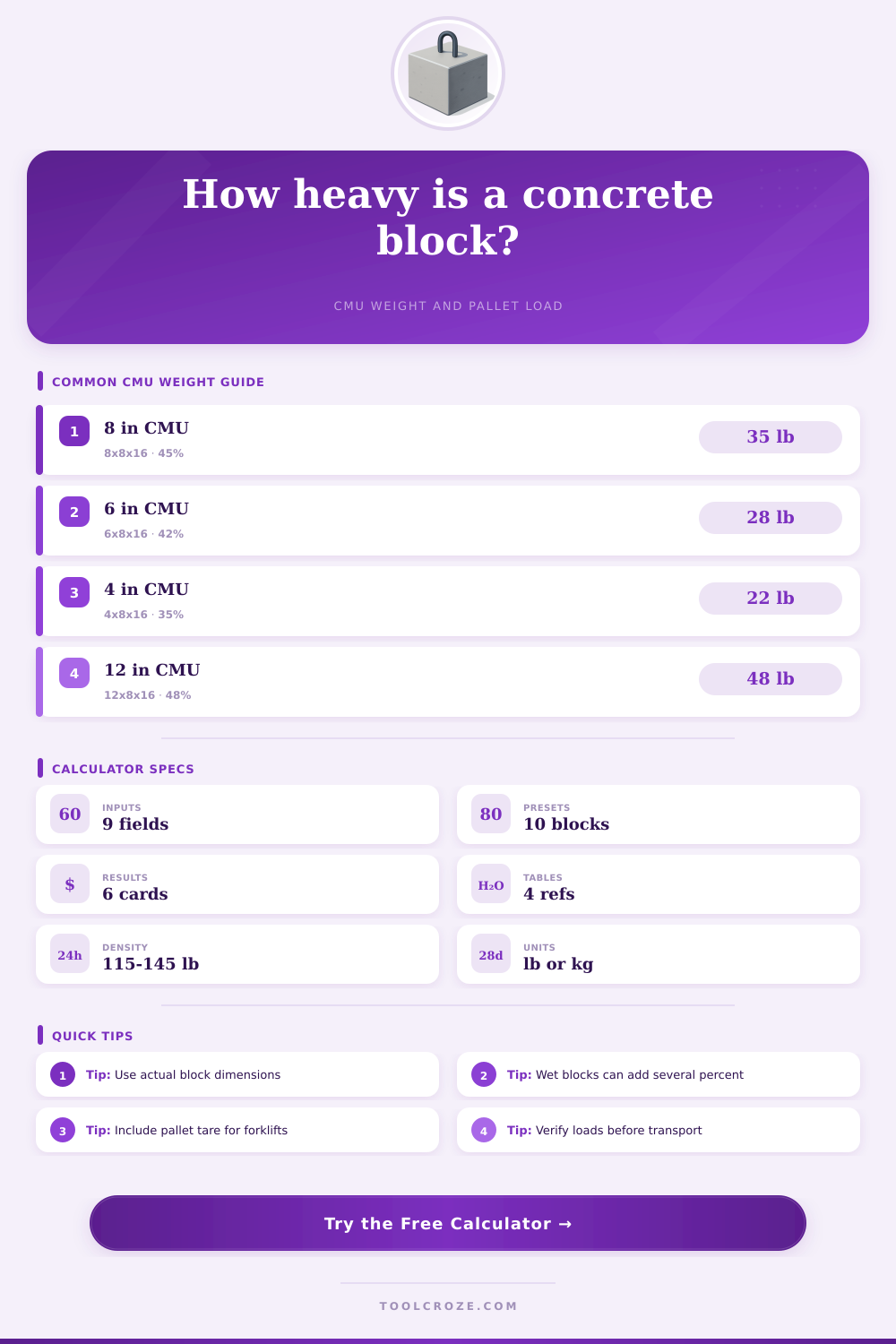
| Standard CMU | 8 × 8 × 16 in | 7.625 × 7.625 × 15.625 in | 40-50% | 32-38 lb |
| Narrow CMU | 6 × 8 × 16 in | 5.625 × 7.625 × 15.625 in | 38-46% | 25-31 lb |
| Partition block | 4 × 8 × 16 in | 3.625 × 7.625 × 15.625 in | 28-40% | 19-24 lb |
| Wide CMU | 12 × 8 × 16 in | 11.625 × 7.625 × 15.625 in | 42-52% | 42-55 lb |
| Solid cap block | 4 × 8 × 16 in | 3.625 × 7.625 × 15.625 in | 0-10% | 28-34 lb |
🏗Density and Moisture Reference
| Concrete unit type | Density input | Metric equivalent | Typical use | Weight note |
|---|---|---|---|---|
| Lightweight CMU | 85-105 lb/ft³ | 1360-1680 kg/m³ | Interior walls | Lower handling load |
| Medium-weight CMU | 105-125 lb/ft³ | 1680-2000 kg/m³ | General masonry | Common estimate range |
| Normal-weight CMU | 125-145 lb/ft³ | 2000-2320 kg/m³ | Exterior walls | Heavier pallets |
| Damp storage | Add 2-6% | Add 2-6% | Outdoor pallets | Rain and curing moisture |
🚚Pallet and Load Planning Table
| Load item | Typical range | Input to check | Why it matters |
|---|---|---|---|
| 8 in CMU pallet | 72-108 blocks | Quantity per pallet | Forklift and truck load |
| Block pallet tare | 40-75 lb | Pallet tare weight | Adds to gross load |
| Moist block load | 2-10% heavier | Moisture factor | Rain can change totals |
| Multiple pallets | 1+ pallets | Pallet count | Scales total weight |
🧮Formula Reference
| Step | Formula | Input source | Output |
|---|---|---|---|
| Gross block volume | Length × height × width | Block dimensions | Gross ft³ or m³ |
| Net solid volume | Gross volume × solid percent | Hollow core percent | Concrete volume |
| Block weight | Net volume × density | Density input | Dry block weight |
| Total load | Block weight × quantity + tare | Pallet inputs | Total load weight |
💡Practical Notes
With two hands, you grab a typical 8-in. Concrete masonry unit. Diameter concrete masonry unit. Immediately, you realize someone had to invent forklifts. Dang thing’s heavy! It is uncooperative. And if dropped on your foot… Ouch!
It is one block. That’s all. Yet it is part of much bigger picture. Consider this: When looking at a full pallet of these gray rectangles, stacked sky-high, the number of pounds increases rapidy. A manageable lift turns into quite a feat of engineering. It also provides a major stress test of axles, floors, and the rating of lifting gear.
How to Calculate Concrete Block Weight
Because we tend to consider each block separately, most folks don’t realize how rapidly those pounds can accumulates. So what if you’re not sure how much a bag of cement will weigh or want to use multiple bags per cubic foot? That’s where this calculator comes in. You’ll input your dimensions (length x width x height) and density, and it do all the math for you.
First, it calculates the gross volume of the block according to those true dimensions. Next, it multiplies that by your selected Hollow Core Percentage, which reduces the net volume down to just the solid concrete part of the block. Why? Because air doesn’t weigh anything! A seemingly solid-looking block may have 45% void space within it. That means using gross dimensions to calculate weight would resulted in a grossly overestimated load.
To avoid this, calculator takes into account your provided density and applies it only to real-world concrete part of the equation. Not all aggregate mixes is created equal, so you have to consider density as a variable. A normal-weight block contains limestone and gravel while an expanded shale or clay-based block will be much lighter. What’s more, without knowing whether you’re working with lightweight or normal weight, no estimate should of been trusted. One-hundred twenty-five pounds per cubic foot is roughly what to expect for normal weight, with lightweight options falling well below than at perhaps as low as ninety.
If you get the data wrong, you will build your load plan on false information. There are a lot of variables that will screw up an estimate, but one of them is moisture and wet cement blocks sucks in water like a sponge. Especially if they’re new or have been sitting outside exposed to the elements. A few percent increase in water content can push you past safety even on low loads. If you think you might be off by a bit, add a few percent for moisture content. Better to assume you’ll have more weight than find out at the weigh station that you’re over.
The other thing that’s easy to overlook is the pallet tare weight, meaning all of the wood (or plastic) that holds up the individual blocks has weight as well. A typical pallet weighs 50 pounds, and that sounds like nothing by itself. But times that by multiple pallets on a truck and it add up. It helps keep your total weight number accurate for what actualy exists… Not just the weight of masonry alone.
Knowing what’s on a pallet. Exactly how much it weighs; is important. When planning for transportation, you have to think through how everything will be handled. For example, a forklift operator need to pick the right forks and decide if a pallet is stable based off its weight. The truck driver must also know the overall gross weight to make sure his truck complies with axles. If not, you’ll have safety violations, damage to cargo or rushed deliveries. Knowing those figures in advance lets you properly coordinate the equipment needed. It helps avoid the last-minute realization that your liftgate can’t manage the load when it gets to the site.
If your manufacturer doesn’t have any info, then at least you can use the reference table on the page, which outlines it for popular block sizes. But as always, things change a bit in real-world situations, so measure whenever you can. Don’t rely on a guess; taking a quick measurement with a tape measure goes a long way. Little things makes a big difference here, and that’s true in the end results, too.
To summarize. You must respect physics and safety. You also need to respect masonry because concrete doesn’t care how heavy it is. It just sits there waiting to break something when mishandled. Accurate load calculations will keep you out of trouble with your workers as well as your equipment. What could be a blind spot turns into something you can control. The blocks are still heavy, but you make yourself light on uncertainty.