Weight of Steel Pipe Calculator
Calculate steel pipe ID, hollow section area, weight per foot, single pipe weight, and total bundle weight from NPS/schedule presets or manual OD and wall inputs.
▣Real steel pipe presets
▦Pipe weight inputs
Steel pipe weight results
▨Pipe/spec grid
▩Steel pipe reference tables
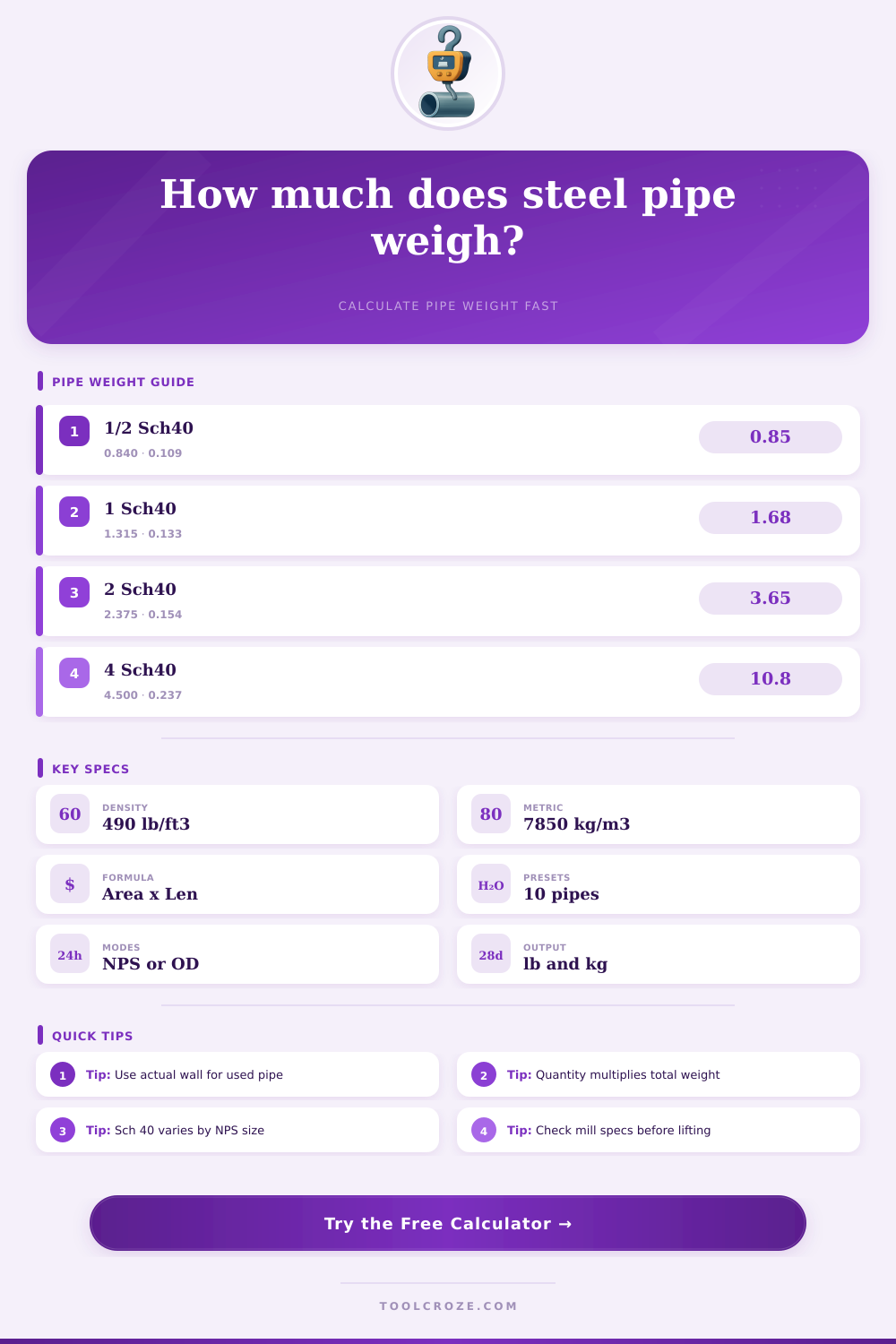
| NPS schedule | OD (in) | Wall (in) | ID (in) | Weight (lb/ft) |
|---|---|---|---|---|
| 1/2 Schedule 40 | 0.840 | 0.109 | 0.622 | 0.85 |
| 1 Schedule 40 | 1.315 | 0.133 | 1.049 | 1.68 |
| 1 Schedule 80 | 1.315 | 0.179 | 0.957 | 2.17 |
| 2 Schedule 40 | 2.375 | 0.154 | 2.067 | 3.65 |
| 2 Schedule 80 | 2.375 | 0.218 | 1.939 | 5.03 |
| 4 Schedule 40 | 4.500 | 0.237 | 4.026 | 10.79 |
| Steel material | Density (lb/ft³) | Density (kg/m³) | Use in calculator |
|---|---|---|---|
| Carbon steel | 490 | 7850 | General A53, A106, structural pipe estimate |
| 304 stainless steel | 500 | 8000 | Slightly heavier stainless pipe runs |
| 316 stainless steel | 499 | 7990 | Corrosion-resistant process pipe estimate |
| Alloy steel | 489 | 7830 | Chrome-moly and alloy pipe planning |
| Galvanized steel | 492 | 7880 | Small allowance for zinc coating |
| Formula item | Imperial formula | Metric formula | Meaning |
|---|---|---|---|
| Inside diameter | ID = OD - 2t | ID = OD - 2t | Open bore after wall thickness |
| Steel area | A = pi(OD² - ID²) / 4 | A = pi(OD² - ID²) / 4 | Metal cross-section only |
| Weight per foot | A / 144 x density | Area x density | Linear weight from volume |
| Total weight | lb/ft x length x qty | kg/m x length x qty | Bundle or order total |
| Planning case | Typical length | Quantity | Useful output |
|---|---|---|---|
| Shop rack stock | 20 ft | 1 to 10 | Weight per stick and total bundle |
| Pipe support lift | 10 to 24 ft | 1 | Single pipe handling weight |
| Fabrication cut list | 2 to 12 ft | Many | Trim loss plus total material weight |
| Metric project stock | 6 m | Bundle | kg per meter and total kilograms |
△Practical tips and safety
The Pipe Calculator is here. So what’s it do? Sometimes you order a piece of pipe and think to yourself that your forklift isn’t strong enough to lift it. You look at manifest from shipping. It weighs two hundred pounds. Twenty feet of pipe, six pieces of it. Twenty feet. The pipe feel heavier than the paperwork.
Projects fail because they is based off a misunderstanding of how heavy things realy are. How much does something weigh? You must consider nominal size versus actual weight. We discuss pipes in terms of their internal capacity (nominal size) but never considers the exterior bulkiness of that pipe. We create an illusion of lightness. The above calculator do this math for you. It translates confusing NPS numbers to hard pounds or kilos. Now you know exactly how much to expect and you can rig with confidence.
How to Use the Pipe Weight Calculator
So what are we talking about? Pipe Nominal Size is a ghost. What this means is it bears no relationship whatsoever to the actual physical size of steel before you. Two-inch pipe isn’t actually two inches on the outside. Historically it was named based off some crude guess of flow capacity rather than the size of envelope around the steel. And this applies to steel pipe. It is 3/4ths of an inch. Yes, that last quarter inch make all the difference because weight scales with the square of radius. That’s how much steel has to carries the load.
To know that, you need to calculate the annular area (area between inside and outside). So if you assume the nominal size is the actual diameter, you will always makes an incorrect estimate. People screw this up. It’s also important to understand that wall thickness doesn’t change at a steady rate. Just because a Schedule 80 pipe is twice as thick as a Schedule 40 doesn’t mean it’s always going to be half and double every single size. It’s based upon schedule standards, and these schedules is nothing but groups established by pressure rating. As the size of pipe increases, so does the uneven increase in wall thickness. Oftentimes a very slight increase in outside diameter result in a large leap in metal mass needed to withstand internal pressure and still remain structurally sound.
Take a look at reference chart on page. It shows how much the weight per foot increases from a two-inch Schedule 40 to its Schedule 80 counterpart, nearly forty percent more steel for the same nominal size. This isn’t something you can eyeball. There’s a bit of variation in starting point depending on material, but generally speaking material does not fix the issue either. Carbon steel is roughly four hundred ninety pounds per cubic foot. It is a little heavier than stainless steel because it has some nickel or chromium (304 & 316) and so forth. These variations in density gets factored into calculator automatically, but knowing what you’re buying is still essential.
Then there is galvanized steel. It is just adding a coat of zinc on top of the existing steel, which only adds a tiny amount of mass to the whole. But again, if you’ve got thousands of feet going out, those few ounces turns into pounds of extra weight on back of your truck scale. It is a small thing, but it matter when you are cutting it this close to your payload limit.
Next up is the question of allowances. Clean steel with perfect geometry weighs one thing. However, real-world pipe contain internal scale, residual fluids, coating, and manufacturing tolerances. Five percent for handling allowance isn’t pessimistic; it’s prudent. It covers very small variation in wall thickness that any manufacturer allows for when they produce to spec. Estimate precisely to the pound and chances are you’ll underestimates. You should of estimated more. You can also enter cut allowance and trim loss into the tool. This is helpful when estimating the final weight of a fabricated product, since the raw stock will be reduced by waste.
In the end, it’s a matter of logistics, but also safety. It is a matter of how to get something off the ground, whether with a hoist or a crane. You must consider whether your support structure can take the static load and whether your trailer axles will sag under weight. It removes the confusion between nominal names. It shows you true physical reality of steel. When you stop believing the label and let the math tell you the truth, the panic subsides.
You order the correct rigging gear. You send the proper quantity of material. And there’s no more wondering in the yard whether it’s even lifting anything at all.