Torque Wrench Calculator
Calculate corrected wrench settings for extensions and crowfoot adapters, convert torque units, estimate handle force, and compare the result against fastener class guidance.
Choose a real torque scenario, then adjust the target, length, angle, calibration, or fastener class for your exact setup.
The torque specified by the manual or drawing.
Measure from drive center to handle force center.
Center of square drive to center of fastener.
0° inline, 90° sideways, 180° reversed.
Positive means the wrench applies high versus its scale.
Calculation breakdown
| Adapter angle | Effective added length | Setting formula | Practical use |
|---|---|---|---|
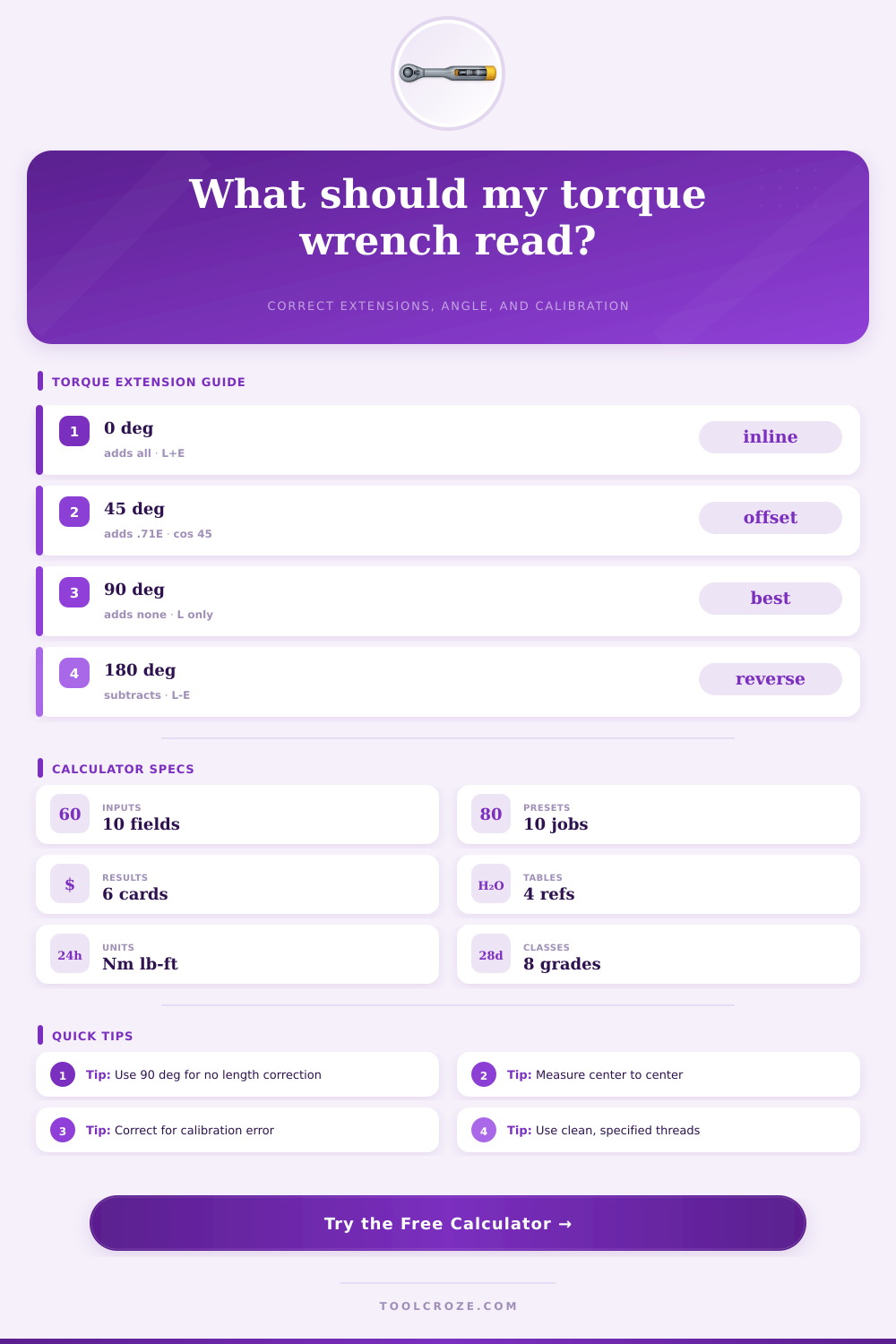
| 0° inline forward | 100% of extension | Target × L / (L + E) | Most common crowfoot correction |
| 30° offset | 86.6% of extension | Target × L / (L + 0.866E) | Small angle clearance work |
| 45° offset | 70.7% of extension | Target × L / (L + 0.707E) | Line fittings and tight spaces |
| 90° sideways | 0% of extension | Target × L / L | Preferred when geometry allows |
| 180° reversed | -100% of extension | Target × L / (L - E) | Can require a higher wrench setting |
| From | To N⋅m | To lb-ft | Typical wrench scale |
|---|---|---|---|
| 1 lb-ft | 1.35582 N⋅m | 1 lb-ft | Automotive and fabrication |
| 1 lb-in | 0.112985 N⋅m | 0.08333 lb-ft | Small covers, clamps, electronics |
| 1 N⋅m | 1 N⋅m | 0.73756 lb-ft | Metric service manuals |
| 1 kgf⋅m | 9.80665 N⋅m | 7.23301 lb-ft | Older import manuals |
| Class | Approx strength level | Best use | Torque caution |
|---|---|---|---|
| SAE Grade 2 | Low carbon steel | Light brackets, covers | Do not use Grade 8 torque |
| SAE Grade 5 | Medium strength | General automotive joints | Use correct thread condition |
| SAE Grade 8 | High strength | Suspension, drivetrain | Check manual sequence |
| Metric 8.8 | General high tensile | Machinery and frames | Dry/lubed torque differs |
| Metric 10.9 | Higher tensile | Automotive, fixtures | Verify washer and thread pitch |
| Metric 12.9 | Very high tensile | Tooling and clamps | Threads must be sound |
| Stainless A2-70 | Moderate stainless | Corrosion resistant joints | Anti-seize can lower torque need |
| Aluminum threads | Soft parent material | Covers and housings | Use service data, go gentle |
| Preset | Target torque | Adapter setup | Fastener class |
|---|---|---|---|
| Car lug nut | 100 lb-ft | 18 in wrench, no adapter | SAE Grade 8 / 10.9 style |
| Spark plug | 18 lb-ft | 12 in wrench, 2 in extension at 90° | Aluminum head caution |
| Brake caliper bracket | 85 lb-ft | 18 in wrench, 1.5 in inline | SAE Grade 8 |
| Bike crank bolt | 40 N⋅m | 300 mm wrench, direct drive | Metric 10.9 |
| Flare nut crowfoot | 22 lb-ft | 12 in wrench, 1 in at 0° | Stainless / fitting |
| Hydraulic fitting | 55 lb-ft | 14 in wrench, 1.8 in at 45° | SAE Grade 5 |
But too much force damages a joint; forcing an extension into place without loosening the setting. Too much force comes from relying on your own arm strength rather then physics. Broken bolts and stripped threads is prevented with a torque wrench, yet they’re still frequently misused in garage because people ignore how the shape of nut affects how it is handled.
Using a long extension or adding a crowfoot adapter alter the leverage completely. You guess at how much force gets to the fastener if you don’t account for that shift. Torque isn’t simply “click it till it goes.” That mindset overlooks leverage, torque equals force times distance. When you insert a crowfoot extension on your wrench, you alters that distance.
Why You Must Use the Right Torque Wrench Settings
If the extension parallels the handle, the fastener sees less tension than desired because the wrench click early. Tight? Yes. But not really. Late clicks occur when the extension pushes back against the handle (in the opposite direction) introducing excess force into the joint. Before you know it, you’ve exceeded the limit. Your aluminum thread are stripped.
The calculator does the length and angle math to determine the exact setting required to deliver proper load at the bolt head. Technicians also don’t want to admit that it’s not just the length of the adapter, but the angle of the adapter which are important. A 90 degree bend doesn’t actualy extend your lever arm any further. Therefore, the force is always true to the wrench scale no matter how far extension protrudes.
Because mechanics are used to keeping things accurate in tight spaces, we like a head that can be bent to angles (or a flexible drive) as well as angled heads which saves us doing complex math. When you’re working in an engine bay, there isn’t a lot of room; you frequently have to work at forty-five degrees so the extension partially contributes to the leverage. It depends on the angle. Because of the cosine of that angle, intermediate angles adds extra effective length to the leverage. How does this work? Because of the cosine of that angle, you add that much less effective length to the leverage.
If you’re working with precision component on motorcycles or high strength Grade Eight bolts, it makes a difference. Torque wrenches also gets off calibration over time from being dropped on concrete floors or even being stored while under tension. If your torque wrench has a four percent tolerance out of the box (which happens often with cheaper click wrenches), the number you set the tool at may be above or below your target torque amount. When combined with incorrect use of extensions, the error compound quickly.
You might not realize that you are tightening a cylinder head to as little as seventy five percent of what is needed to clamp it. That will result in warped cylinder heads under heat cycles, and eventually blown gaskets. Presets let you compare your setup against something you know well, like spark plugs, lug nuts, or brake calipers. This grounds your estimation in the real world.
A second reason is that anti seize compound treated bolts has different friction properties than a dry bolt. Because friction will rob energy out of your turn, you can factor it into the calculator under “thread condition“. If there is less friction, more of your work is stretching the bolt, where higher friction burns up energy as heat. When you lube the threads and leave the torque spec alone, you are probably over tightening the joint. It is a trade-off between friction and clamp load that few people should of thought about until something breaks.
This isn’t about perfection; it’s about getting it right without guesswork at critical joints. Whether you’re repairing a leaky pipe or tuning a car suspension, knowing how changing the length affects the lever arm can save your sanity and hardware. Measure well, then use the numbers to lead your hand. Not your ego, and think of the wrench as a measuring tool. It’s good manners to properly torque your fasteners.