Metal Tubing Weight Calculator
Estimate round, square, and rectangular metal tube weight from outside dimensions, wall thickness, length, material density, quantity, and coating allowance.
📌Real Tubing Presets
⚙Calculator Inputs
📊Results
Calculation breakdown
🧪Material / Spec Grid
📚Tubing Reference Tables
| Material | Density lb/ft³ | Density kg/m³ | Typical tube use |
|---|---|---|---|
| Mild steel | 490 | 7850 | Welded frames, brackets, guards |
| ASTM A500 steel | 490 | 7850 | Structural HSS posts and trusses |
| 304 stainless | 501 | 8030 | Corrosion-resistant rails and frames |
| 6061 aluminum | 169 | 2700 | Light fixtures and machine frames |
| Brass | 532 | 8520 | Decorative and instrument tube |
| Copper | 559 | 8960 | Electrical, thermal, and specialty tube |
| Common tube | Wall | Material | Approx weight |
|---|---|---|---|
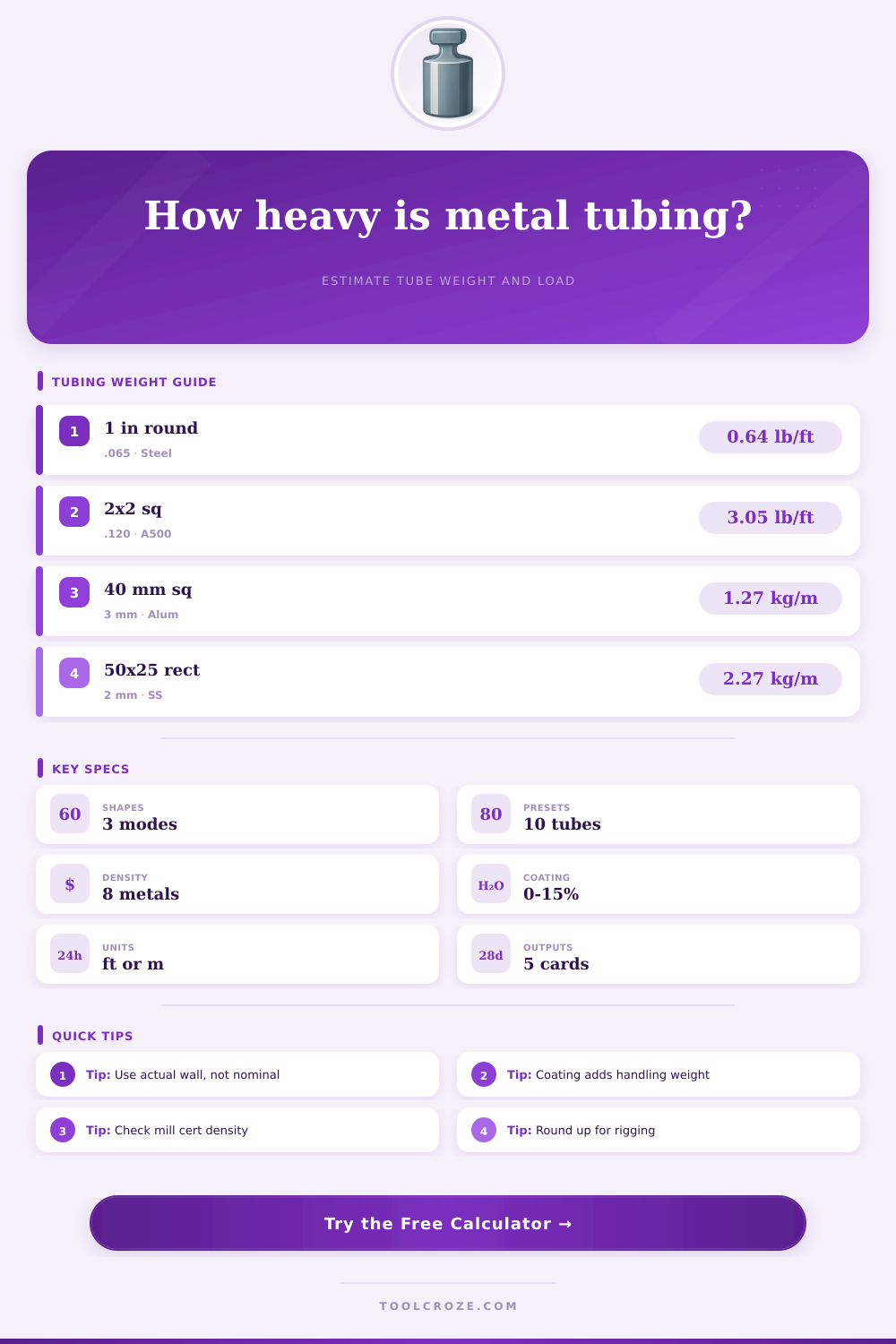
| 1 in round OD | 0.065 in | Mild steel | 0.64 lb/ft |
| 1.5 in round OD | 0.120 in | DOM steel | 1.77 lb/ft |
| 2 x 2 square | 0.120 in | A500 steel | 3.05 lb/ft |
| 3 x 2 rectangle | 0.125 in | A500 steel | 3.75 lb/ft |
| 40 x 40 square | 3 mm | 6061 aluminum | 1.27 kg/m |
| 50 x 25 rectangle | 2 mm | Mild steel | 2.27 kg/m |
| Shape | Area method | Watch item | Best input habit |
|---|---|---|---|
| Round tube | Outside circle minus inside circle | OD and wall tolerance | Use measured outside diameter |
| Square tube | Outside square minus inside square | Corner radius not modeled | Use mill weight for final buying |
| Rect tube | Outside rectangle minus inside rectangle | Height and width can swap | Keep width and height consistent |
| Coated tube | Calculated weight times allowance | Hot dip adds more than paint | Use a conservative allowance |
| Total load | Handling class | Typical lift aid | Planning note |
|---|---|---|---|
| Under 50 lb | Manual piece | None or hand carry | Still watch long stock balance |
| 50 to 150 lb | Two-person or cart | Material cart | Strap long bundles before moving |
| 150 to 500 lb | Shop equipment | Forks or hoist | Confirm rack and sling capacity |
| Over 500 lb | Rigged bundle | Forklift or crane | Use rated rigging and tag lines |
💡Practical Tips
⚠Safety Note
If you’ve ever been in a supply yard with two bundles of tubing that appear similar on the outside, you know what I’m talking about. You think you can handle it alone, but before you even take a step, the bundle pull your shoulder toward the ground. The difference in weight is rarely due to length or outer dimensions. Hidden behind that steel shell is density of materials and thickness of the wall. This can make the difference between a relaxed afternoon making something versus being in a hurry to get back to shop for more lifting equipment.
You do the logistics; the calculator will do the geometry. Choose your shape first. The math vary depending on whether you use rectangular frames, square hollow sections, or round tubes. Next it calculates the real volume of metal involved by subtracting out the empty space inside. That’s why folks gets tripped up by nominal sizes. A one-inch square tube doesn’t weigh the same as a one-inch round tube even though both have the same wall gauge. Your tube dimensions might vary slightly different than what you expect due to manufacturing tolerances that are hidden behind those catalog labels. The calculator makes you specify actual wall thickness and outside dimension so it can do the math for you.
Why You Need to Calculate Tube Weight
The second big variable that matters are material density. The general range on mild steel and structural carbon steel is about four hundred ninety pounds per cubic foot. That’s the ballpark for typical framing applications. Because it contains chromium and nickel, stainless steel is heavier and exceeds five hundred pounds per cubic foot. By contrast, aluminum gets much lighter and typically sit at about one hundred seventy pounds per cubic foot. Switching from a steel prototype to aluminum in the final product could reduce your weight by two-thirds, while maintaining all of same physical dimensions. For something like machine guard or even a portable structure where operator fatigue becomes a factor, this is a huge benefit.
When calculating your lift, don’t overlook the allowance for coating. Each square inch of surface area gain real mass with hot-dip galvanizing. And while paint doesn’t add as much, it does count when you’re stacking hundreds of pounds into a single bundle. You can enter a percentage buffer for mill tolerances, coatings, weld caps and tabs (which adds local weight), etc. This is often where theory meets reality with the crane operator seeing something different on the scale compared to what was entered into the tool.
If you underestimate the buffer, your slings will snap. Your racks will buckle under an unexpected load. Plan for five percent more. It’s better to learn about physics the hard way after the fact than from a day’s worth of injuries.
There are reference tables for a fast sanity check of your entries. Is your density choice right? Did you enter the right thickness on your walls? If you compute out that your two-by-two square tube only weighs half as much as the industry standard claim, you know you entered something incorrecty. Common configurations such as six-oh-six-one aluminum or ASTM A500 structural steel appear in these tables so you can see if you’ve entered wrong values into the form and then catch it before your data turns into a safety hazard. It will also remind you that square tubes has rounded corners, meaning there is less metal than in a perfect geometric box. This is how you end up with published weights that don’t exactly match your raw calculations, off by a little bit.
It makes me think of load classes. If it’s less than fifty pounds, it’s manually carried. If it’s over one hundred and fifty pounds, then you’re gonna have to have either two strong people or some sort of mechanical help. Anything more than five hundred will require consideration and planning to not sway on transport and needs to be rigged with rated equipment. You should of planned for that weight.
Knowing what you’re carrying ahead of time lets you make the proper decision based off the ground prior to leaving the warehouse floor. This eliminates the guessing and makes it a manageable process with defined limits on what can safely be done. It’s all about simplicity without compromise, which means no doctorate in materials science required to safely move steel…but yes, understanding leverage and mass is essential. Input your measurements accuratey, include a conservative cushion for coatings, and let the numbers do the talking (not your eyeballs). If the calculations match what you can comfortabley lift, it’s an easy, safe job from beginning to end.
Professional shops know this is how they gets work done efficienty. It also helps them avoid expensive downtime and injuries from undetected weight-related mishaps.