Concrete Calculator
Estimate slab, footing, pad, pier, and column concrete volume with waste, density, bag yield, truck load volume, and ordering margin.
⚒Named Job Presets
📏Concrete Inputs
Concrete Takeoff Results
Full Breakdown
🧱Material / Spec Comparison Grid
📊Reference Tables
| Concrete job | Typical thickness | Common waste | Takeoff note |
|---|---|---|---|
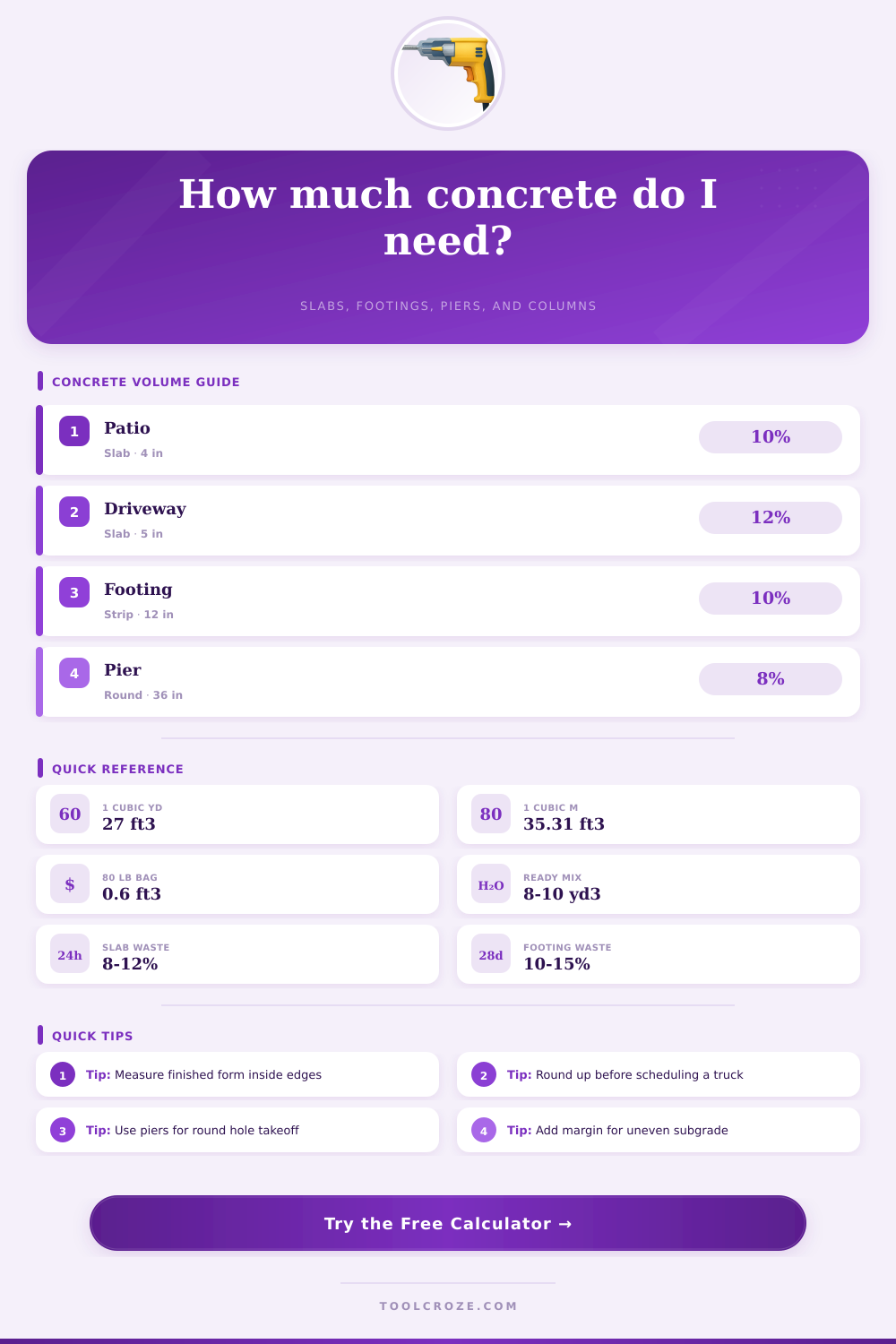
| Patio slab or walkway | 4 in / 100 mm | 8% to 12% | Measure inside form boards |
| Light driveway slab | 5 in / 125 mm | 10% to 15% | Allow for grade variation |
| Garage slab | 4 in to 6 in | 8% to 12% | Use thickened edges separately if needed |
| Strip footing | 8 in to 12 in | 10% to 15% | Width x depth x total run |
| Round post pier | 24 in to 48 in deep | 8% to 15% | Diameter controls volume quickly |
| Shape | Volume formula | Best for | Dimension warning |
|---|---|---|---|
| Rectangular slab | Length x width x thickness | Slabs, pads, landings | Convert thickness to feet or meters |
| Strip footing | Run x width x depth | Continuous wall footings | Use total linear run |
| Round pier | 3.1416 x radius² x depth | Post holes and columns | Use actual hole diameter |
| Multiple forms | Single form x quantity | Repeated pads or piers | Keep all forms same size |
| Bag size / source | Approx yield | Cubic yard bags | Use case |
|---|---|---|---|
| 40 lb bag | 0.30 ft³ | 90 bags | Small patches and fence posts |
| 60 lb bag | 0.45 ft³ | 60 bags | Post holes and small pads |
| 80 lb bag | 0.60 ft³ | 45 bags | Small slabs and multiple piers |
| 90 lb bag | 0.68 ft³ | 40 bags | High-output bag mixing |
| Ready-mix truck | 8 to 10 yd³ | One truck load | Larger slabs and footings |
| Specification | Normal concrete | Lightweight concrete | High strength mix |
|---|---|---|---|
| Fresh density | 140 to 150 lb/ft³ | 105 to 120 lb/ft³ | 145 to 155 lb/ft³ |
| Common placement | Slabs and footings | Weight-sensitive decks | Columns and heavy loads |
| Takeoff risk | Subgrade dips | Yield variation | Tight delivery timing |
| Margin suggestion | 5% ordering margin | 5% to 8% margin | 6% to 10% margin |
💡Concrete Takeoff Tips
But if you know how many bags you need, it keeps you from panicking. Before you even dig, you figure out how many bag are needed. There are two pitfalls to guessing. First, you might guess wrong and end up wasting money by buying more then necessary. 2) You might guess wrong and run out of material halfway through your pour, which results in a weak joint.
So measure the volume accuratley first. But it doesn’t do the math for you. The calculator up top does that for you. It turns your measurements into bags (or cubic yard). It flags margin and waste separately.
How to Estimate Concrete Bags and Avoid Mistakes
Waste is based off physical problems with the site. The ground’s never perfectly flat, and forms warps too. Concrete spills when placed. Add a waste percentage for this.
Margin covers the buffers built into our schedules. It includes variation in the load from each mixer. The calculator breaks those down for you because you want to know why your total has gone up.
The waste percentage is the number you adjust depending on the job. Eight percent additional material may be needed for a patio, for example. Rocky ground with an irregular footing require even more.
Scale determines whether you go with ready-mix or bags. For small jobs (fence post repair, etc.), it makes sense to buy bags because they give you control over how much material is used. Mix just enough so you can carry and use it all within 90 minutes. Because slabs are too big to haul around manually, however, truck delivery would of make more sense for larger pours.
A four-inch-thick, ten-by-twelve-foot patio requires roughly 45 standard eight-pound bag. Concrete weighs a lot. How heavy? It is about 145 lbs/cubic foot. This vary a bit depending on density. Density affects both the weight and the strength of the structure.
Slab and driveway concrete are normal. For upper-story decks with reduced load, you use lightweight mixes. The calculator will update its weight estimate according to your mix type selection.
Concrete requirements is also affected by placement conditions. Air entrainment occur if pumped or poured into tight forms. Rougher subgrade require more volume. Tight forms create more spillage. You address all that complexity by adjusting inputs in the tool.
Put safety first when pouring anything. Lift carefully; wet concrete burns skin and can be dangerous! Protect yourself with boots and gloves. Make sure your form are secure, no blowouts. Check local codes in advance of starting anything.
A good plan makes for a solid slab. Good math is the key to keeping it together long term.