
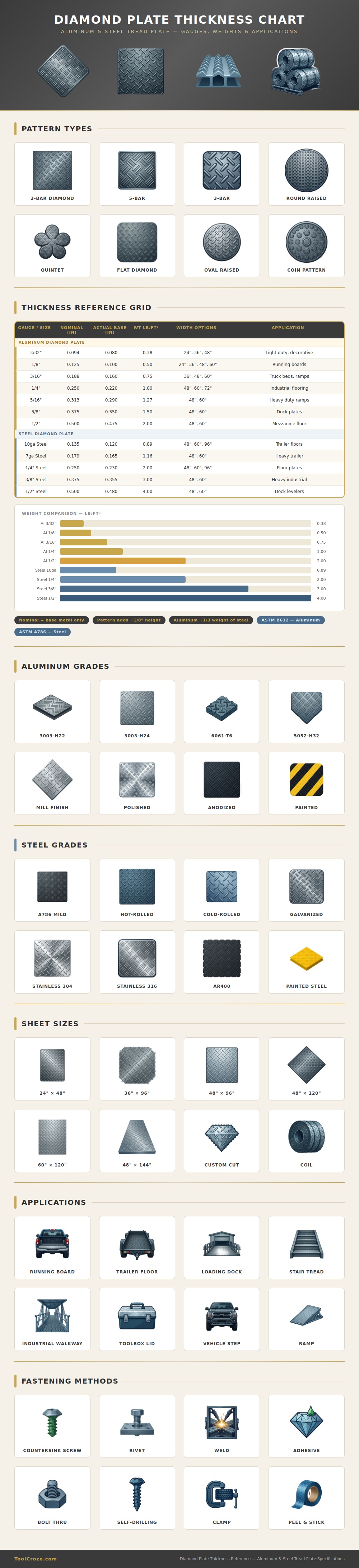
A guy walks into a supply house and asks for some diamond plate. They give him a gauge number that sounds right. Then he installs it and finds out it’s way too flexible under people walking on it. The ramp sag when someone with a lawnmower goes over it at 1/2 speed. Or the toolbox lid is too flimsy compared to the body of the truck. Why does this occur? This occurs because what they call gauge is a nominal thickness, which isn’t necessarily what you have in your hands. A good example can be seen here (chart above) where they show the nominal vs base thicknesses for both steel and aluminum. This makes a big difference for structural integrity and load carrying capabilities. This matters even before you consider finish or corrosion related problems.
For light weight but still durable uses such as light ramps, trailer sides, and running boards, aluminum is popular. For general use it’s typically either in the H22 or H24 temper of 3003 grade. This offers a balance between strength and workability, but is also usable with simple welding methods. Other alloys are available for higher-strength projects where appearance isn’t the main focus, such as using 6061-T6 for extra rigidity, or for marine use and saltwater environments, such as using 5052 alloy. And the good looks don’t hurt. Anodizing adds a scratch-resisting and protective charcoal color that masks scratches more effective than raw aluminum. A polished mill finish has a moddern industrial appearance without needing to be painted. It looks great on a garage door step and look great in a warehouse aisle.
Why Diamond Plate Choice Matters for Strength and Safety
On the other end of the spectrum, you have steel. If you require a floor that can handle heavy machinery such as forklifts and pallet jacks, even the thickest available commercial grades of aluminum often feel too light. At this stage, you switch to either hardened abrasion resistant (AR) 400 steel plate or ASTM A786 mild steel. Because steel is heavier per square foot, your floors won’t deflect as much with a point load, but they’ll exert greater stress onto whatever structure holds them up. Once you’ve entered the industrial space, thicknesses are quoted in fractions of inches instead of gauges. Quarter inch-thick steel plate is mighty strong, and while there’s a severe weight penalty to pay, it’s well worth it for permanent flooring applications in busy areas like docks or manufacturing floors. Keep in mind that another eighth or so of an inch is added by the pattern height to the overall profile, so be careful about clearance calculations if trying to fit this inside cramped spaces.
While pattern choice might initially appear solely cosmetic, each configuration of ribs impacts how much grip you have differently. A traditional two-bar diamond pattern sheds water and debris effectively and gives solid footing for shoe treads. More bars like five bar can increase contact area for greater grab in an oily situation like the auto bay or machine shop floor. Raised round or coin patterns look clean and are suitable for interior use, such as stair treads in a lobby. These environments demand safety over an aggressive industrial appearance. The flat diamond is largely for looks, offering little traction compared to raised designs. That’s not to say it doesn’t have a place, like decorative accents or wall cladding, where your feet will seldom visit.
Different materials and needs require different installation techniques. For permanent mounts, weld lock steel plate to frame sections to make one solid piece. These welded joints will handle vibration much better than mechanical fasteners in extreme applications. For light duty applications, using structural adhesive would be best, but when dealing with aluminum, MIG welding should be used with special alloys of welding wire to ensure that metal doesn’t crack under the heat. Thinner gauge aluminum sheet can also be screwed directly onto wood surfaces such as plywood sub floors with self drilling screws and a washer to spread the load. This prevents any tear through. If you are after a nice clean exterior finish, rivets are a good choice. They don’t need the hole countersunk so there is no damage to anodized or painted finishes. For removable parts, clamps or peel and stick items would work but not something holding much mechanical stress at all.
Width constraints often dictate project feasibility more than thickness does. Four foot wide sheets (which are also the size of standard drywall) are easiest to handle and commonly available from stock. Wider (up to 5 ft) cuts will cut down on seams on big floor areas, but might cost a bit more if you want custom cutting service to avoid waste of materials. If your area is oddly shaped, using a custom cutting service will help avoid waste, although it will be a little more per pound for the precision service. Only use coil stock if you have a continuous run, such as the side of a conveyor or very long vehicle steps. These parts benefit from having no joints, which will strengthen the assembly.
Diamond plate gets cut best with abrasives or special carbide blades for the circular saw, so always measure twice before buying because you’ll go through regular saw teeth fast trying to cut this stuff in the field. Getting it right the first time is worth much more than the small discount you might get from buying bulk steel. So that’s the thing: Understanding those physical limitations, and honoring them, is what makes or breaks a project that will serve decades versus fail within months. Material matters (corrosion resistance, weight); pattern matters (safety underfoot); thickness matters (strength). Guess wrong on any of these, and you’re essentially gambling that the metal behaves the way you think it does, which means that it doesn’t hold up. The same careful consideration that ensures no sag in a ramp ensures no wear-through on a floor; the same metal sheets becomes dependable infrastructure, not a throwaway surface.
