
The gauge numbers on steel plates are backwards. The higher number represent thinner material. That seems backwards because the system began based off musket ball holes.
If you don’t know how thick the piece is, you’re not going to cut it. Once you do, there’s no undo button. Here’s the breakdown of those numbers so you can make heads or tails out of em quicklly.
Understanding Steel Gauge Numbers and Thickness
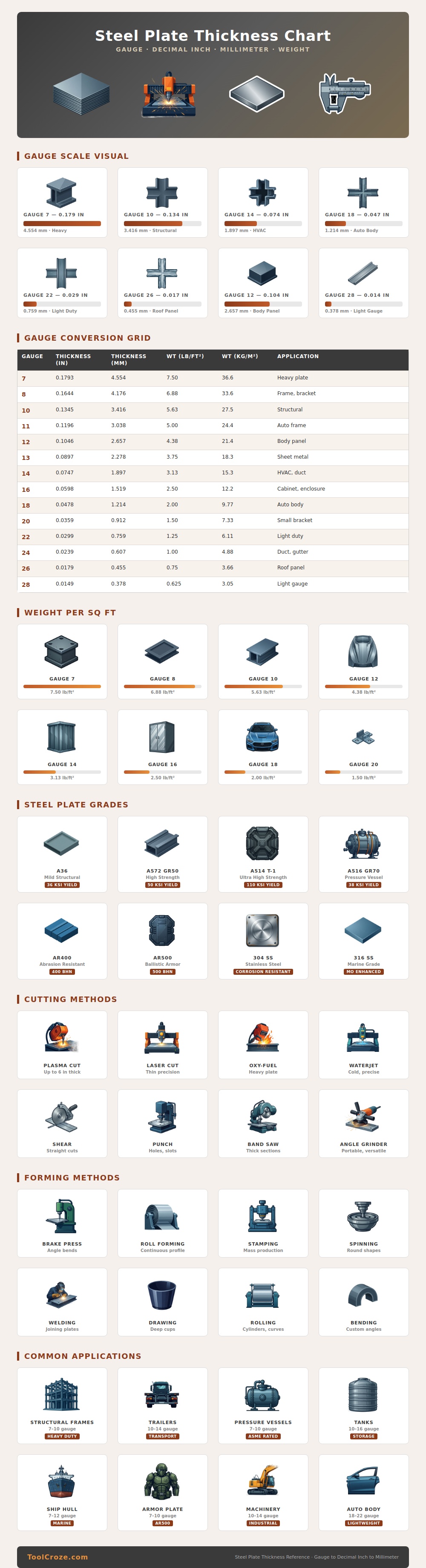
Thickness are measured in gauges. Looking at this graphic you can see that thickness varies greatly by gauge. Gauge 28 is thin, while Gauge 7 is thick. Why does this matter? Because thickness equals weight. Seven and a half pounds per square foot is the approximate weight of gauge 7 plate. And guess what? Ten sheets adds up to eighty pounds. Ten sheets adds up to a hundred and fifty pounds. Not too bad, till you realize your trailer require ten sheets for the floor alone. Eighty pounds just for the floor! Most people don’t realize how heavy that is until they pick it up. But looking at the chart will allow you to see the cumulative weight before you place an order.
It will also help explain why some grades matches certain thicknesses. Heavy armor plate are not used on a lightweight car panel. That’s like building a concrete house and trying to hang a picture on it.
The grade selection gets into technical stuff (it’s not hard). General purpose mild steels such as A36 is popular due to cost and weldability. For extra-strong applications, such as heavy loads, opt for higher strength types like A572 Grade 50. Use specialized alloys for harsh environments or specialty uses like pressure vessels. That last bit is all spelled out in the infographic along with each type of steel’s yield strength, which lets you pair up the correct material to the task.
It’s not only about how thick something is. It’s about resistance and strength. Welding won’t save you from choosing the incorrect grade.
How do you cut? It depends on your previous selection. Laser cut provides exact edges, but can’t deal with thick stuff. Plasma cutter are great for heavy plate, but results in rough edges requiring grinding. Waterjets is clean and versatile, though slower and more expensive for simple shapes. If you’re working in a shop, the choice often comes down to what equipment you have available versus what your budget allows.
Physics won’t let you laser cut a three-inch plate. An oxy-fuel torch will melt through thin Gauge 24 sheet metal, but burns a big hole as it does so. It melts quicker then it cuts. The same is true when it comes to thickness tolerance in forming. A brake press bends thin sheets nicely but fails to hold that shape unless you compensate for memory of the material. Thicker materials needs heat and additional force to avoid cracking.
The image illustrates types of forming techniques ranging from simple shearing to complex deep drawing. All have limitations regarding the thickness and thinness of metal. Respect these mechanical boundaries. Attempting to roll a heavy plate into a tight cylinder without proper machinery is a recipe for broken equipment and ruined metal.
Other than that it’s all application driven. A structural frame will require heavier gauge plate to safely hold up to load. An auto body requires a lighter gauge for fuel economy. Panels used on roofs falls somewhere in between, light enough to not weigh down a roof but strong enough to last. This chart plots out those applications and allows you to get a sense of where yours falls.
Need to build a machine base? Check out the heavier gauges. Looking to build an electrical box? Mid range sheet metal should of do it. Match the mission with the metal.
It’s about knowing before making. Knowing thickness means you won’t waste money or need to do it over. Knowing which gauge to use means not wasting money learning the hard way. You end up with a build that stands up to real-world stress. Not knowing creates confusion, knowing means controlling that confusion.
