
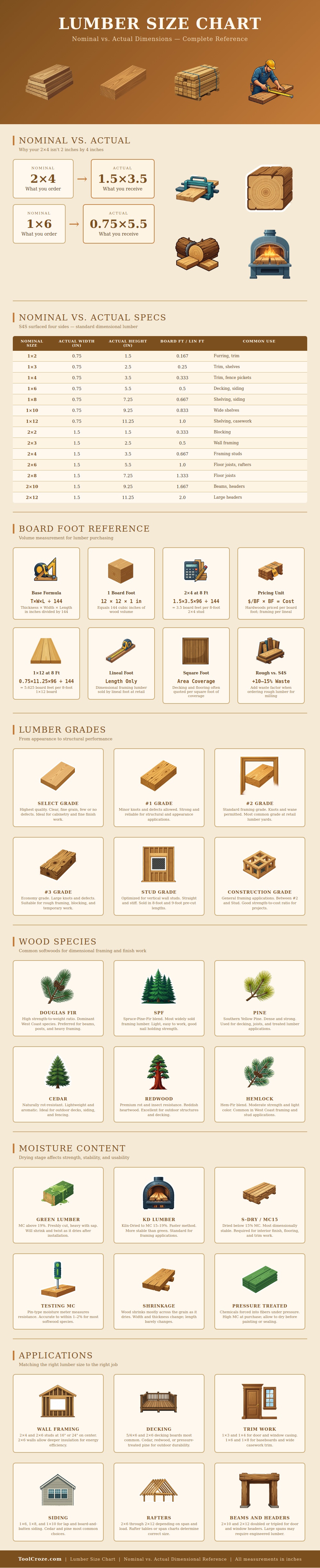
It is one of those moments that happens when walking into a lumber yard, having a plan to build a deck… until you pick up a piece of wood. Two by four? Not quite so much. That’s one of the lessons in building things with wood. Before wood gets planed and dried it has historical names called nominal sizes. It’s not what it says on box.
As you can see from the chart, each dimension lose half an inch. That’s right: A two-by-four is actualy one-and-a-half by three-and-a-half inches. The rest of the sizes works similarly. Why? They was cut down to fit building code and then machined flat on face.
Why Wood Sizes Are Smaller Than They Look
Knowing this difference is critical whether you’re building shelves or framing up walls. In either case, precision counts. If you design a cabinet based off its nominal width, the joints will be loose and the doors won’t close propery. Measure the real thing. Not the tag on the rack.
Why? Because new lumber contains water. Wood coming from the mill is saturated with moisture. As the wood dries, it loses that water. And as it does so, it shrinks… More so across the grain then along its length. If not carefully watched, this lead to warpage and twist. Kiln-drying wood puts it through that process under controlled conditions; in an oven. Its moisture level stabilizes at around fifteen to nineteen percent. That’s why kiln-dried stock is required for finish carpentry work. Slightly wetter wood will settle up over time, which are fine for structural framing. It makes all the difference between trim that remains true and gaps opening up around windows within a year.
Also, be aware when you look at each board that it’s been marked for species and grade. For example, selected grade is beautiful, almost knot free. It is perfect for fine cabinetry or items where they will be seen. Number two common is the workhorse of building. There may be some character marks but nothing that compromises strength needed in wall studs.
Not all wood is the same under load so be sure to pay attention to species. If you’re working with something like beams or posts, Douglas fir are an incredibly strong wood. Spruce-Pine-Fir mixes offers a lighter blend for ease in nailing and cutting. Redwood and cedar is naturaly resistant to rot, making them a good choice for outdoor decks that is exposed to year round sun and rain.
The other complication comes with price: Many times, instead of buying boards individually, they are priced per board foot, which is a certain volume of hardwood. Board feet is determined by dividing thickness X width X length by 144. Basically, it measures out how much wood you’re paying for. Typically, when you shop for framing lumber in regular building supply retailers, you will be billed per lineal foot. That’s easier to budget for large jobs. However, there is a catch, bad knots, cuts that don’t come out well, etc., can eat into your total numbers fast so build some wiggle room for waste.
But combine all this stuff and now you’re seeing the picture. For structural pieces, you select a stronger type of lumber. For the parts that show, you go with something cleaner grade. You plan out your joinery and think about true size of things. You don’t have to memorize numbers off a table. What you do is learn what the wood does when it gets home from the hardware store.
A two by four may not always be as big as it sounds. But if you measure twice and cut once, that thing would of support your house. It’s getting down to basics here. Trust your tools instead of label. Let the material itself lead your hand on each cut.
