
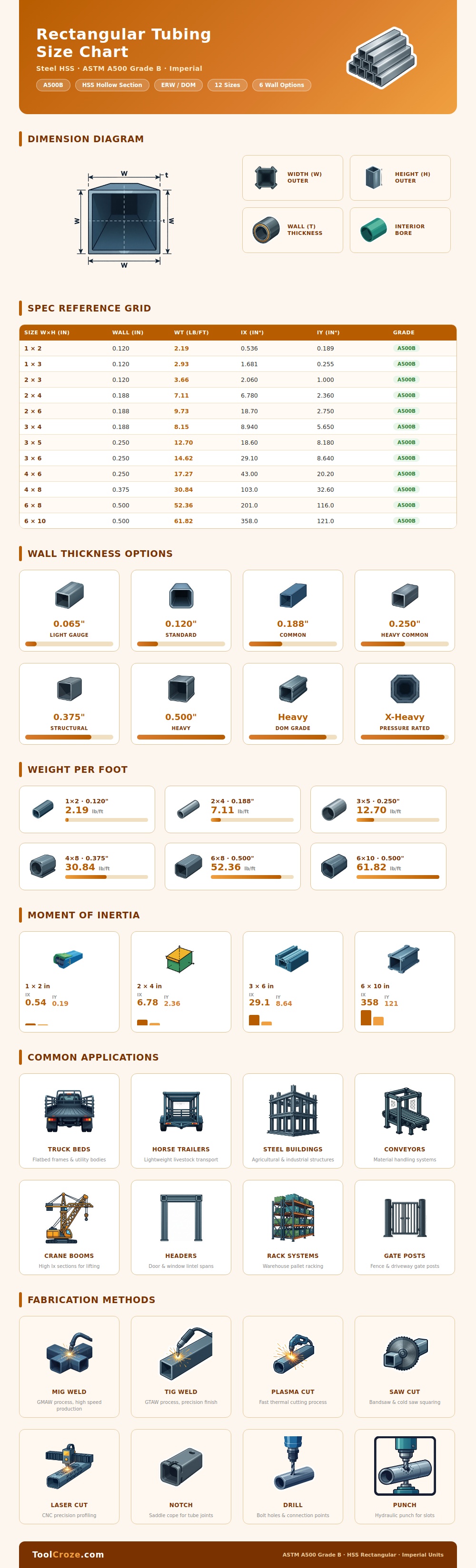
It’s a list of sizes in the supply yard, and there you stand. It’s for your project; you’re looking for steel tubing. Get the specs wrong and a frame bucks. Get them right and the tube take the load and keeps its form. Rectangular hollow sections is everywhere, like in warehouse columns, fence posts, and even garden gates. How do you get what fits exactly? Do not waste money or fail. This chart shows a tube’s size using it’s common Imperial measurement and physical properties. It’s for an ASTM A500 Grade B steel. That’s the most popular grade as it strikes a balance in strength and weldability.
Note that what you’re looking at is width and height, but they relates to wall thickness and hence the strength of the tube. A bigger tube isn’t necessarily stronger if the walls aren’t thick enough. The relationship between the exterior profile and interior bore matters. Many mistakes are made with wall thickness. That two by four inch tube look hefty. Tap it and you can see that light gauge is flimsy.
How to Pick the Right Steel Tube
The infograph displays the variety of wall choices from light framing up to the heaviest of structural sections. Many purchase tubes by their face only. What do you think the tube will have to bear? A truck bed frame must be strong enough not to bend in gravel carrying duties. A decorative railing requires less weight and cost, which mean it has lighter walls.
Your ultimate design will be driven off part by weight per foot. The heavier the tube, the more robust the connection and foundation. A six-by-ten-inch tube with half-inch walls alone weigh more than 60 lbs per linear foot. That adds up fast when talking about a long run and affects labor, shipping fees, and material cost. Conversely, lighter tubes such as one-by-two-inch ones will weighs nearly nothing and work well for detailed framing. You must choose between durability and ease of handling.
It is also called the moment of inertia. This is how stiff something will be and how easily it can bend. As shown in the chart, increasing height of the tube makes a more dramatic effect on this number. The taller and narrower the tube, the stiffer it becomes compared to a wider, flatter tube of equal weight. That’s why when using a header or beam above a doorway, you’d want to have the material placed to resist the way the load will go. So knowing that principle would help you choose which orientation to cut it into.
Your fabrication techniques will affect your decision as well. Thin skins behave different than thicker walls when it comes to drilling and welding. Most people use either MIG or TIG welding. Getting a clean bead on very thick tubing require more skill and heat input. Complex joints with accurate notches will need to be plasma cut or shaped by laser. Moderate wall thickness is manageable in the home shop, it puts less strain on power tools. There is less chance of warping when welded.
The correct rectangular tubing has strength needed for the job. From a conveyor system used in industry to a horse trailer enduring road vibration, it works for both. With the numbers as your guide, there is no need to remember them all. Just recognize that wall thickness, height, and width forms into strength. Begin by understanding what will be on board. Then follow the weight limitations and let the structural properties complete the process. When it’s time to haul heavy stuff, the proper tube keep it all together.
