
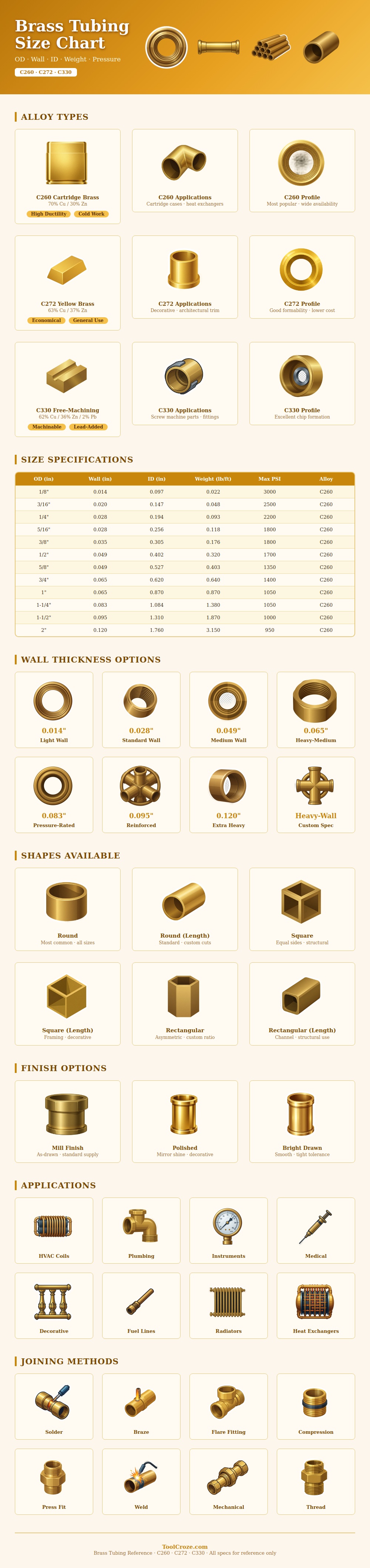
So what’s confusing about those brass tubes that you stand in the aisle looking at? Some of the tubes seems pretty much the same, but they’re not. They vary in weight. But you have no idea what you’re supposed to be looking at. That’s where size chart comes in. It matches the physical features of the tube to your requirements as an engineer.
Whether it’s railing you’re creating or fuel lines you’re installing, the table provide you with a visual reference. How does wall thickness relate to outside diameter? How do these things translate into weight vs. Strength? It doesn’t matter which row you don’t remember, only that you know relationship between the rows.
How to Choose the Right Brass Tube
First you decide what alloy. Many people picks up whatever tube is available. That lead to mistakes. For bending purposes, you want C260 cartridge brass. Why? This material are highly ductile and won’t crack or snap when bent. Use this for curved pipe or heat exchanger uses where the metal need to flow. The copper-zinc combination doesn’t resist flowing; it wants to flow. It’s called cold working.
C272 yellow brass is used for aesthetic reasons as well as cost. A nice warm color is good for architectural trim work. It do not involve much structural stress. When cutting on a lathe, free machining brass (C330) have lead added. This cleans up nicely. It allow for clean cuts that don’t dull your tools so quickly. What goes into the brass alters it’s behavior at the cutter’s teeth.
Does it pass? Will it hold? That depends on wall thickness. Wall thickness is illustrated in the chart. Lighter walls is cheaper initially but will be weaker under pressure. They’re prone to being dented when installed, too. And they may even cave under high pressure. Think of it as a balance between bore diameter (how much you need inside) and structure strength (what’s going through that tubing).
For example, a 1-inch OD tube with a normal wall resists lower pressures with water inside. But that same tube isn’t safe for hydraulic use. The infographic illustrates increasing wall scales. Increasing the wall thickness of the tubing make it more durable. What goes through the tube must come out intact.
Size isn’t everything. Finishing and shape count too. Rectangular or square shapes offer more mounting area. Round tubing shares load equally well. Square tube has weak corners, this is where corrosion begins. Hidden uses call for mill finish. Polished Brass highlight every scratch.
How do you connect it? Plumbing with solder is fine, but only for very light loads. Welding or brazing offers strength for structural frame. Compression fittings allow for fast repair. They add bulk which is not always possible with round tubing. Joining method determines wall thickness required. Pressure rating is another consideration.
Brass buying is about metal for the task and not the cheapest price. Measure twice; cut once. Look at the alloy content with care. Consider the wall thickness requirement. If you line all of those up then it’s a usable tube. It is not just another generic thing. It is something that meets the specs for your project.
