
Here you are, standing in hardware store staring at loops of white, blue and red plastic tubing. It’s not unlike colored rope, only it has a job to do in your house. Why does it matter what kind, or what size? Because if it’s buried behind your wall, then when it fails, will it fail or not?
Here is how PEX meets all moddern plumbing needs. We will also show how choosing the wrong type or size can lead to leaks, poor pressure, or even frozen, burst pipe. We want our water running well for years with no leaks through the ceiling.
How to Choose the Right PEX Tubing
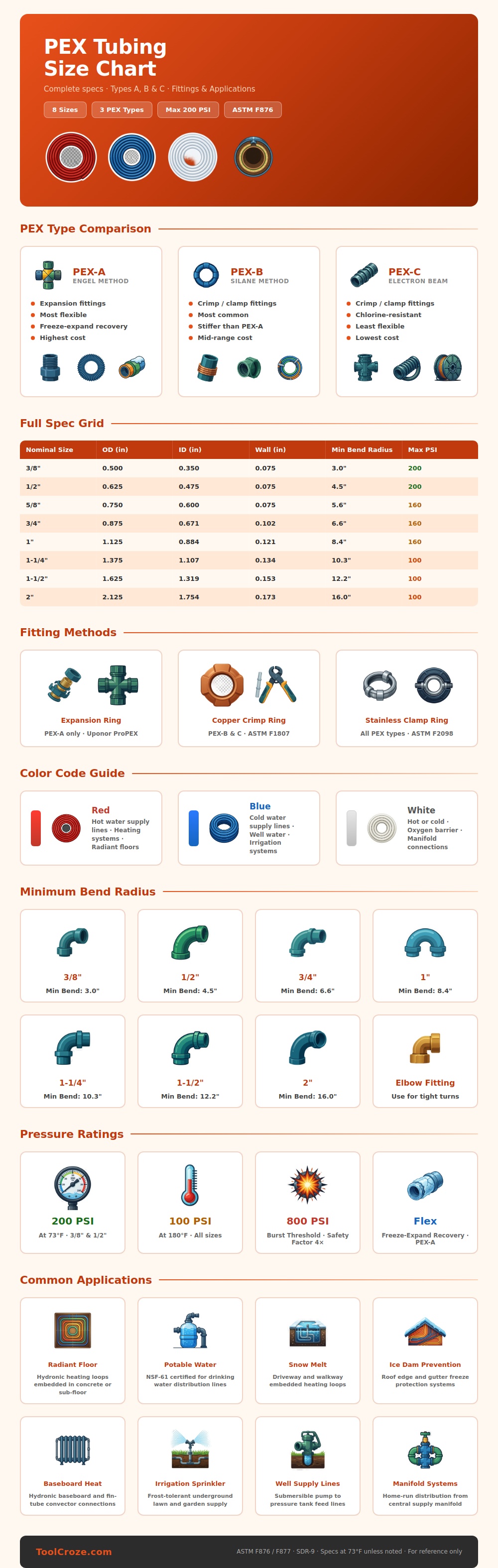
As you can see from the chart above, there are three kinds of PEX: PEX-A, PEX-B, and PEX-C (note: these aren’t interchangeable; they’re all physically different). To put it simply:
• PEX-A is made using the Engel method, resulting in a flexible tube that can stretches when frozen and snap back to its original shape. This flexibility comes at higher cost, but also means no bursting pipes in cold weather.
• PEX-B uses silane crosslinking, resulting in a stiffer tube with a lower price tag.
• PEX-C uses an electron beam process, resulting in the most rigid kind of tube that’s also the most resistant to chlorine.
The type of PEX doesn’t matter to most homeowners day-to-day. But plumbers do care, each kind needs special connector tools. Don’t mix connectors willy-nilly, or your joints will fail. You’ll know something is wrong when water starts leaking inside your home.
Most people mess up here: They try to approximate using copper pipe size. But with PEX, that’s not how it works; the nominal labels don’t exactly align with outside dimensions. Here’s what the outer diameter and wall thickness of PEX looks like for tubes ranging from three-eighths inch to two inches (infographic).
You’ll note: smaller tubes like half-inch has higher pressure ratings. Sometimes as high as two-hundred PSI in normal conditions. The larger ones go down to a hundred PSI. That’s not something wrong with them; it’s just physics. Since a thinner-walled tube has less surface area to stretch relative to its diameter, it will give way sooner then thicker tubing when the same internal force is applied.
Knowing this will help you determine if you need a heavyweight supply line, or if branches might be fine with lighter stuff.
There’s one thing that separates smooth installations from frustrating ones: Bend radius. Don’t think you can kink up some PEX and call it good, it weakens the construction of the tubing and restricts flow. Even the smallest tubing (three-eighths inch) requires at least a three-inch bend radius (see chart). Bigger pipes require bigger bends; as much as sixteen inches for two-inch diameter tubing!
When a piece is too big to go around a stud, or a chase is crowded, forcing it into a tight turn will cause problems. That’s why elbows exist. They aren’t used for looks, but because they keeps the pipe strong in tricky layouts. If there is room for an elbow, use it to avoid pinching off your water flow later.
Beyond just identification, color coding offers practical direction. Red typically means hot water; blue typically means cold. White can be considered neutral, often applied as an oxygen barrier on a loop that includes a heater. Technically, mixing colors is fine provided they are properly labeled. However, sticking with what most people do simplifies troubleshooting down the road. If the pipe is still blue in five years, it will be easier to remember why you put it there while chasing down a leak.
So when working with PEX, use the flexibility of this material within the bounds of what the material can handle. This means running a system that can stands up to physical stresses, temperature fluctuations and pressure spikes. The specs will guide you on the road to good durability whether your system is simple home-run distribution from a manifold or more complex radiant floor heating loops.
Fitting compatibility, bend radii, and pressure ratings are all the details that convert a possible headache into a trustworthy tool. A well-designed plumbing system isn’t seen and should of not be.
