
You are standing in an aisle with a pile of seemingly equal-sized aluminum tubes in front of you. You’re holding one in your hand. How do you know which will fit? And more importently, which will last?
The answer is often found where you least expect it: understanding how outside diameter, wall thickness, and temper interacts. In other words, you don’t grab the first tube that seems like it might work; instead, you select based off the materials’ ability to sustain stress without bursting or buckling.
How to Choose the Right Aluminum Tube
For most builders, that process begin with the outer profile, as that tell us whether the tube passes through a bracket. But underneath that, inside wall, lies the real story. It’s there that you find things like weight versus structural integrity. Everything is governed by wall thickness, as well as type of alloy and temper.
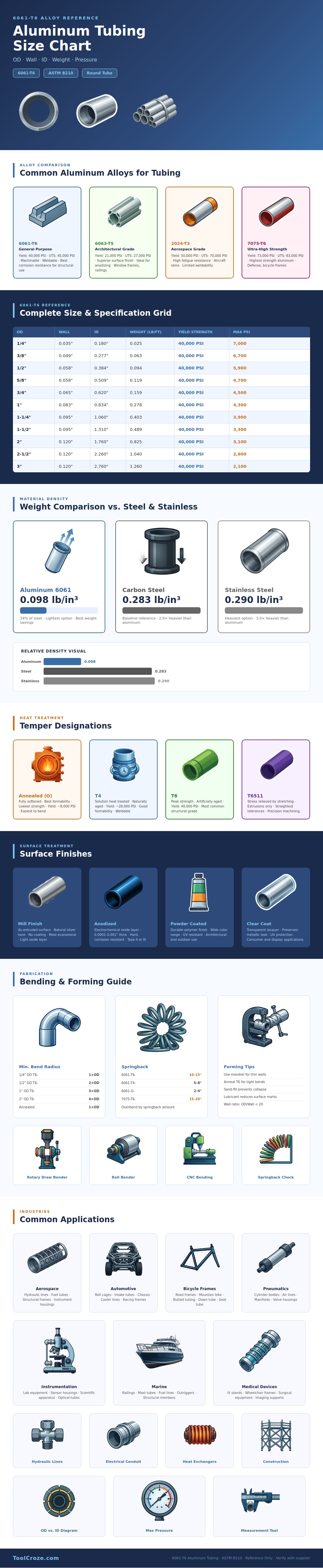
Here’s how those relationships breaks down for 6061-T6 aluminum (see table above). The chart show why this material is so nice; you can have a quarter-inch OD tube with a standard wall that weighs very little yet holds thousands of pounds per square inch of pressure. This stuff has a strength-to-weight ratio that steel just doesn’t possess unless you add a bunch of bulk to whatever you’re trying to build.
That means if you’re making something like a drone chassis or bike frame, where ounces count, then aluminum provide you with structural honesty. Your design is rigid without being weighed-down by dead weight as would be the case with carbon steel design. When engineers are designing anything from marine railings to aircraft components they turn to this material first because it won’t corrode and stay light enough to bear the load.
Most folks get tripped up on selecting the proper alloy temper. The infographic provides details on some popular grades such as 6061-T6, 6063-T5, etc., all the way up to a high-strength type like 7075. Generaly speaking, 6061-T6 is the workhorse grade which combine good yield strength with decent weldability.
If you want something easier to bend into tight curves (for example, a decorative handrail), you may wish to consider one of the softer tempers (T4 or annealed) which will be more forgiving during bending. But there’s always a tradeoff. Formability vs. Strength. You can’t have maximum bendability and maximum hardness in the same piece of metal. Knowing this saves you from getting material that’s hard enough to crack when you attempt to bend it.
The biggest enemy of the bend is springback. Springback describes what aluminum desires: to go right back into a straight line. If it is heat treated (in the case of T6) in a hard temper, it will want to spring back even more. The stronger the alloy the greater the springback (see the chart). So you have to slightly over bend to get the desired angle.
At first, this seems odd. However, once you factor in the springback, your joint snaps into place precisely on the first try. Filling the tubing with sand or using a mandrel prevents the wall from collapsing when making those tight bends. This maintains round cross section that makes the tube strong.
The surface finish helps too; it not only looks nice but lasts longer. Paintable mill finish is cost effective. Anodized aluminum has a protective hardened coat that resist corrosion while keeping weight low. That’s important on any product subject to the weathering effects of harsh conditions or exposure to salt air.
In short, the choice of aluminum tubing has more to do with imagining its performance than remembering which number means what. From backyard pergolas to hydraulic lines, once you understand what your material can handle you stop guessing and begin precise engineering. A basic round tube becomes something that function just as planned.
