
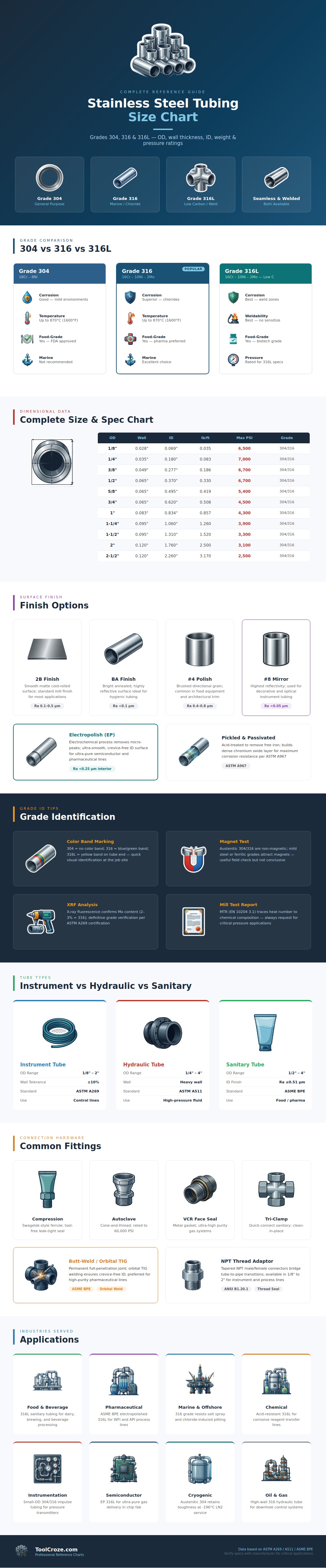
Do you have a piece of stainless steel tubing in your hand? It’s the right size on the outside but what about inside diameter? How do you know that it fits connection in the other person’s hand? You didn’t take into account the wall thickness. Having a clear reference point takes guesswork out of it at job site. If you look at chart above, you can clearly see specs related to weight, inner space and outer diameter.
There is different tubing options, and first decision is the grade. This determines the location of the tubing. The most common choice is 304 grade, which has been approved by FDA for food processing and are suitable for general atmospheric exposure. It’s not recommended to be used on a boat as it will be destroyed within minutes by salt water.
How to Choose Stainless Steel Tubing
For an environment with acidity or other chlorides, consider 316. That has some added protection from those elements due to its molybdenum content. Working around a chemical plant? Around the ocean? Use 316 versus 304…just because.
That last part is important for welding; the L means low carbon. In regular grades of steel, heating it up cause the carbon to come out. That makes area around a weld prone to corrosion. The special 316L formula prevent this from happening. The joint stays held together and no extra welding steps are required. They save money on their purchase but end up shelling out more because of leaks.
Seamless vs Welded Tubing
Seamless tubing is extruded through a die. Therefore there is no weld line to concern yourself with. Seamless tubes has an even distribution of pressure all around their circumference. Welded tube is made from sheet steel and then fused closed. This means that they are lighter and less expensive. Be cautious with high-pressure application because the weld may be weaker.
The ratio of the wall thickness to the radius of the tubing decide the ability to withstand PSI. In general smaller diameter will hold more pressure different than larger diameter. The surface finish is where things trip folks up. The words BA or 2B sound similar but mean different things. If you have piping behind the wall or need structural support, a dull matte finish called a 2B are fine. For running pharmaceutical fluids, you want a bright electropolished or an annealed inside surface.
Pressure drops occur in rough spots; average roughness matter. Bacteria can hide in nooks and crannies. The smoother the tubing the better it will clean out.
The final piece to all of this is to pick the proper type of connection. Compression fittings works well for instrumentation lines, which may change over time. Install them correctly, and then there is no need to fuss around with tools after that. If you’re working with ultra-high purity gases like in a semiconductor fab, you’ll either want an orbital welded joint or a VCR face seal. If you’re dealing with sensitive process gases, leaks aren’t acceptable; the connection has to be perfect.
The key to using tubes is matching material to the environment. Don’t put general purpose tubing on a cryogenic nitrogen line, nor do you require marine grade steel for your kitchen backsplash. Read the chart; let the data guide you. If in doubt, take your time, look at the specs. It’s better to measure twice then to replace a system later. You should of read the chart and the metal will tell you what it can do.
