
How frustrating is it when your pneumatic tool won’t operate? The compressor starts up loudly and the gauges shows the right pressure, yet impact wrench only gives an intermittent sputtering of air. Chances are you think something’s wrong with the machine. Most times, however, it’s not. Usualy it’s an issue relating to the connection between nozzle and the tank.
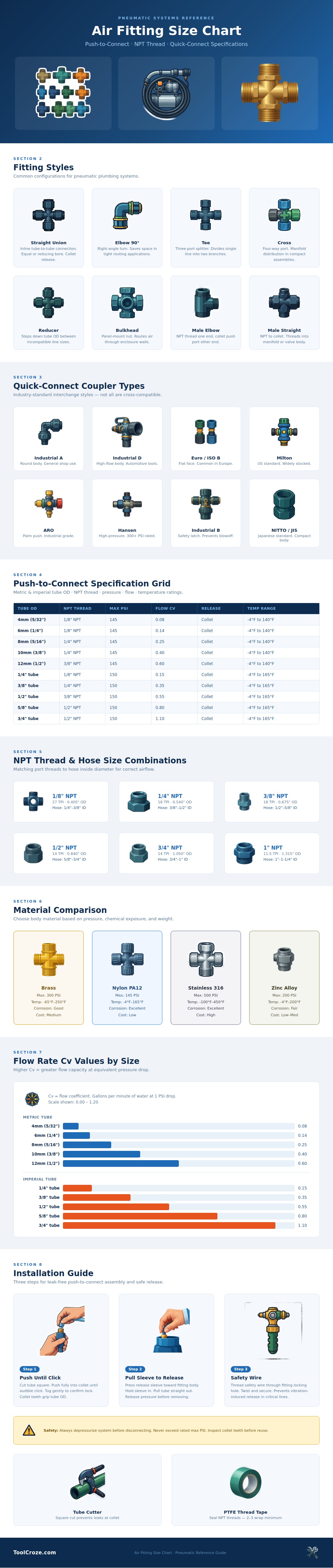
Air fittings is tiny little things you’ll tend to forget about until they interfere with productivity. Knowing how they’re connected will help you in controlling flow and pressure necessary for proper tool operation. As the visual guide demonstrates, there is a range of connection types to choose from. You can use straight unions for inline runs, 90 degree elbows for snug installations, and crosses or tees when you need to feed air to more than one tool. Sounds straightforward, right? But it gets complicated quickly when you discover that there’s also a difference between quick-connect coupler designs. For general-purpose around-the-shop jobs, it’s the Industrial A style; high-flow applications like automotive use call for an Industrial D coupler. Euro fittings, as name implies, are common on European-built equipment (they feature flat-faces). Don’t assume that two pieces that look alike will fit just because their looks is close: They won’t. The chart explains who matches up with whom.
How to Choose and Install Air Fittings
After determining the right kind of coupler, then comes finding tubing that will fit the port on fitting. That’s where the Cv value (or flow coefficient) enters the equation. A larger Cv number mean the fitting can moves more air through it without restriction. As shown in the chart, smaller diameter tubes has far less capacity. Using small tubing on a high consumption tool causes a restriction in the system reducing the volume of air and even though you might keep the same pressure, there won’t be enough volume to do job properly. The middle part of graphic depicts relationship between tube size, pressure rating and thread size.
The majority of push-to-connect fittings are rated to about one hundred forty-five PSI; plenty for typical shop air. But if you need higher pressures some is available in stainless steel bodies. Beyond this, there’s the material itself which has a bigger impact on performance different than most people might expect. Fittings made from nylon PA12 are light-weight, resistant to corrosion and ideal for cleaner garages. They’re relatively cheap and simple to mount. If you are operating in more extreme temperatures or a corrosive atmosphere, stainless steel thirty-six fittings becomes necessary despite the higher cost. Even at an increased cost, these require stainless steel thirty-six fittings. For those looking for something between these two options, zinc alloy provide adequate strength, but is less resistant to corrosion. Ultimately, longevity is just as important as fit; consider both your budget and the environment in which it will be used.
As much as the components are essential, how they’re installed is equally critical. The push-to-connect fittings have teeth inside that bite into outside wall of tube. These teeth would of fail to seat correctly if the tubing is cut on an angle, resulting in slow leaks that sap your line pressure gradually. Always make a clean square cut each time you attach a piece of tubing. Insert it fully by pushing hard until it click. Gently pull back to confirm it’s seated secureley. To take it off, be sure to first depressurize the line and pull release sleeve inward as you pull the tube straight out. Don’t attempt to yank a full line loose when it’s under pressure. Safety wiring through the locking hole on critical lines can save you grief from vibration loosening connections with heavy use. A simple extra step now can eliminate headaches later.
Pneumatic plumbing is not a complicated process; it’s about getting flow going and not the engineering. Use the right sized tubing to ensure enough volume. Cut the ends square. Use correct type of coupler. Make sure they are connected correctly. Let air flow freely with no restrictions. Your tools will be happy, no more coughing… And functioning as designed. Mechanics want that from the tool we operate.
