
Dowel pins are these little guys that look like bolts without threads. You find them in woodworking jigs, injection molds and machine tools, where there location controls the positioning of another piece. If a part isn’t positioned correctly, it goes into jig but won’t fit properly and has to be adjusted. They have to be precise.
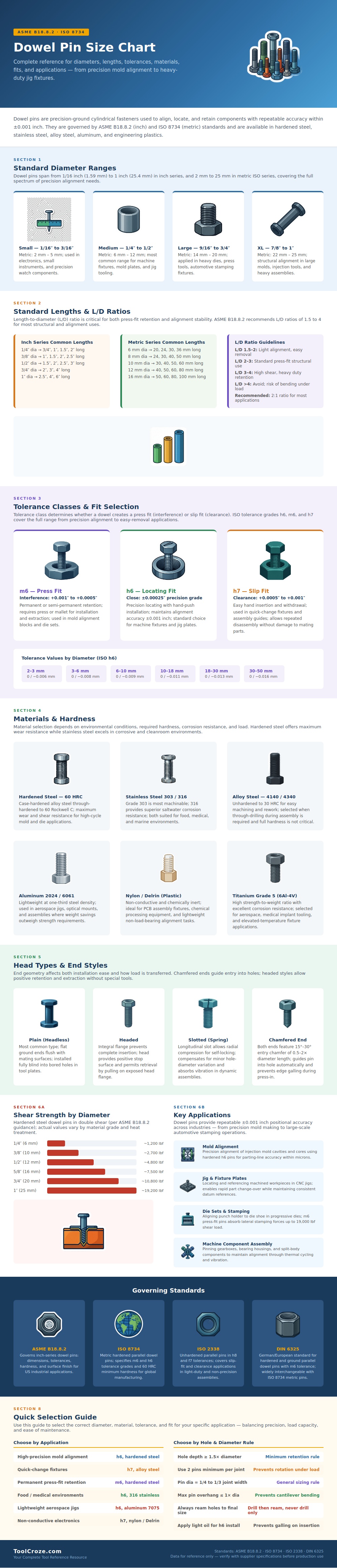
Fit trumps size: There’s a reason for each diameter range, and you’ll find a visual guide here going from fractions-of-an-inch up to a block of inches. But most designers choose a pin width they like the look of and stop there. Wrong. Tolerance class and material type matters more than thickness.
How to Choose Dowel Pins
Early in your design process, you need to decide whether your pin is removable or permanent. If it’s permanent, use a tight fit to keep it in place; if it’s removable, provide enough space to insert it by hand without scratching surfaces.
A basic rule of thumb for pin length is that a pin should of be at least twice as long as its diameter. Under load, any pin shorter than that wobble. Any pin much longer will bend under lateral force. Stability comes from short pins because they’re rigid columns. Failure invites itself with long pins since they behave like levers. Two to one are the standard ratio; deviate only if your use demands it.
What about materials? That is also something to consider. By default hardened steel is selected due to its shear strength and great wear resistance. If you’re working with corrosion, such as in medical applications or food processing, stainless steel is mandatory. Otherwise, it will fail from corrosion before fatigue failure. For an aerospace jig, aluminum pins might be called out since weight is more important than the strength of pin. In electronics fixtures, nylon may be specified because it won’t create any electrical shorting on delicate circuit boards. The reason for selecting material is determined by highest risk to the joint, whether it’s electrical interference, weight limitations or corrosion from rust.
It is easy to assemble. A chamfered end guides the pin into snug fitting holes and prevents binding. Pins with plain ends needs to be lubed during install or they can mar. The headed styles feature a stop to keep the pin from getting pushed too far inside cavity. It saves time when aligning on heavy plates in tough conditions.
Tolerances on these parts are specified by standards such as ISO and ASME. If it’s an m6 fit, you know that part is kept in place through intentional interference. And if it’s an h6 fit, you’ll have some precision location but minimal play. The right grade lets you avoid ordering errors. Swapping interchangeable fittings isn’t an option; you run the risk of loose parts or assembly failure. Over time, loose items can vibrates apart.
For multiple cycles with repeat accuracy and control, use dowel pins. Whether it’s a watch component or a stamping die being aligned, the same principles apply. Pick the right fit, heed length limitations, and pick materials that will last in your environment. Do so and those pins becomes the back bone of precision engineering, putting each component precisely where it needs to be on each lock of a fixture or closing of mold.
