
The clevis pin is a humble piece of steel with a hole, a head, and a simple bar of metal. But go too small or big on a job, and it’s no longer a sure thing; It’s a potential failure. “You get a nice handy clevis pin in your hand,” and you use it instead of a proper-sized one.
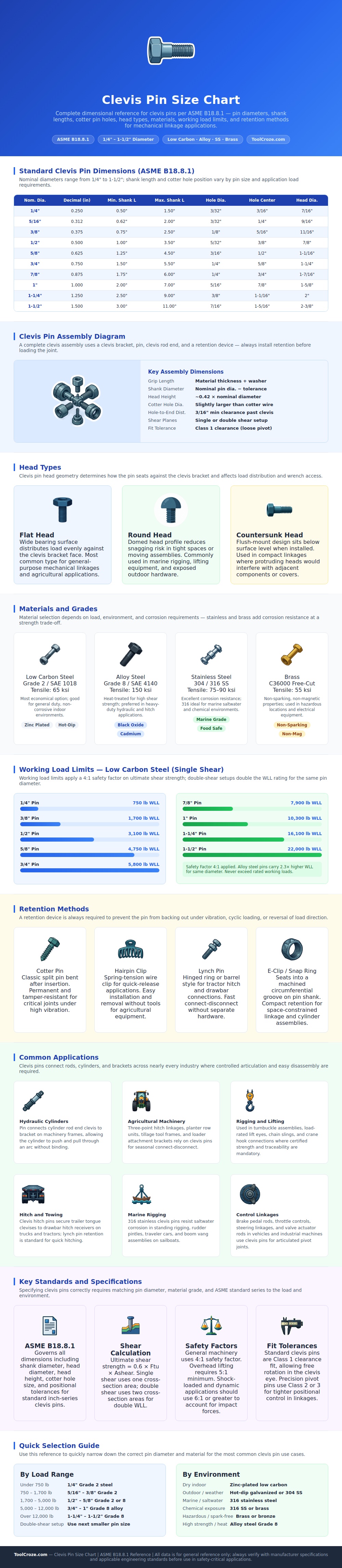
Standard sizes illustrate just how different the cotter hole and length of shank varies by pin diameter (one-half inch vs. One and a half). Not all bigger is better; bigger pins is not necessarily proportionally stronger, shear-wise. Choosing the right length of shank for the size of your washer and material are critical. It has to be long enough to firmly hold the washer and material but not so long you have excess slack in the connection. A pin that is too short will lose its holding power. This can be hazardous when using heavy pull on tractor equipment or hydraulic cylinders, as they will swing under load. The cotter hole position shift slightly as the pin gets thicker to ensure there’s always enough clearance past the clevis bracket. Don’t be tempted to trim a pin down for the sake of space. If it loosens up, vibration will do it.
How to Choose the Right Clevis Pin
Where most go wrong is with material selection. It’s two factors; force and environment. Indoor environments can be done on a budget using low carbon steel, however when left out in the rain…uh-oh! If you need something to hold a lot of weight in a hitch, use alloy steel which has about twice the tensile strength than standard grades. For corrosion resistance in chemical or salt water environments, stainless steel resist corrosion very well. In locations where a stray spark might cause trouble like hazardous areas, brass will not spark. Consider what type of threat your pin faces, shear force or environmental decay?
The pin stays in place without back-out under repeated loading due to its retention. The bent-open cotter pin locked into position after installation provide a permanent lock that prevents backing out under cyclic loading. Hairpin clips is used for fast detachment; common on farm equipment as implements come and go often. For hitch setups, lynch pins provides built-in retention and save time every day when coupling up.
Even with perfect fit, any loose pin will work loose with vibration and reversal of loads. Always secure the pin prior to mounting a clevis assembly. Clevis pins also have single and double shear applications and each has its own working load limit. The working loads for low carbon steel in single shear, which is four to one safety factor, are shown on the reference chart. So if your pin holds four thousand pounds before snapping, then you only rely on it for one thousand pounds in ordinary use. Because two cross-sections shares the load, a double-shear arrangement doubles that number. Safety factors tend to be higher during overhead lifting where the consequences of failure are more serious, five to one or even higher.
Choose the appropriate pin by matching the application type, the environment, and the load. For example, constant motion links require a tighter tolerance fit to reduce play in the linkage. Looser tolerances is allowed for static links as long as they stay connected. Check with manufacturer for specs for critical applications; don’t assume generic charts will be safe. Better to be big (slightly) than little (marginal). Get it right and this thing handles massive loads and binds the whole machine together.
