
When your bearing starts humming inside of its housing and gets loose, I think you know what’s going on. A small piece didn’t hold it all together anymore. Most times the problem is one of these snap ring wasn’t big enough for its groove. It doesn’t seem like much until it shoots itself off.
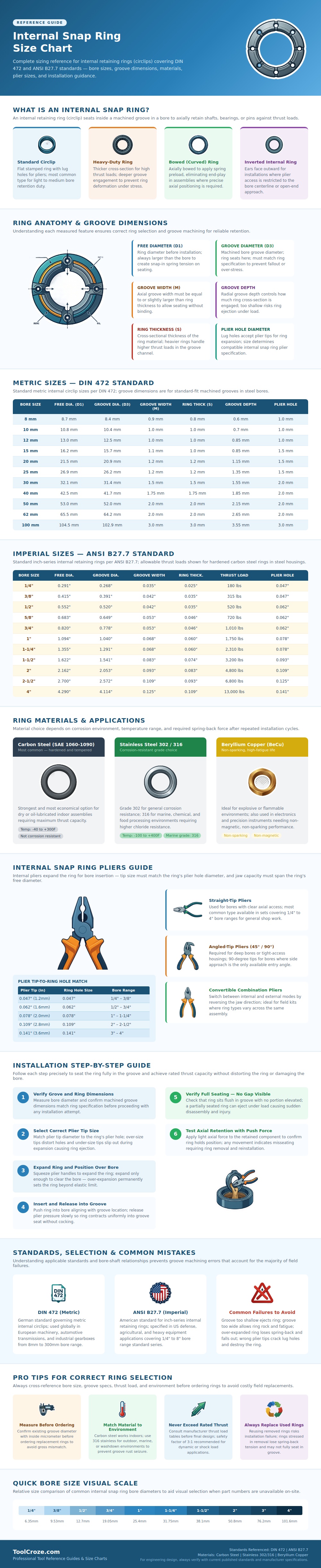
Circlips are important pieces of hardware, they are designed to fit into a machined bore to secure a bearing or other shaft. Think of them as the last line of defense from being torn apart. The above table shows the relationship between groove dimension and bore sizes for both ANSI B27.7 and DIN 472 standards. While there’s no need to memorize this stuff, understanding the geometry are essential before using pliers.
How to Choose and Use Snap Rings Correctly
But how it perform under stress is determined by its ring’s own anatomy. The outer diameter (free diameter) is larger than the inner diameter (bore diameter). When snapped in place, the ring is expanded and maintains this expansion with an ever-present inward pressure. Under load, if the groove isn’t deep enough for the ring to grab sufficient cross-section, then it will pop out of the groove. And if the axial width of the groove is too large, the ring will rock back and forth causing it to fail rapid due to fatigue. Knowing what the groove width and depth should of be from the manufacturer’s specs is more important than guessing at them based off shaft size.
For any given environment, choosing a material determines how well it fits and how long it lasts. If you don’t have corrosive issues indoors, then plain ol’ carbon steel work great, it’s strong, won’t break the bank, and can take pretty good thrust loads. But if your assembly will be exposed to salt air, chemicals, or just general moisture, then standard steel will seize in its groove and rust like crazy. Use stainless steel instead; grades 302 and 316 work well. In situations where sparking is hazardous (explosive environments) or magnetic interference cannot be allowed (precision electronics), beryllium copper are required.
Even the best choice can be spoiled by how you install it. Too many mechanics use oversized pliers whose tips bend the ring beyond its elastic limits and crack the lug holes as they force the ring onto place. The graphic shows that your plier tip size must closely match inside diameter of the ring. Squeeze just enough for edge of the bore to be clear of the ring. Then slowly let up and allow the ring to contract evenly into the seating groove.
A ring that is not fully in place is actualy more dangerous than none at all. It leaves a false sense of confidence and will wait until vibration forces it out. Don’t ever use a previously used internal snap ring again after removing it. Because you stretched that metal out and then let it go back into shape, you’ve weakened its spring-back tension. It might look okay but it cannot handle much of the thrust load anymore. Buying a new one each time gets you maximum rated capacity for your assembly. A few bucks isn’t too much to spend when considering the cost of rebuilding your bearing housing or a destroyed gearbox.
If you need to measure the existing groove, take your time and use an inside micrometer before you order. Then you know the measurements is still within tolerance. More importantly, you know nothing changed the shape of the bore while it was running through. Buying something that looks right and fits wrong happens way too much. A lot of times it’s millimeters of precision not brute force that make the difference between success and failure.
At their heart, retainers are as much about precision and waiting as they are different than brute force. Mass has nothing to do with it; tension and geometry is what hold big stuff together using a few small metal clips. Choose your material based off your conditions and respect the tolerances. Always use the proper tool to install them.
When you do, those little guys go completely out of your mind. They keep everything exactly where it belongs until the day when you finally need them once more.
