
Why does it seem like it’s so hard to clean? You’re standing there, a tangled hose in one hand and a pressure washer in the other, wondering what’s going on. The water doesn’t have any power and the machine are running loud. Is this due to malfunctioning pump or clogged filter? Often, the answer is no.
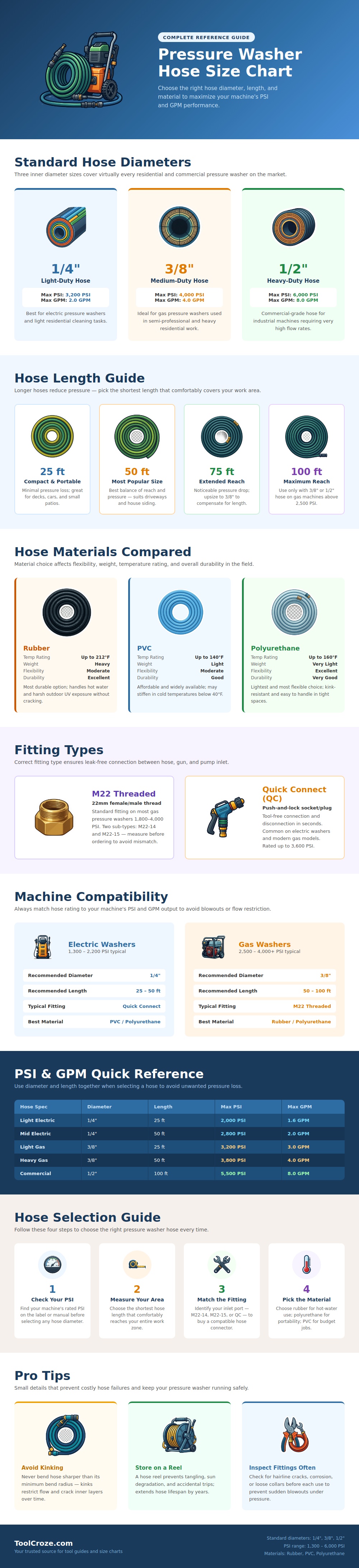
More often than not, it’s related to the hose. Selecting a pressure washer hose isn’t just purchasing a rubber tube from store. Does your machine produce the power it’s rated for or not? That depends off the hose material, length and diameter. These three factor will either make your machine operate as intended or cause it to fail. See chart for the effect of these three factors on both GPM and PSI.
3 Tips for Choosing the Right Pressure Washer Hose
The first thing is diameter. Most people gets this wrong as home owners. For washing out their bike tires or washing their patio chairs, a quarter inch hose will do fine. But anything bigger than that, that narrow tube becomes equivalent to a drinking straw. It restricts flow and cause backpressure if you’re pushing high pressure water from a gas-powered machine.
For those heavy duty machines, go up to a three-eighth- or half-inch diameter hose. That’s what the visual guide illustrates, from residential to commerical ratings. What does it mean? You want the interior of the hose to be same size as the output volume of your pump. Anything else is going to cause premature wear on your pumps’ pistons and seals.
Long hoses are also desired by many. Everyone wants more reach without dragging heavy machine around the driveway. But a long one (like 100 feet) impairs pressure. The longer your hose, the more friction loss there is, pressure drop increases rapidly with each additional length of hose. For house siding and driveway applications, a 50-foot hose is usually optimal; plenty of length, minimal reduction in pressure.
For larger properties requiring greater range, you’ll either have to upsize the diameter or settle for a lower flowrate (a compromise between performance vs. Convenience). Most folks never know they’re losing power till the dirt doesn’t come off the surface.
For long term use and day-to-day convenience, the material is more important then maximum pressure. In the winter, rubber hoses are stiff and heavy. They also cost more. However, they can take abuse and stands heat. Cheaper PVC gets rock hard in cold temps making it difficult to carry around.
For most people, polyurethane sits right in the middle. It’s light, flexible and easy to handle. The infographic compares these materials. Choose what’s best for you; do you want something durable or portable?
Lastly, fittings can drain a lot of pressure, too. If they don’t fit correctly, a fitting is leaky, so you lose PSI and create safety issues. Standard gas washer connectors are usually threaded and must fit exactly. Electric machines may have quick-connect couplers. These snap on easily. Know what’s on the inlet of your machine before purchase.
And when finished using the hose, put it away. Use a hose reel to store it. That way it doesn’t crack or get tangled up in the sun. A coiled hose lasts longer than a hose livig on the hot asphalt.
Know the specs and understand fluid dynamics to make your next cleaning job easier.
