Sprocket Pitch Diameter Calculator
Estimate pitch diameter, outside diameter, chain speed, center distance in pitches, wrap angle, ratio, and approximate chain length from chain pitch and sprocket tooth count.
Sprocket and chain results
Calculation breakdown
| Chain series | Nominal pitch | Roller diameter | Typical sprocket teeth |
|---|---|---|---|
| ANSI 25 | 0.250 in / 6.35 mm | 0.130 in / 3.30 mm | 10 to 48 teeth for small mechanisms |
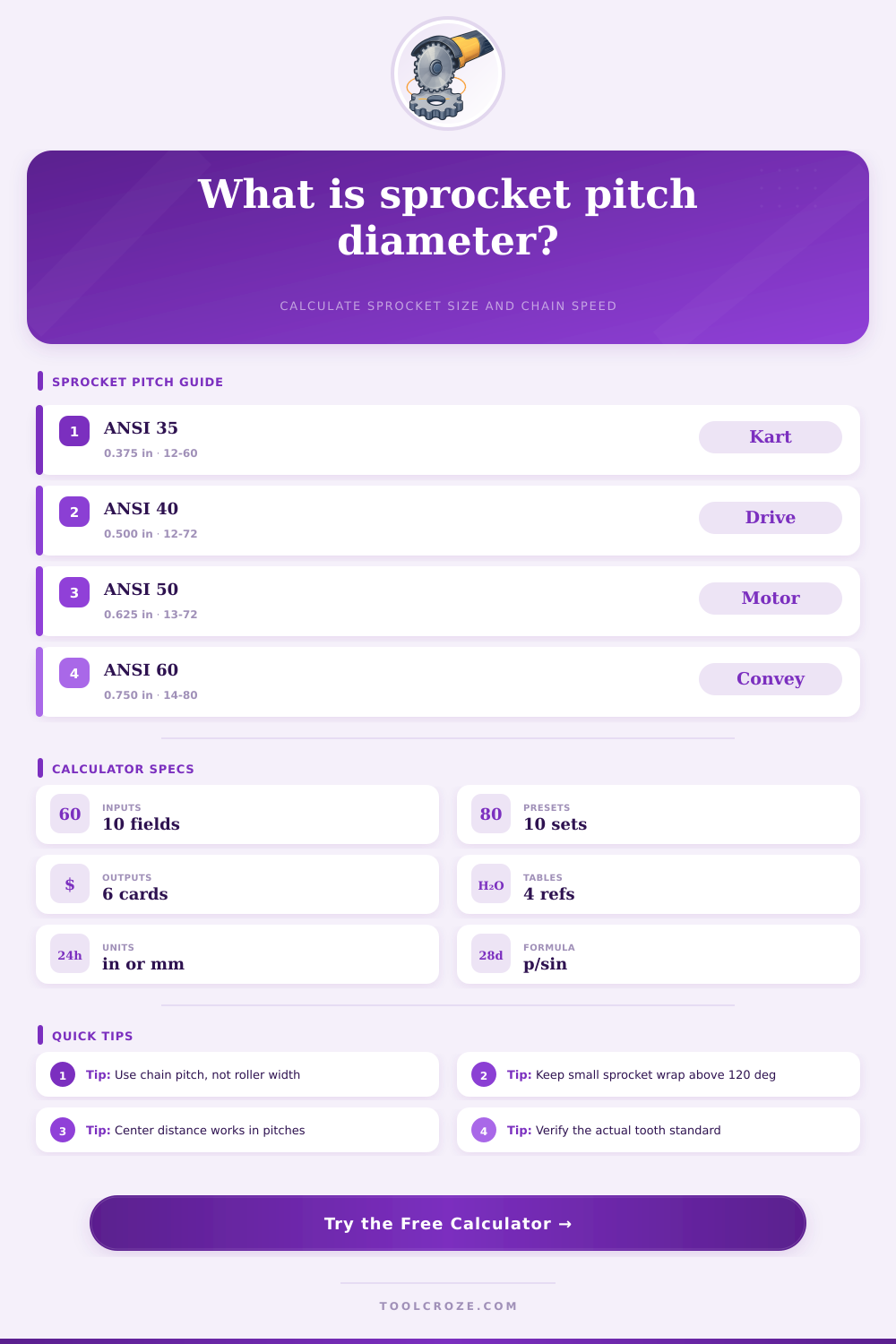
| ANSI 35 | 0.375 in / 9.53 mm | 0.200 in / 5.08 mm | 12 to 60 teeth for kart and light drives |
| ANSI 40 / 08B | 0.500 in / 12.70 mm | 0.312 in / 7.92 mm | 12 to 72 teeth for shop machinery |
| ANSI 50 / 530 | 0.625 in / 15.88 mm | 0.400 in / 10.16 mm | 13 to 72 teeth for higher torque drives |
| ANSI 60 | 0.750 in / 19.05 mm | 0.469 in / 11.91 mm | 14 to 80 teeth for industrial drives |
| ANSI 80 | 1.000 in / 25.40 mm | 0.625 in / 15.88 mm | 15 to 90 teeth for heavy equipment |
| Tooth count | Geometry cue | Practical effect | Typical action |
|---|---|---|---|
| 9 to 11 teeth | Very small pitch polygon | High chordal speed variation and wear | Use only where compact size matters |
| 12 to 14 teeth | Minimum common drive range | Usable, but wrap and lubrication matter | Prefer a larger sprocket for high speed |
| 15 to 23 teeth | General purpose driver range | Good balance of size and smoothness | Common starting point for power drives |
| 24 to 45 teeth | Smoother polygon action | Lower articulation angle per link | Good driven sprocket range |
| 46+ teeth | Large diameter and high wrap | Often limited by clearance and chain length | Check guard and hub clearance |
| Center distance | Pitch cue | Wrap cue | Design note |
|---|---|---|---|
| Under 20 pitches | Tight layout | Can lose small sprocket wrap | Check interference and tension adjustment |
| 20 to 30 pitches | Compact drive | Usually workable | Common for small machines and kart drives |
| 30 to 50 pitches | Preferred starting zone | Good wrap with room for adjustment | Often easiest to align and tension |
| 50 to 80 pitches | Long center distance | Wrap is usually high | Watch sag, vibration, and support span |
| Over 80 pitches | Very long span | Geometry may look fine | Consider guides, idlers, or extra support |
| Chain speed | Drive cue | Risk level | Practical check |
|---|---|---|---|
| Under 500 ft/min | Low speed mechanism | Low geometry speed stress | Focus on alignment and lubrication |
| 500 to 1500 ft/min | Common power transmission | Moderate | Verify tooth count and chain rating |
| 1500 to 2500 ft/min | Fast industrial or vehicle drive | High | Use rated chain data and guarded layout |
| 2500+ ft/min | Very high chain speed | Special design | Confirm manufacturer limits and lubrication |
A sprocket chain drive is a basic way to pass power from one shaft to another. But when you want parts to fit together neatly and not slip or wear each other down early, it’s a geometric exercise. The key reference point of such system is called its pitch diameter. That’s not the outside surface of the teeth, visible to your eye and measurable with a caliper gauge. Rather, it’s the imaginary circle where the chain rollers rest when they engages with the sprocket.
Get that wrong, and all the other dimensions in the drive fail. You’ll have a sagging chain bumping against the frame of your machine. Or a tight chain clashing against the bearings. Once you input the tooth count and chain pitch into the calculator above, it do the math on the trig side so you don’t have to fumble with sine functions at a workbench.
Why Pitch Diameter Matters for Chain Drives
Most folks attempt to take their ruler and simply lay it down on top of sprocket from the inside out. You’ll get your outside diameter there. However, different manufacturers round off their teeth differently, so you’ll get a slightly different result. But that’s not telling you anything about where the chain runs. The pitch line is what matters.
The pitch line are determined by the number of teeth engaged with the chain and distance between the pin centers in the chain itself. Using the same size chain, an eighteen-tooth sprocket has a much tighter pitch circle then a twelve-tooth sprocket. On paper, it looks like a pretty insignificant difference but it alters the form of polygon traced by the chain as it turns. A sharper angle between links means that having fewer teeth lead to more speed variation and stress each time one of those rollers comes into contact with or exits a tooth.
Mechanical vibration acts like noise. For drivetrain longevity, generally speaking you want your driver sprocket to have at least twelve teeth. Use the calculator to view the effect of that decision on your build plan. By adjusting the tooth count of the driven sprocket, yes, you adjust gear ratio, but also wrap angle. That’s how many degrees of contact the chain has with smaller sprocket. If the angle gets down to less than one hundred and twenty degrees, the chain doesn’t get good grip on sufficient teeth to hold torque well. Under load it’ll start skipping.
The solution is to add an idler pulley or move the shafts farther apart. Either solution make for a more complex system in what ought of be a simple system. The other headache-causing variable on install is center distance. Adding the diameters does not equals the math for chain length. It factors the straight runs between centers plus the arc of engagement around each sprocket. When you run the first calc, you are unlikely to end up with an even number of pitches. You can’t buy a half link or a quarter pitch.
So you round up to the next highest even number of pitches. Then you compensate by adjusting your center distance slightly to pick up any slack. That’s where adjustable mounts comes into play so much on real builds. On rigid frames there is zero margin for error. Your initial geometry must be perfect before bolting anything down.
Here, material selection is a quieter player. Standard roller chains will wear at different rates against cast iron or steel sprockets, but the geometry are the same. It doesn’t matter if the sprocket teeth are in cast iron or steel; all the calculator cares about is the number of teeth and their distance from each other, i.e. This is the pitch diameter. That said, heavy loads do care about how wear happens. For applications with shock loads such as farm equipment or a go-kart with lots of horsepower being put to the drive, you want to respect the smaller sprockets’ limitations even more.
These conditions are built into the calculator itself, flagging when a setup may be pushing against its physical limits. At a quick glance, chain drives look alike and is easy to treat like interchangeable parts. But they’re not. A half-inch pitch chain running on a motorcycle goes very fast and under high stress, quite different than one on a conveyor belt spinning fifty times a minute. Not only do you need the right size gears for the chain, but also the right speed. Better alignment, better lubrication, and smoother sprockets is necessary.
These elements become even more important as the chain moves faster. Keeping that motion controlled begins with getting the pitch diameter right. It’s the first step in learning how to design around the invisible circle instead of struggling against it. Then the geometry makes sense and the drive holds together where it belongs.