Perforated Sheet Open Area Calculator
Estimate percent open area, active perforated area, solid sheet weight, remaining weight, and a practical airflow cue from hole size, pitch, pattern, margins, and material.
Perforated sheet results
Calculation breakdown
| Perforation | Pattern | Typical open area | Common use |
|---|---|---|---|
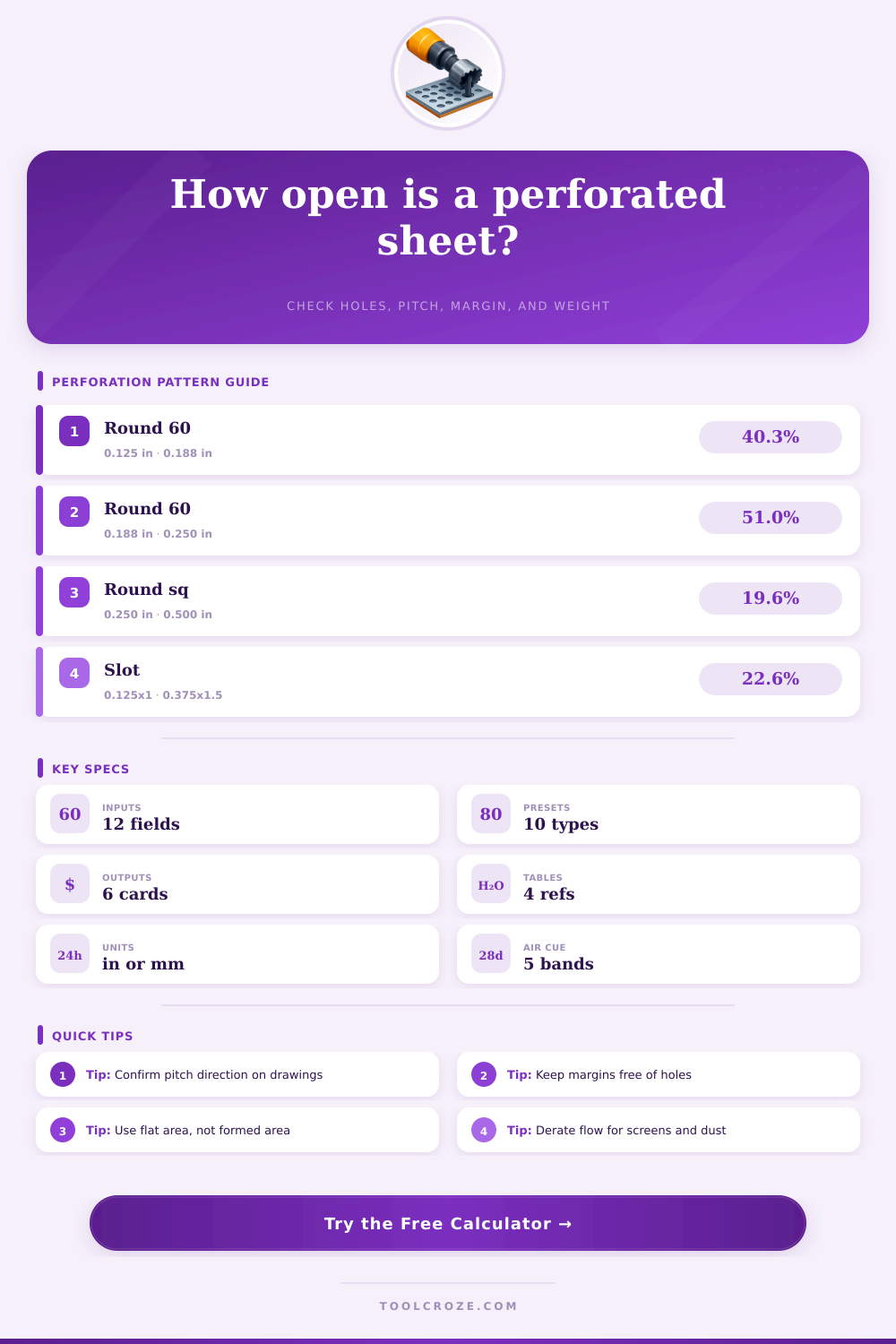
| 1/8 in holes on 3/16 in stagger | 60° round | about 40% | Speaker grilles, small guards |
| 3/16 in holes on 1/4 in stagger | 60° round | about 51% | Air intake panels, machine covers |
| 1/4 in holes on 3/8 in stagger | 60° round | about 40% | General ventilation and screening |
| 1/4 in holes on 1/2 in straight | Straight round | about 20% | Decorative panels and guards |
| 1/8 x 1 in slots on 3/8 x 1.5 in pitch | Obround slot | about 23% | Cabinet vents and drains |
| Hole type | Hole area formula | Pitch cell formula | Open area percent |
|---|---|---|---|
| Round hole | π x D² / 4 | Pitch X x Pitch Y | Hole area / cell area x 100 |
| Obround slot | (L - W) x W + π x W² / 4 | Pitch X x Pitch Y | Slot area / cell area x 100 |
| Sheet effective open | Open area percent x usable field | (L - 2M) x (W - 2M) | Open area / full sheet area x 100 |
| Remaining weight | Base weight - removed weight | Area x thickness x density | Base weight x solid fraction |
| Material | Density | Perforation note | Typical application |
|---|---|---|---|
| Mild steel | 0.283 lb/in³ | Good general punching behavior | Machine guards, panels |
| 304 stainless | 0.289 lb/in³ | Higher force, watch burrs | Food, chemical, exterior |
| 5052 aluminum | 0.097 lb/in³ | Light, easy to form | Vents, transport panels |
| Galvanized steel | 0.283 lb/in³ | Protect coating at cut edges | HVAC and outdoor grilles |
| Brass | 0.307 lb/in³ | Decorative, softer ligaments | Architectural screens |
| Polycarbonate | 0.043 lb/in³ | Use clean support to avoid cracking | Clear guards and covers |
| Effective open area | Flow cue | Common result | Design note |
|---|---|---|---|
| Under 10% | Very restrictive | Pressure drop can dominate | Use only when strength or shielding matters more than flow |
| 10% to 20% | Restrictive | Works for modest vents | Increase panel area when fans are close |
| 20% to 35% | Moderate | Common balance for guards | Check dust screens and filters separately |
| 35% to 50% | Good flow | Useful for intakes and returns | Verify ligament strength and flatness |
| Above 50% | High free area | Very open grille behavior | May need thicker sheet or frame support |
At first glance, perforated sheets seem like straightforward industrial products, but each design choice impact look, cost, strength and airflow. In order for the sheet to perform correctly you need the right amount of open area. Too much and you might compromise structure or air flow; too little and maybe your fans won’t perform well.
But first, we need to know what ‘open area’ means. And it’s not what you think. Open Area isn’t just how many holes are illustrated in a drawing. Rather, it is a calculation that compares empty space to the repeated cell defined by centers of all the hole. The diagram below illustrates this concept as an example.
Why Open Area Matters for Perforated Sheets
When a hole is round and on a 60 degree staggered pattern (left), the row spacing is different than when that same hole was on a straight grid (right). Although both use the same hole diameter, the resulting open area will be significently different: shifting from 40 percent to 51 percent. This happens without changing size of the hole itself.
These kinds of relationship are handled by a calculator so you don’t have to guess, but rather run some quick test. But margins is important and far more important than most designers care to acknowledge. Those blank, boring frames surrounding all edges make the entire sheet lie flat when it’s punched out and allow it to be clamped together or welded. But each additional inch of margin also shrinks overall open area of the entire sheet. If you have a 24 by 48 inch panel with a healthy half inch margin, that’s nearly ten percent less usable breathing space.
The trade-off happens immediately, and the tool shows you what you have designed while keeping you connected to it. Choosing the material makes things even harder. All materials don’t punch out the same way (or weigh the same). A 5052 aluminum sheet is lighter then both mild steel and 304 stainless sheets. When hanging a light venting panel or a perforated guard above your head, seemingly insignificant weight can mean a lot. You know exactly how much you’re going to lift or secure once it’s been punched.
Reality vs. The theory are about airflow. A 35 percent open panel sounds great until you realize that adding a mesh filter reduce it. Dust on the filter reduces it even more. Mounting the sheet behind a louver reduce it even further. Derating the fan provides a way to handle those real-world penalties and make the airflow estimate match what the fan curve will actualy encounter. View the estimate as guidance not absolute truth. When the application is critical nothing can replace an actual pressure-drop test.
Projects tend to repeat common errors. Some designers confuses row spacing with the triangular center-to-center distance (which throws all calculations off). Some forget that the open area formula does not account for flat sheet. It accounts for a shape that will later be formed into a box or some other kind of curve. There’s also ligament width between holes to worry about. If the ligament width gets too small… Below the sheet thickness, then you’re likely going to get tearing/distortion, no matter what your open area percentage look like.
Each slot pattern has its own set of rules. For example, an obround vent may be great for acoustic performance or drainage, but the effective open area change dramatically if you rotate the long dimension relative to airflow. You can input either a round or slot pattern and switch back and forth to compare options. No need to use more than one spreadsheet.
Bottom line: The math’s only half the story. Even a dead-on 42 percent open panel might not work. It depends on whether the sheet will be loaded enough to require an adequate edge distance, or if the resulting burr would break the guard safety rules for your machine. Run the numbers, test the ligaments, and then think about how the sheet will perform in real-world use. It’s this well-balanced perspective, not simply the number, that makes the difference between a design that works and something that only looks good on paper.