Springback Angle Calculator
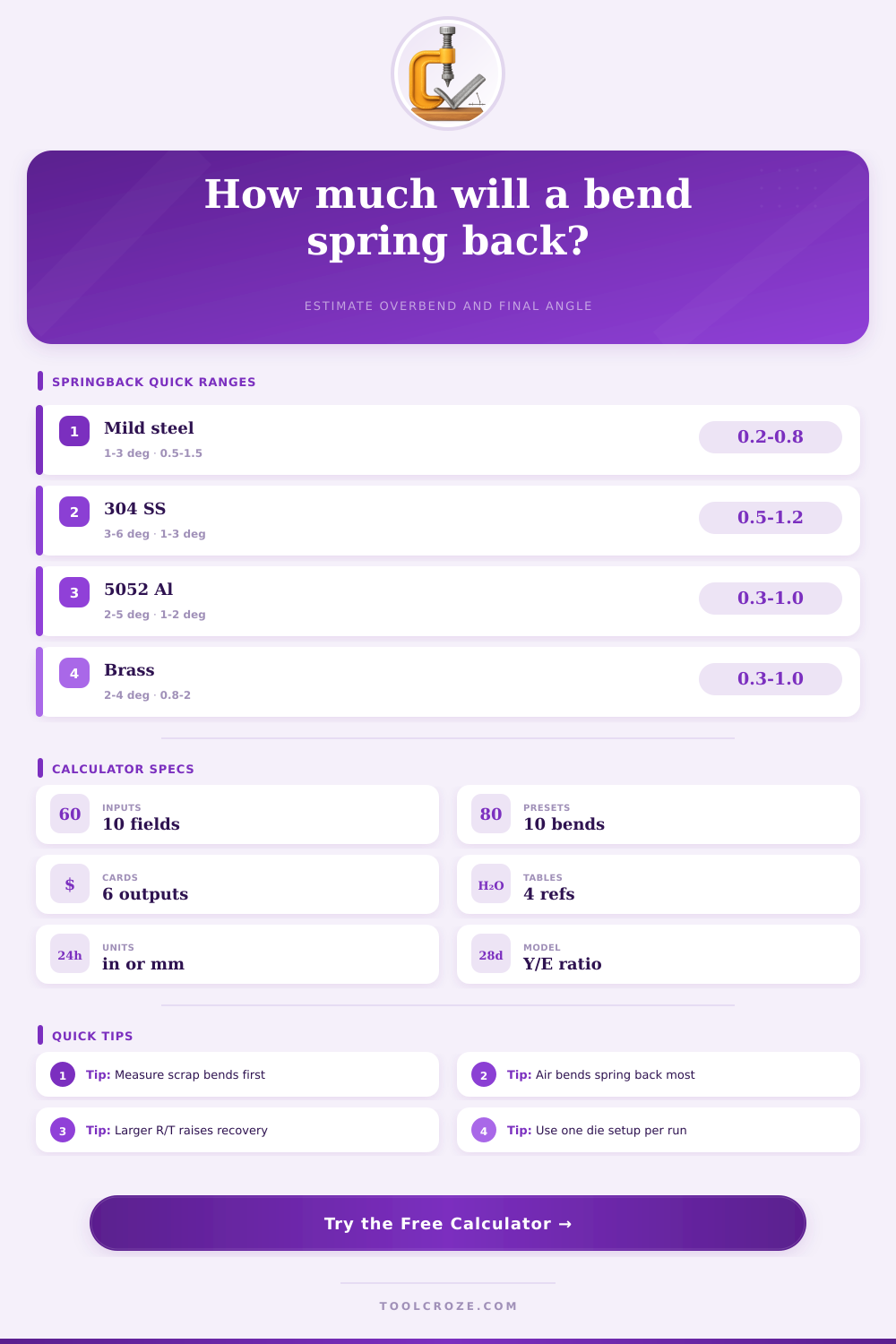
Estimate sheet metal springback, required overbend, press brake set angle, final angle error, and R/T bend severity from material modulus, yield strength, thickness, radius, die opening, and forming method.
Springback and overbend results
Calculation breakdown
| Material | Typical modulus | Typical yield | Common springback note |
|---|---|---|---|
| Mild steel, low carbon | 29,000 ksi / 200 GPa | 30-45 ksi / 205-310 MPa | Often 1-3 deg in air bending near 90 deg. |
| HSLA steel | 29,000 ksi / 200 GPa | 50-80 ksi / 345-550 MPa | Needs more overbend than low carbon steel. |
| 304 stainless steel | 28,000 ksi / 193 GPa | 35-75 ksi / 240-515 MPa | Work hardening and high yield raise recovery. |
| 5052-H32 aluminum | 10,200 ksi / 70 GPa | 28-32 ksi / 190-220 MPa | Lower modulus makes springback noticeable. |
| 6061-T6 aluminum | 10,000 ksi / 69 GPa | 35-45 ksi / 240-310 MPa | Use generous radius to reduce cracking risk. |
| Copper and cartridge brass | 15,000-17,000 ksi / 103-117 GPa | 10-45 ksi / 70-310 MPa | Temper changes springback more than alloy name. |
Values are practical shop ranges. Use certified material properties and coupon bends for production offsets.
| Bend method | Springback tendency | Best use | Calculator factor |
|---|---|---|---|
| Air bending | Highest | Flexible angles, lower tonnage | 1.00 baseline |
| Bottom bending | Medium-low | Repeatable 90 deg bends with matched tooling | About 45% of air |
| Coining | Lowest | Tight angle control where tonnage is available | About 18% of air |
| Wiping or edge forming | Medium-high | Flanges, hems, and edge bends | About 65% of air |
| Rotary bending | Medium-low | Cosmetic flanges and reduced marking | About 35% of air |
| Die opening ratio | Typical use | Springback effect | Shop note |
|---|---|---|---|
| 5-6 x thickness | Sharp or small radius work | Lower radius effect, higher tonnage | Watch cracking and marking. |
| 7-8 x thickness | Common mild steel air bends | Balanced repeatability | Good first-pass setup for many 90 deg bends. |
| 10-12 x thickness | Stainless or aluminum | More radius, more recovery | Often needs extra overbend. |
| 14-16 x thickness | Large-radius forming | High springback sensitivity | Use test coupons and staged angles. |
| Symptom | Likely cause | Adjustment | Check before run |
|---|---|---|---|
| Part opens too far | Underestimated springback | Add overbend or reduce set angle | Measure a same-grain coupon. |
| Part closes too tight | Too much overbend | Reduce overbend in 0.2-0.5 deg steps | Confirm angle gauge zero. |
| Angles drift through batch | Material or tooling variation | Increase checks and sort stock | Track heat, thickness, and grain. |
| Cracks outside bend | Radius too small for temper | Increase inside radius or anneal if allowed | Compare R/T to material spec. |
Before even starting production, springback can wreck a setup. You adjust right angle on your press brake and as soon as you let go of ram, that sucker opens back up. The part bounce back and misses its tolerances. Instead of dealing with it after-the-fact, shops employ a springback angle calculator to predict the problem.
As you remove the bending force from a piece of metal, it will try to spring back into its previous flat state. How much it do depends on how far out of its “yield point” you took it when bending it. If a material’s yield strength is relatively high compared to its stiffness, then it resist being deformed, which means you need more overbend (springback) than if it had lower resistance. This is why stainless steels and other higher-strength alloys takes a greater overbend than mild steels.
How to Calculate Springback
The calculator uses your measured yield value, modulus, and the geometry of your bends in that equation. Springback is affected quite a bit by thickness and inside radius. Springback will be higher on a thin sheet with a tighter radius. This is because it puts more stretch on the outside fibers which raises elastic ratio and increases springback. Also, you can use a larger radius without relaxing as much of same alloy. The tool accounts for this R/T ratio and will alert you if you risk cracking in setting up.
Air bending also takes into account die opening. A wider V-die means a greater naturaly radius. This alters springback amount. The model factors all of this together so you don’t have to guess what will happen.
How much does it recover? And that’s where the bend method comes into play. When you bottom (coin) the part to close the gap between the die corner and material, you eliminate some of the springback by plastically deforming it. With air bending, the metal contact the punch only at the center. This give it the ability to have the greatest springback. That’s why the calculator has an internal factor to account for that difference.
Depending on which method you choose, coin or air bend; your input values could result in a swing of a few degree. Rotary and wiping bends lies somewhere in between those two types. It takes operators time to get used to how each will behave.
In the world of real metal there are variables that math doesn’t cover. Your shop temperature, previous cold working, grain direction, and thickness variation can all change things. Best bet is to cut out a coupon from the same sheet you intend to run through the process. Use the same tooling as intended, measure it and then see what happens. It’s a start and using the calculator will help you waste fewer test bend.
To get successful results, make it a habit to change only one variable at a time when running the test and production parts. Once you set your overbend, do not change it. You cannot then go back and alter the lubrication, radius, or even die opening and expect past numbers to hold true. Parts will fits right each time if they are consistent.
Instead of fighting springback, accept that this is a known quantity. Enter your floor numbers honestly into the calculator. Use its results as guidance and double-check against your real steel. That way, springback becomes one more manageable variable in your workflow, along with punch angle and tonnage. Relax the bend; you should of didnt lose control of the process.