Sheet Metal Shear Force Calculator
Estimate guillotine shear peak load from cut length, thickness, material shear strength, rake angle, blade clearance, hold-down factor, and machine tonnage.
Shear Load Results
| Material | Typical shear strength | Clearance range | Notes |
|---|---|---|---|
| Mild steel, low carbon | 280-340 MPa | 7-10% of thickness | Baseline for shop shears |
| Galvanized sheet | 260-330 MPa | 7-10% of thickness | Watch coating burr and flake |
| 304 stainless steel | 480-560 MPa | 8-12% of thickness | High load, work hardens |
| Aluminum 5052-H32 | 120-150 MPa | 6-8% of thickness | Common formed sheet |
| Aluminum 6061-T6 | 200-230 MPa | 6-10% of thickness | Stronger, less forgiving |
| Copper C110 | 170-220 MPa | 5-8% of thickness | Soft but can smear |
| Cartridge brass | 260-330 MPa | 5-8% of thickness | Clean cuts with sharp blades |
| Spring steel shim | 650-900 MPa | 8-12% of thickness | Small thickness, high stress |
| Setup item | Light sheet | General sheet | Thick or hard sheet |
|---|---|---|---|
| Blade clearance per side | 4-6% thickness | 7-10% thickness | 10-14% thickness |
| Common rake angle | 0.5-1.0 degrees | 1.0-1.5 degrees | 1.5-3.0 degrees |
| Hold-down force estimate | 8-12% of cut load | 12-18% of cut load | 18-25% of cut load |
| Reserve factor | 5-10% | 10-15% | 15-30% |
| Job | Material and thickness | Typical cut length | Machine note |
|---|---|---|---|
| HVAC duct blank | Galvanized 20 ga | 36-60 in | Light force, burr check |
| Cabinet side panel | Mild steel 16 ga | 48 in | Common 50 ton class job |
| Restaurant backsplash | 304 stainless 18 ga | 48-96 in | High peak force for gauge |
| Trailer skin | 5052 aluminum 0.063 in | 72-120 in | Long cut, low force |
| Nameplate blanks | Brass 0.032 in | 12-24 in | Sharp blade for clean edge |
| Base plate strip | Mild steel 1/8 in | 24-48 in | Check tonnage and hold-down |
| Gauge or plate | Steel thickness | Aluminum thickness | Use in calculator |
|---|---|---|---|
| 20 ga | 0.036 in / 0.91 mm | 0.032 in / 0.81 mm | Light panels |
| 18 ga | 0.048 in / 1.21 mm | 0.040 in / 1.02 mm | Covers, backsplashes |
| 16 ga | 0.060 in / 1.52 mm | 0.051 in / 1.29 mm | Cabinet sheet |
| 14 ga | 0.075 in / 1.90 mm | 0.064 in / 1.63 mm | Heavy sheet |
| 11 ga | 0.120 in / 3.04 mm | 0.091 in / 2.30 mm | Light plate |
| 1/8 plate | 0.125 in / 3.18 mm | 0.125 in / 3.18 mm | Plate capacity check |
You don’t know until you start running a long run of 16-gauge steel and hear the blade grinding into material and your machine groaning to make that happen. That’s when you know you are at max force in a single shot, which can damages both the blade and part being twisted off if you are not using the right rated equipment.
Knowing what generates that load turns guesswork into planning. A tool that predicts the required tonnage and margin help with this when working with leftover scrap piece.
Why Use a Shearing Calculator?
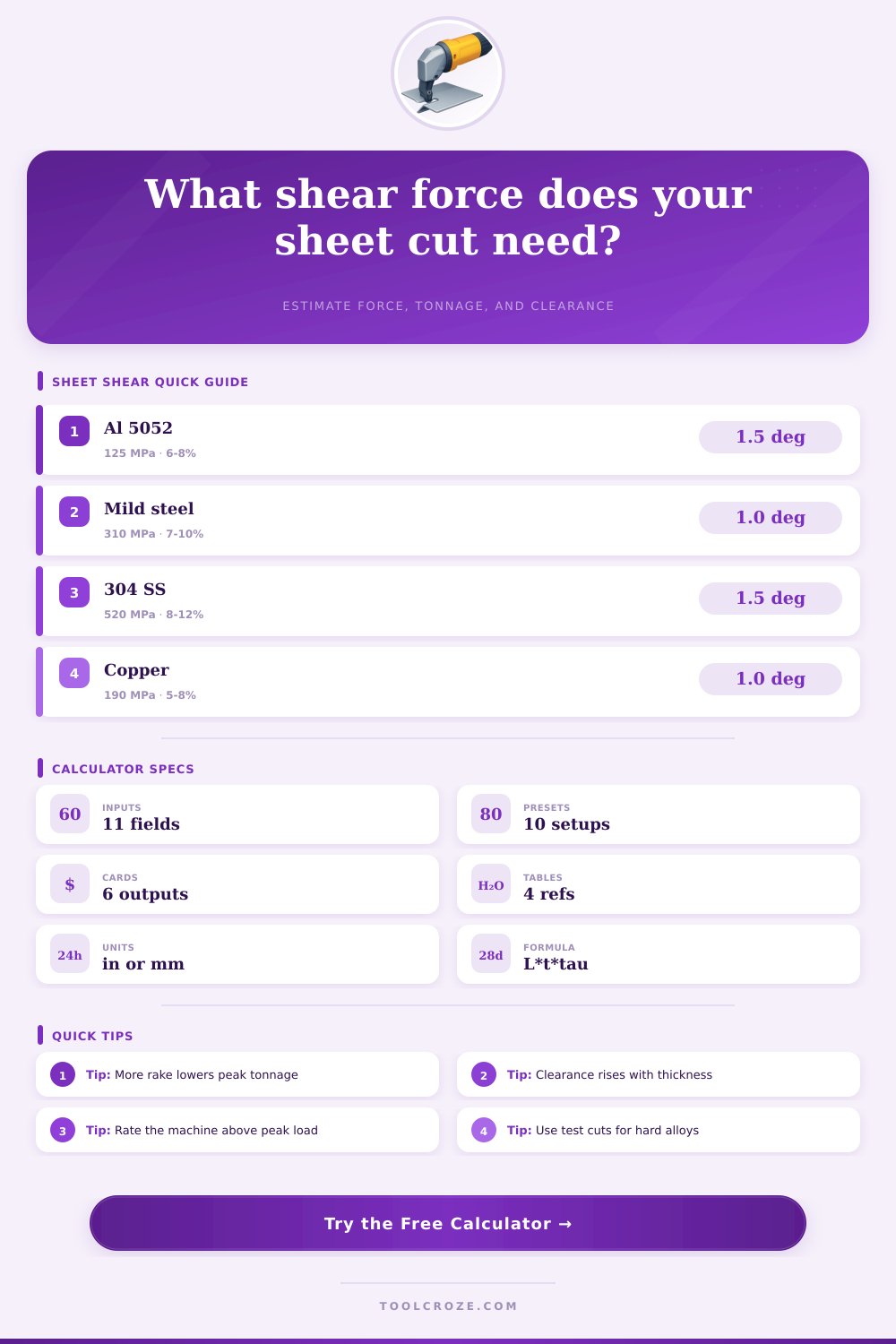
There is three basic facts about shearing sheet metal: the blade has to contact it for some period of time; there’s no getting around material thickness (the area being severed grows with it); and resistance of the metal to slicing also factor in. Obviously, a four-foot cut require more pushing power then a single-foot-long notch. Thickness contributes proportionally too, as the area being severed grow linearly with it. Then there’s the multiplier effect of material strength, which everyone underestimates. Mild steel is 310 MPa, while 304 stainless is closer to 520 MPa, and aluminum is even lower.
Once those numbers are fed into calculator, it multiplies them out for you. But really seeing where such slight changes ripple into impact is the point. One useful lever is rake angle. One of the most practical levers you have is rake angle, which is how much you tilt the top blade so that it meets the sheet gradualy, thus reducing the instantaneous load. That’s why they is usually set between half a degree and three degrees (most shop shears) for a good reason.
There is also some logic to the clearance between blades. Too little gap means you increase force and gall the edges, too great a gap and you get all kinds of rollover and rough cuts. For most alloy, the sweet spot is between 6 and 12 percent of thickness. Harder metals requires a bit more clearance to prevent work hardening at edge.
The often-forgotten cousin in this equation are hold-down force; the sheet will shift or lift if there isn’t enough clamping pressure. The calculator shows this as a percentage of the cutting force so you can make sure your machine’s clamps is strong enough for the job.
It also adds another wrinkle for stack cutting. Each additional layer increases total thickness, raising force more than you might expect if sheets aren’t exactly flat against one another. At least, those are the numbers that matter most in practice. This is especially true if you’re looking at a machine that’s been in shop for two decades and lost its original capacity chart.
You should of not want to find out the hard way that your 50-ton shear at max capacity barely handles 10-gauge stainless at full length. So you apply a safety factor and see how much margin there is, that give you confidence before committing to a production run.
Test cuts on scrap are still irreplaceable, especially if you have an unfamiliar alloy, or it’s a lot of cold-worked material that might not match published shear strengths. And blade sharpness is part of the equation, a new edge can reduce needed force by as much as 10-15% versus a dull edge. A lot of shops runs their blades too long.
If you combine that with realistic tonnage margins and correct clearance and rake, you are working with the material instead of fighting it. Fewer headaches, longer tooling life, cleaner parts; it’s the difference that shows up at the end of the day.
Numbers don’t replace experience; they simply substitute risky guesswork with educated decision-making. You’ll know the math is on your side when there’s no more violent bang, just a smooth, even shear cut. That’s the difference between breaking a machine and meeting quota in a hectic shop.