Press Brake Tonnage Calculator
Estimate air bend, bottoming, or coining force from material thickness, bend length, tensile strength, V-die opening, inside radius, method factor, and machine capacity.
Press brake tonnage results
Formula breakdown
| Material | Typical tensile | Recommended V/t | Air bend factor |
|---|---|---|---|
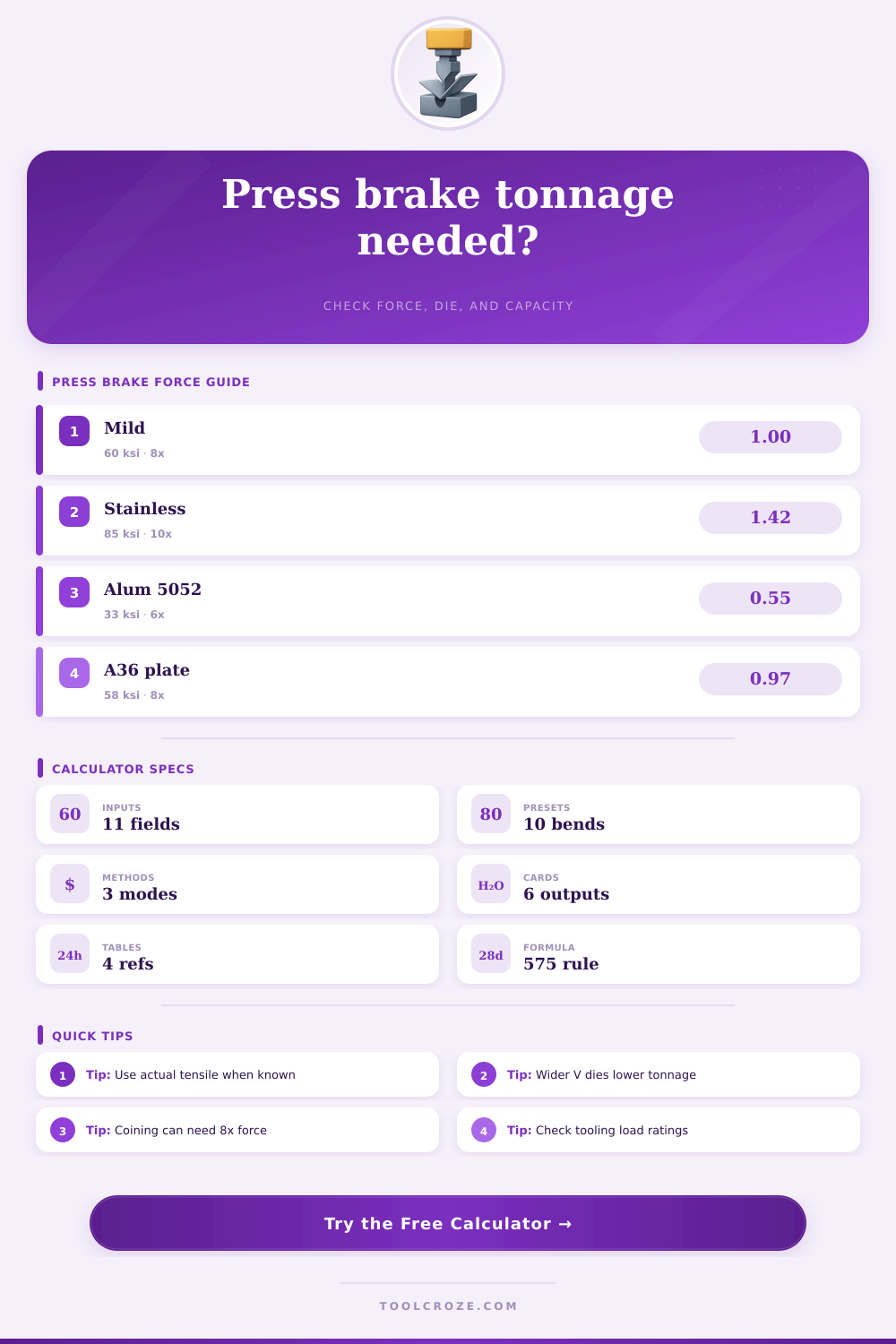
| Mild steel sheet | 60 ksi / 414 MPa | 8 x thickness | 1.00 |
| A36 plate | 58 ksi / 400 MPa | 8 x thickness | 0.97 |
| Galvanized steel | 62 ksi / 427 MPa | 8 x thickness | 1.03 |
| 304 stainless | 85 ksi / 586 MPa | 10 x thickness | 1.42 |
| 316 stainless | 90 ksi / 621 MPa | 10 x thickness | 1.50 |
| 5052-H32 aluminum | 33 ksi / 228 MPa | 6 x thickness | 0.55 |
| 6061-T6 aluminum | 45 ksi / 310 MPa | 8 x thickness | 0.75 |
| C110 copper | 32 ksi / 221 MPa | 6 x thickness | 0.53 |
| Method | Typical factor | Best fit | Calculation note |
|---|---|---|---|
| Air bending | 1.0 x | Most sheet metal bends | Force varies strongly with V opening |
| Bottoming | 3.0 to 5.0 x | Tighter repeatability | Calculator default uses 4.0 x |
| Coining | 5.0 to 10.0 x | Sharp, set radius bends | Calculator default uses 8.0 x |
| Custom | User entered | Known tooling data | Use tooling supplier limits when available |
| Thickness range | Mild steel V | Stainless V | Aluminum V |
|---|---|---|---|
| 22 to 16 gauge | 6 to 8 x t | 8 to 10 x t | 6 x t |
| 14 to 10 gauge | 8 x t | 10 x t | 6 to 8 x t |
| 1/8 to 3/16 in | 8 x t | 10 to 12 x t | 8 x t |
| 1/4 in and thicker | 8 to 10 x t | 10 to 12 x t | 8 to 10 x t |
| Scenario | Material | Typical setup | Watch item |
|---|---|---|---|
| Cabinet panel flange | 18 ga mild steel | 0.375 in V, air bend | Long bend length |
| Stainless splash guard | 16 ga 304 | 0.625 in V, air bend | High tensile factor |
| Aluminum enclosure | 0.125 in 5052 | 0.750 in V, air bend | Crack radius |
| Structural bracket | 0.250 in A36 | 2.000 in V, air bend | Total machine tons |
| Bottomed cover bend | 10 ga galvanized | 0.875 in V, bottoming | Method factor |
The tonnage calculation for a press brake ensures that you don’t break your tools or your machine. Simply enter information regarding the bend, metal, and press into the calculator found here and it will tell you how much force is necessary. There’s no more guessing so you know exactly what to expect when getting started.
The two main factors that go into all these calculations are material thickness and tensile strength. It takes more force to bend a piece made out of 304 stainless steel then one made from mild steel, even if they have an equal thickness. Because stainless is stronger it multiplies the amount of force needed to do this. When you choose a grade on the calculator it will load your starting point accordingaly. If you switch to aluminum it’s going to reduce the tonnage considerbly which might mean you can use a smaller machine or release some larger ones back for additional work.
How to Calculate Press Brake Tonnage
The die opening is frequently misjudged. A V-opening that’s too small will cause increased tonnage and danger of cracking the outside of the bend. An opening that’s too large impair accuracy. Some references provide formulas such as: Use 8x material thickness for mild steel; use 10x for stainless; use 6x for soft aluminum. That’s a starting point. Use the calculator to experiment with variations to find a balance between finish quality, springback, and amount of force required.
The more bend length, the greater the tonnage will be. For example, running that same profile for an eight-foot width instead of a four-foot flange means you is staring at double the load. In addition to showing the total load, tool shows you the tons per foot so that you can determine if your job will fit on a 175-ton machine or if you need a bigger 400-ton press.
Force required is a function of bending method. Floating material between the die and punch for an air bend requires minimal force. Bottoming out sets precisely at the desired angle and therefore needs more pressure. Coining the metal so it’s squashed into the die demands as much as 8x more load than air bending. Until the machine fights back, most operators don’t expect that multiplier. When you choose the style of forming, the calculator will use proper factor.
The inside radius impacts the force calculation. The closer you are to 0, the tighter the radius and the harder it will be on your material compared to a larger radius. The calculator accounts for that difference between theory and real life. Want some cushion before the press is at full tilt? Set safety margin as well.
The above is a tool that applies factors and rules of thumb. They are not replacements for field knowledge. Real world outcomes may vary based off shop temperatures, tooling ratings, grain direction, and work hardening. They are not replacements for field knowledge. Real world outcomes may vary based off shop temperatures, tooling ratings, grain direction, and work hardening. But having a solid reference point will keep us from making the two most frequent mistakes.
We either underuse and damage our dies or overuse and strand huge presses just because we think “it takes this much.” Using these final figures will help you take care of yourself, the tooling, and the machines. You should of used them to stay safe. Plug in the specifics of your job, run through the math and use your best judgment. It’s going to make the whole bending process safer and more predictable.