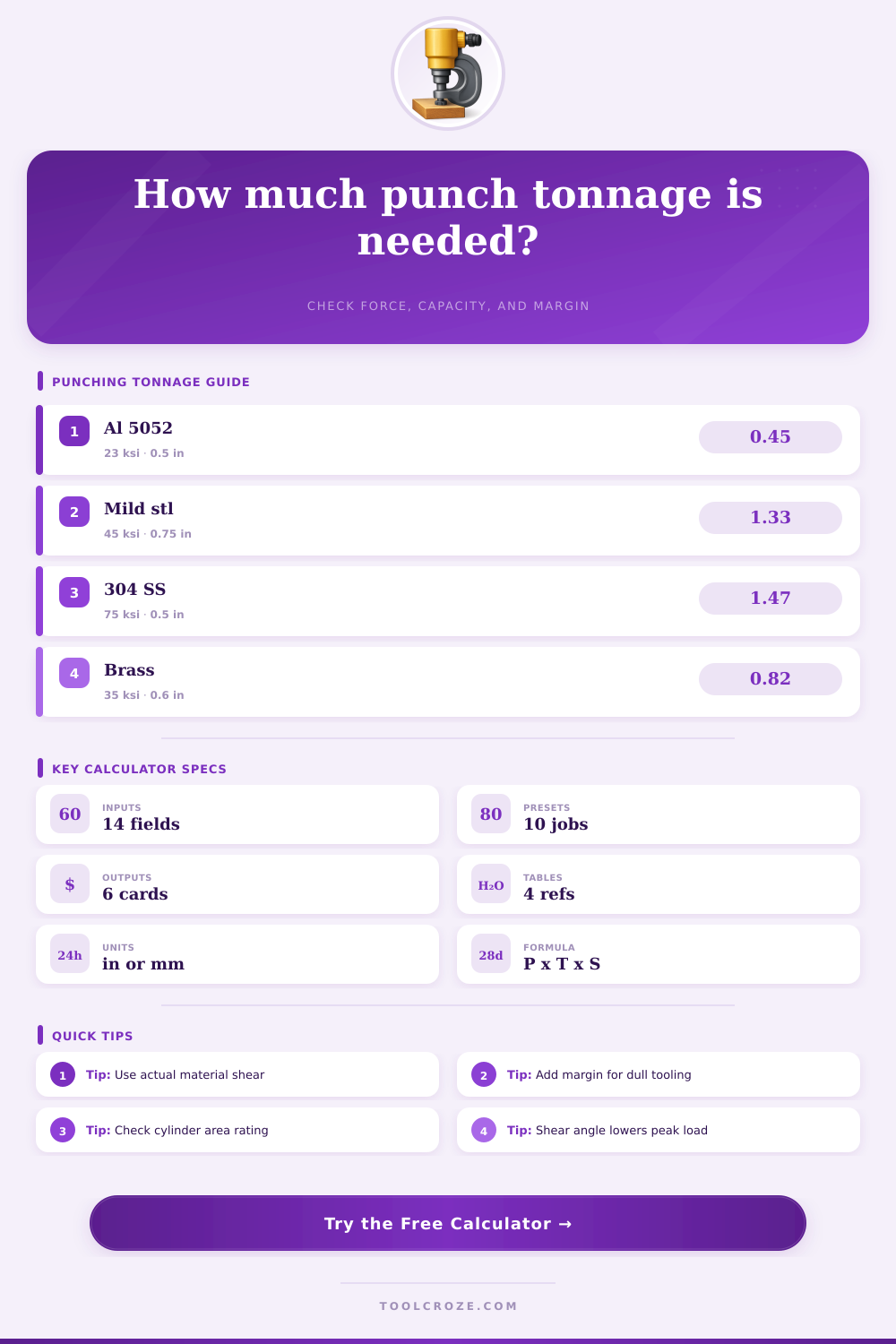
Hydraulic Punch Tonnage Calculator
Estimate required punching tonnage from hole perimeter, material thickness, shear strength, stripper load, punch shear angle, cylinder area, hydraulic pressure, and operating margin.
Hydraulic Punching Results
Calculation Breakdown
| Material | Typical shear strength | Clearance per side | Punching note |
|---|---|---|---|
| 5052 aluminum sheet | 22-24 ksi / 150-165 MPa | 4-6% thickness | Low force, watch burr on soft temper |
| 6061-T6 aluminum | 30-32 ksi / 205-220 MPa | 5-7% thickness | Higher shear than 5052 |
| Mild steel | 42-48 ksi / 290-330 MPa | 6-8% thickness | Common baseline for shop estimates |
| Galvanized sheet | 45-50 ksi / 310-345 MPa | 6-8% thickness | Coating can raise stripping load |
| 304 stainless | 70-80 ksi / 480-550 MPa | 8-12% thickness | High force and rapid tool wear |
| 260 brass | 34-38 ksi / 235-260 MPa | 5-7% thickness | Crisp punching with proper clearance |
| 110 copper | 24-28 ksi / 165-190 MPa | 4-6% thickness | Ductile material may need more stripping |
| Annealed tool steel | 80-95 ksi / 550-655 MPa | 8-12% thickness | Confirm press and die rating first |
| Shape | Input fields used | Perimeter formula | Best use |
|---|---|---|---|
| Round | Diameter | π x diameter | Standard round punches and knockouts |
| Square | Width / side | 4 x side | Square panel holes and tabs |
| Rectangle | Width and length | 2 x (width + length) | Connector windows and slots with corners |
| Obround slot | Diameter and straight length | π x diameter + 2 x straight | Mounting slots with radiused ends |
| Custom | Custom perimeter | Measured developed edge length | Irregular punches and nibble profiles |
| Cylinder bore | Area | Capacity at 2500 psi | Capacity at 3000 psi |
|---|---|---|---|
| 3 in bore | 7.07 in² | 8.8 short tons | 10.6 short tons |
| 4 in bore | 12.57 in² | 15.7 short tons | 18.9 short tons |
| 5 in bore | 19.63 in² | 24.5 short tons | 29.5 short tons |
| 6 in bore | 28.27 in² | 35.3 short tons | 42.4 short tons |
| 8 in bore | 50.27 in² | 62.8 short tons | 75.4 short tons |
| Condition | Suggested factor | Why it matters | Calculator field |
|---|---|---|---|
| Sharp punch, light sheet | 0-10% margin | Close to theoretical tonnage | Tonnage margin |
| Normal shop production | 15-25% margin | Covers material variance and wear | Tonnage margin |
| Dull punch or heavy burr | 25-35% margin | Peak load rises quickly | Tonnage margin |
| Sticky metals or coatings | 10-20% stripper | Withdrawal force can be significant | Stripper factor |
| Angled punch face | 1-5 degrees | Reduces peak load over the stroke | Punch shear angle |
How much pressure will it take? Depending on the material (shear strength), sheet thickness, cut length, hydraulic punch tonnage is the difference between running a job smoothly vs. It can result in an expensive repair bill. To protect tooling, you must knows the amount of force needed for each cut.
Diameter doesn’t matter as much as perimeter: An inch-diameter hole require more than three inches of cutting surface. Double that size, and circumference goes up a lot, possibly requiring a bigger press. Going from 15-ton to higher-capacity machine can be a difference of just a few sizes.
How to Choose the Right Punch Press Tonnage
Theory and the real world are separated by material shear strength. For mild steel it is roughly 45,000 pounds per square inch. For 304 stainless steel it is more than 75,000. That tells you what kind of hydraulics you need for your punch set up. Supplier batches will differ so use certifiable data on the materials, not some generalized number from a handbook. Getting that wrong means that your punches won’t break through cleanly or will have burrs you didn’t expect.
Thickness isn’t a simple linear multiplier; it is its own factor. The thicker the material, the greater stripping force, and many times the punch won’t let go of coated galvanized steel as easy as it will from light aluminum. Sticky materials can give the same pulling power in the withdrawal direction as they do while cutting. If you don’t take that into consideration, you may have observe the ram pause on its way back up.
Adding a punch shear angle spreads the cutting action over a distance and lowers peak tonnage. Angling the face by a few degrees reduce the required force from twenty to forty percent. This means you can get away with using a smaller machine but there’s increased side thrust on the tooling. And you’ll have a slightly bigger burr on one side of hole. In most cases that’s an acceptable trade-off for production work.
The amount of pressure you have available and the diameter of your cylinder bore determine how much force you can get out per shot. If you gang-punch more than one punch at once, it multiplies by the number of holes being punched with each hit. What was safe on one might not be safe then the other.
Four punches or six? Rush jobs? Material variation? Dulling tools? Plan for all this. Give yourself some breathing room which will protect your machine in high volume runs.
Don’t confuse shear strength with tensile strength. Sharp tools don’t remain sharp; therefore, punch wear result in increased tonnage requirements. Because the process becomes dynamic in a productive environment, build a reasonable margin into the equation. Respect the machines personality. It’s not conservatism; it’s respect for the machine. Protect your schedule, press and tooling by calculating this stuff. Run the numbers and know what each variable means. You should of use these guidelines to ensure quiet running presses that make nice holes.