Quick Clamp Force Calculator
Estimate one-handed clamp load from handle squeeze force, lever ratio, ratchet pitch, jaw pad area, rail friction, rated clamp class, workpiece sensitivity, and safety factor.
Quick clamp force results
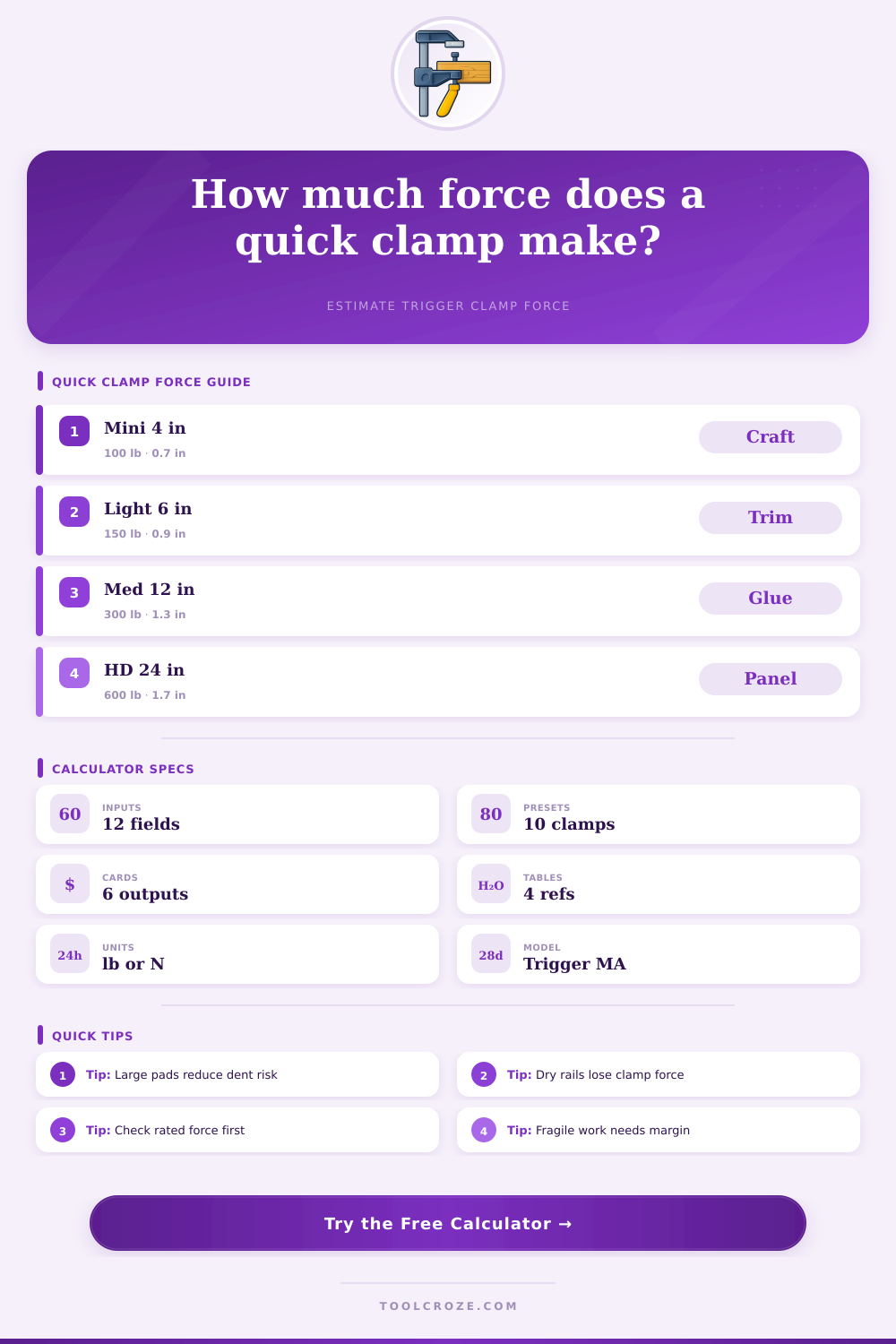
| Clamp class | Typical rated force | Pad area | Lever ratio | Common use |
|---|---|---|---|---|
| 4 in mini trigger clamp | 80 to 120 lbf | 0.35 to 0.70 in2 | 3.2 to 4.5 | Craft jigs, light stops, small trim |
| 6 in light quick clamp | 120 to 180 lbf | 0.55 to 0.95 in2 | 3.8 to 5.0 | Trim, thin panels, temporary holds |
| 12 in medium bar clamp | 250 to 350 lbf | 1.00 to 1.60 in2 | 4.5 to 5.8 | Cabinet parts and small glue-ups |
| 18 in cabinet quick clamp | 350 to 500 lbf | 1.40 to 2.10 in2 | 5.0 to 6.5 | Door frames and casework |
| 24 in heavy quick clamp | 500 to 700 lbf | 1.80 to 2.80 in2 | 5.5 to 7.0 | Panel glue-ups and assemblies |
| 36 in long quick clamp | 450 to 650 lbf | 1.80 to 2.80 in2 | 5.5 to 7.0 | Wide frames where bar flex matters |
| Workpiece surface | Starting pressure limit | Friction range | Use larger pads when | Warning sign |
|---|---|---|---|---|
| Softwood or pine face | 250 to 700 psi | 0.35 to 0.55 | Pad marks will remain visible | Crushed earlywood rings |
| Hardwood face grain | 800 to 1800 psi | 0.35 to 0.60 | Finish surface must stay clean | Glossy pad imprint |
| Plywood or veneer | 350 to 900 psi | 0.30 to 0.50 | Face veneer is thin or prefinished | Depressed skin or edge crush |
| MDF or particleboard | 300 to 800 psi | 0.35 to 0.55 | Clamping near corners or edges | Powdered fibers at pad |
| Acrylic or plastic | 1000 to 3500 psi | 0.25 to 0.45 | Part is thin, brittle, or polished | Crazing or white stress marks |
| Aluminum with finish | 5000 to 14000 psi | 0.20 to 0.45 | Anodized or brushed finish matters | Pad scratch or galling |
| Mechanism condition | Efficiency | Pitch range | Force behavior | Practical note |
|---|---|---|---|---|
| Clean single pawl trigger | 45% to 58% | 0.08 to 0.14 in | Moderate force, faster travel | Good default for light clamps |
| Dual pawl quick grip | 55% to 68% | 0.07 to 0.12 in | Higher force, smooth stepping | Common medium clamp behavior |
| Geared trigger clamp | 62% to 76% | 0.05 to 0.10 in | High force, more squeezes | Watch rated capacity limit |
| Cam assisted rail clamp | 50% to 65% | 0.04 to 0.08 in | Good for rail and track clamping | Pad alignment changes pressure |
| Reversed spreader mode | 42% to 58% | 0.08 to 0.14 in | Lower force than clamp mode | Jaw adapters add flex |
| Dry rail or dirty pawl | 32% to 50% | 0.08 to 0.14 in | More squeeze lost as friction | Force can feel high but read low |
| Preset | Rated class | Handle squeeze | Pad area | Workpiece note |
|---|---|---|---|---|
| 4 in Mini Trigger Clamp | 100 lbf | 25 lbf | 0.45 in2 | Softwood craft work with low dent margin |
| 6 in Light Quick Clamp | 150 lbf | 35 lbf | 0.70 in2 | Pine trim or temporary fence stop |
| 12 in Medium Bar Clamp | 300 lbf | 55 lbf | 1.40 in2 | Hardwood face grain with normal pads |
| 18 in Cabinet Glue Clamp | 450 lbf | 60 lbf | 1.80 in2 | Plywood or hardwood casework |
| 24 in Heavy Quick Clamp | 600 lbf | 70 lbf | 2.30 in2 | Panel glue-up with cauls |
| 36 in Long Panel Clamp | 600 lbf | 70 lbf | 2.30 in2 | Large opening with added bar loss |
| 12 in Spreader Setup | 300 lbf | 45 lbf | 1.20 in2 | Lower efficiency in reversed jaw mode |
| Face Frame Clamp Pads | 300 lbf | 45 lbf | 2.80 in2 | Wide pads for finished cabinet parts |
| Track Rail Low Mark Clamp | 150 lbf | 28 lbf | 1.80 in2 | Low force, high pad area for guide rails |
| 600 mm Metric Panel Clamp | 2700 N | 310 N | 1500 mm2 | Heavy metric clamp on hardwood panel |
This is a handy little tool that calculates the trigger-clamp load, pad pressure, sliding resistance, rating margin, and safe working force based off handle force, pitch, pads, friction, and material limits. A quick clamp enables you to secure an object as you apply clamping pressure, with one hand holding a part steady while the other hand applies the force.
That’s all fine and good, but here’s the issue: “Feels tight enough” does not equal the amount of pressure being applied by the clamp. What feels like a solid hold on a thin piece of veneer may leave a slight impression several hours later; the same squeeze against a thick oak panel may be insufficient to offset its natural springback. So knowing how a clamp works is more important then woodworkers acknowledge.
Why You Should Use a Clamp Calculator
But there’s much more to it than the handle you squeeze. For example, most common triggers multiplies your force by a ratio (the “lever”) that ranges from four-to-one all the way up to seven-to-one. Now add in amount the jaw moves forward on every click (called the “ratchet pitch”), and you’ll understand how two clamps that look almost the same can act so differently. The smaller the pitch, the higher the mechanical advantage, yet the more squeezes you need to close that gap. That’s where the calculator takes over, processing all these relationships when fed actual numbers from clamp in your hand.
And we’ve seen little differences in friction, efficiency or even jaw opening consume the rest of the load far quicker than anyone realizes. Even with a clean, well maintained clamp, efficiency never hits sixty five percent. Each rail flex, each pawl click, each pivot takes away force. Remove the bar from the vice and it falls to the low forties if you allow sawdust to pack in between teeth or leave them dry. What happens? You work harder and workpiece still slips. Many don’t realize this because they wrongly think it’s due to lack of technique. The true cause lies hidden within the mechanism itself where loss occurs.
Pressure is everything; and the size of pad area matters. A couple of hundred pounds on a single square inch equals two hundred psi, enough pressure to shatter earlywood in pine lumber. Spread that across three inches with a caul or wider pad and your 200 pounds become 67 pounds of pressure, easily tolerated by the wood. There’s no such thing as “just being careful.” A little bigger pad isn’t an extravagance; it’s the distinction between a clean glue line vs. A noticeable dent you’ll have to sand away later. This balance becomes immediately obvious when you change the contact area with tool.
There’s another wrinkle: Workpiece sensitivity. Pressure limits is very different depending upon workpiece type, hard maple, mild steel are at opposite ends of the spectrum from softwoods, veneer, MDF. What might be fine for that cabinet face frame will destroy a polished acrylic panel in seconds. Dial in your material and it’ll show you a safety margin before you overcommit.
Once the glue goes down, holding power vs. Sliding often trumps raw squeeze, which is accounted for by the calculator’s friction coefficient between pad and surface. The other half of the story is rated capacity which is merely what the manufacturer promises. If you take a three foot bar with a six hundred pound clamp and put it against something, there will be a noticeable loss in deflection. This results in an opening-loss percentage. The flex bar and long reach make a seemingly suitable tool for the job one that starts out okay but relaxes after several minutes.
Real world clamping is always a game where the geometry of your set up, the tolerance of your work piece and the tools rating are all working together. There are some common pitfalls that follow a clear pattern. For instance, you’ll crank the trigger until your hand cramps, rather than stopping when the calculated safe limit is reached. Or you’ll neglect to replace worn pawls which slip under load. Or you’ll treat particleboard with same squeeze as you do cherry. All of these errors compound each other.
While the calculator won’t stop all bad habits, it eliminates the guesswork for those which matter most. It’s not so much about the numbers in the long run; it’s a matter of conditioning yourself to think about force in addition to just reacting to it. When you begin to see clamps as more than just spring-loaded vices, but as systems involving material limits, friction and levers, every glue-up will be more deliberate. Your joints fit tighter, your surfaces remain cleaner and that one-handed convenience actualy lives up to its reputation. Next time you pick up the trigger, you’ll already know what the clamp is going to do before it ever comes near the wood.