C-Clamp Force Calculator
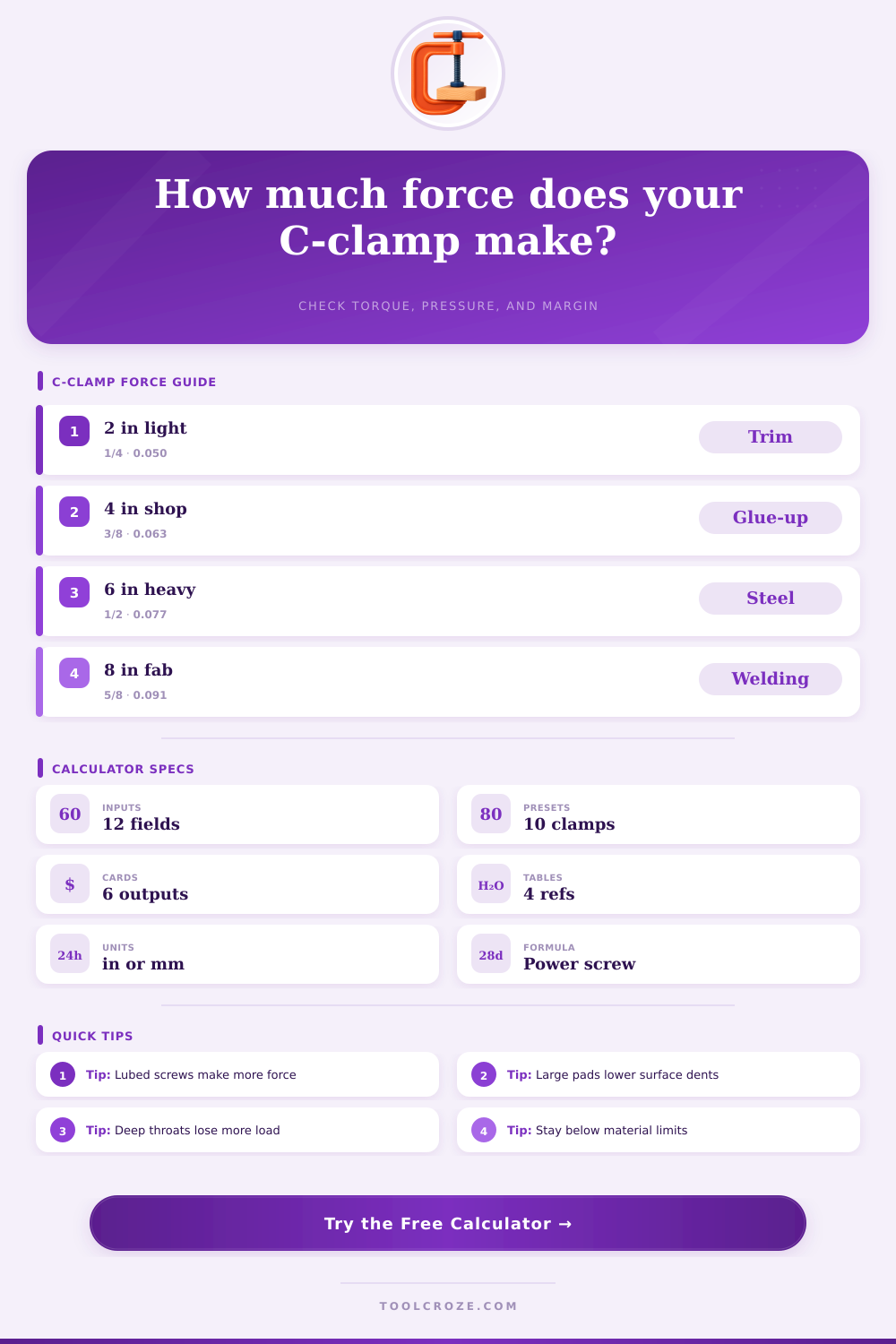
Estimate clamp force from handle torque, screw pitch, screw diameter, friction, frame deflection, pad area, workpiece pressure limit, screw proof load, and safety margin.
C-clamp force results
Calculation breakdown
| Clamp setup | Typical screw | Pitch / lead | Pad diameter | Frame loss | Typical use |
|---|---|---|---|---|---|
| 2 in light trim clamp | 1/4 in screw | 0.050 in/rev | 0.50 in | 18% | Small wood trim, stops, jigs |
| 3 in bench clamp | 5/16 in screw | 0.056 in/rev | 0.63 in | 15% | General bench holding |
| 4 in cabinet clamp | 3/8 in screw | 0.063 in/rev | 0.75 in | 14% | Glue-up pressure with pads |
| 6 in welding fit-up | 1/2 in screw | 0.077 in/rev | 1.00 in | 12% | Steel tabs and brackets |
| 8 in fabrication clamp | 5/8 in screw | 0.091 in/rev | 1.25 in | 10% | Plate fit-up and heavy fixtures |
| Material under pad | Starting pressure limit | Use larger pad when | Common warning sign |
|---|---|---|---|
| Softwood face grain | 350 to 700 psi | Visible pad ring matters | Crushed fibers |
| Hardwood face grain | 900 to 1800 psi | Finished surface is exposed | Dent around swivel pad |
| Plywood or MDF | 450 to 900 psi | Edges or thin skins are loaded | Local face depression |
| Acrylic or plastic | 1500 to 4000 psi | Part is thin or brittle | Crazing or white stress marks |
| Aluminum | 8000 to 18000 psi | Surface finish is critical | Pad galling or imprint |
| Mild steel | 25000 to 45000 psi | Thin sheet can buckle | Pad witness mark |
| Nominal screw | Coarse pitch | Approx stress area | 55 ksi proof load | Notes |
|---|---|---|---|---|
| 1/4-20 | 0.050 in/rev | 0.032 in2 | 1760 lbf | Light duty clamps |
| 5/16-18 | 0.0556 in/rev | 0.052 in2 | 2860 lbf | Small bench clamps |
| 3/8-16 | 0.0625 in/rev | 0.078 in2 | 4290 lbf | Common 4 in C-clamp |
| 1/2-13 | 0.0769 in/rev | 0.142 in2 | 7810 lbf | Heavier welding clamps |
| 5/8-11 | 0.0909 in/rev | 0.226 in2 | 12430 lbf | Large fabrication clamps |
| Condition | Thread friction | Frame loss | Force effect | Practical note |
|---|---|---|---|---|
| Clean and oiled screw | 0.10 to 0.14 | 8% to 14% | Higher force | Smoother tightening |
| Normal shop screw | 0.15 to 0.20 | 12% to 20% | Moderate force | Good default estimate |
| Dry or dirty screw | 0.22 to 0.30 | 15% to 25% | Lower force | Torque becomes heat |
| Deep throat clamp | 0.15 to 0.22 | 22% to 40% | Lower held load | Frame spring dominates |
| Thin casting or wide opening | 0.16 to 0.25 | 25% to 45% | Uncertain load | Use conservative margin |
A tool for calculating safe working load, screw proof margin, workpiece capacity, pad pressure, frame loss, screw force and tightening torque of your C-clamp shop setup. If you’re like me, then you has a C-clamp in your hand whenever you need something held down. But as soon as you begin turning the clamp’s handle, there is some doubt about how hard you’re gripping it. There is also doubt about how much damage it’ll cause to the work piece. Maybe the screw will give way? Or will frame flex and spring once you leave it alone?
For fabricators and woodworkers, this isn’t an idle question: a seemingly tight clamp doesn’t always mean it will hold as much weight as intended. Starting Torque is created by the length of handle and force your hand applies to it. That sounds like a “duh” thing, but most people underestimate how quickly friction eats away at it. Friction greatly cuts down on torque, and a lot faster then you might expect. A lightly oiled clean thread will take almost every bit of torque and turn it into axial force. A dry thread or one covered in dust/other crap takes a bunch of torque but not a ton of holding power. You can play with those variables in the calculator to see what wiping the thread off with a rag realy accomplishes.
How C-Clamps Work
So how does pitch and screw size works in opposition? A larger diameter provides more contact surface area for the head and more thread strength. This typically come at the cost of needing more turning (torque) to create same pressure. Conversely, finer threads multiply force of a moderate amount of handle force, but can be finicky when there’s increased friction. That’s the trade-off that allows a welding clamp with a half-inch screw to behave one way and a four-inch cabinet clamp with a three-eighths inch screw work well for glue-ups.
In all shops, frame deflection reduces effectiveness. While deep-throat clamps may look good on the rack, there’s a cost to that increased reach. A forged frame or a casting behave somewhat like a spring. It soaks up a large part of effort applied before useful force can be used on workpiece. Normal loss is ten percent; common loss is thirty percent or more with inexpensive castings or wide-opening frames. That hidden give takes some of the wind out of your sails, after which actual clamp load can end up being lower than you might expect.
It’s also about the pad. A small swivel pad concentrates force into a tiny footprint and can crush softwood fibers or leave a perfect circular dent in aluminum. Increasing pad diameter will spread same load out, reducing surface pressure a lot. With this tool you can test that relationship immediately, allowing you to choose whether to go with a bigger caul or back off the handle.
The last reality check comes from material limits. Mild steel withstand much greater pressures than softwoods do; even acrylic displays stress cracks well before aluminum begin to flex. The calculator will compare the load you calculate with both the proof strength of the screw itself, and the limit of the workpiece, and apply the safety factor you specify. The last number is the safety factor, and it includes your judgment. For typical shop chores, a factor of 1.5 should of suffice, but anything crucial like an overhead application deserves more.
There is no equation for feeling; that’s what we’re talking about here, real world stuff. You can feel when the clamp takes up slack by a subtle increase in handle resistance. You hear the soft creak of compressed wood fibers. You know that using cheater pipes on the cast handle will take a calculated setup and turn it into a broken casting quicker then you can say “oops”. Ultimately, the numbers let you get confident with something. But the clamp continues to talk back to you in its own language of surface pressure, deflection and torque. Learn to hear that one and learn to hear the other, and your setups quits being guesses. They become decisions.