
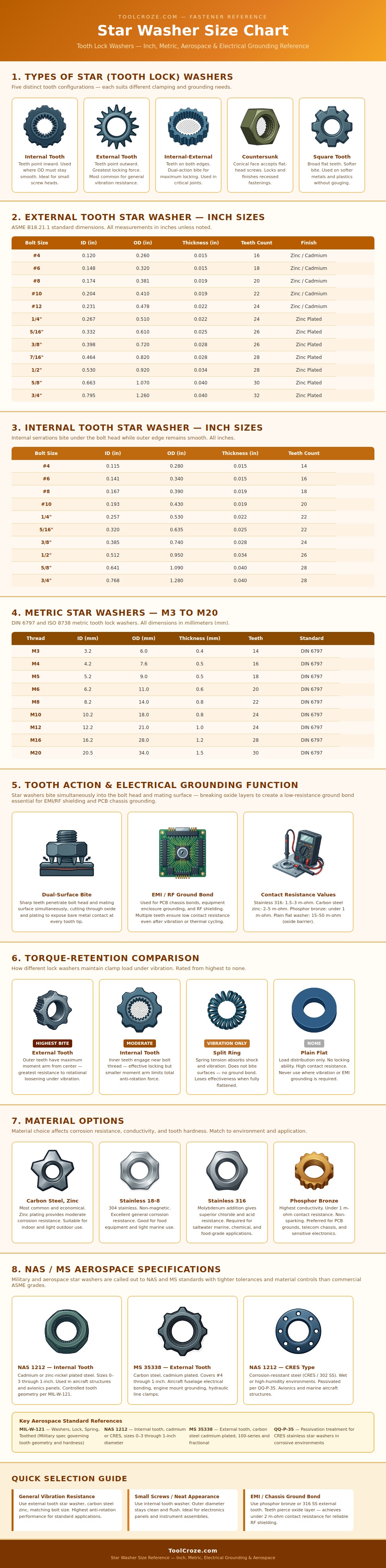
Why are there star washers? Because threaded fasteners will loosens from vibration. Even though a joint might be tight when tightened at first, repeated motion decrease clamp load resulting in downstream failure. Star washers remedy this issue with their serrated teeth which bite into both the mating surface and head of the fastener. They create mechanical interference resisting rotational movement, plus the teeth cut through coatings and surface oxides providing good electrical contact.
So you’ll find them being used in applications like aircraft avionics and control panels where both conductive and mechanical security are required. To help you pair the right part to the job without having to guess, I’ve combined it all into a single chart organized by size and type of washer (above).
How to Choose Star Washers
At one end of the range is external-tooth versions whose teeth are further outboard from center. That gives them more power to resist forces that might loosens it. In contrast, internal-tooth versions give up some of that leverage but feature a cleaner outer edge. That may be important if appearance or clearance around screw head is an issue. Internal-external designs offer both types of teeth for situations where maximum security are more important than appearance.
The table shows how bolt diameter relate to each style. It includes the ID, OD, tooth count, and thickness in one spot so you know what fits before you order. Even if you’re only varying size, material makes a difference which can’t be represented by numbers alone. Zinc plated carbon steel works for everything except outdoor or exposed applications. Stainless steel and phosphor bronze are both longer term choices where there’s potential for salt or moisture to be present. The best electrical (contact) resistance goes to phosphor bronze.
That may not matter so much for a simple mechanical lock but could make a difference if the washer is part of a EMI ground path. Beyond that, aerospace specs further constrain the range with respect to hardness, plating, and dimensional tolerance. This is because a fastener that loosens in flight costs more than one that comes loose from your shop rig.
Looking back on that chart explaining the torque retention of different washers, you now understand why split-rings and star washers are preferred to plain flat washers. The split ring won’t bite into the surface but will take up some of the shock. However, when the ring is flattened its effectiveness stops. Plain flat washers simply spread the load out while doing nothing to prevent rotation or create a low-resistance ground. This means a star washer will do both so you see them used in both structural joints as well as electrical enclosures.
Two questions lead into the actual choice: How much vibration will this joint endure? And, does it need to carry current or should it block the signal? Once you know that, use the table above to find the fastener size for the application. This size maintains the ground path and tight joint long after original assembly torque is lost. You should of checked the material too.
