Knurl Diameter Pre-Turn Calculator
Calculate the blank diameter to turn before rolling a knurl, then check finished OD, wheel pitch, circular pitch fit, tooth count, forming depth, and expected OD growth.
Pre-Turn Diameter Results
| Named wheel pitch | Circular pitch | Diametral pitch | Typical OD range | Pattern use |
|---|---|---|---|---|
| 96 TPI fine straight | 0.0104 in / 0.265 mm | 301.6 DP | Small knobs and pins | Light grip, decorative lines |
| 80 TPI fine diamond | 0.0125 in / 0.318 mm | 251.3 DP | Instrument collars | Fine diamond on aluminum or steel |
| 64 TPI shop diamond | 0.0156 in / 0.397 mm | 201.1 DP | 0.375 to 1.000 in | General handles and thumb screws |
| 48 TPI medium diamond | 0.0208 in / 0.529 mm | 150.8 DP | 0.500 to 1.500 in | Common manual lathe knurling |
| 33 TPI coarse diamond | 0.0303 in / 0.770 mm | 103.7 DP | 0.750 in and larger | Deep shop grip patterns |
| 30 TPI heavy straight | 0.0333 in / 0.847 mm | 94.2 DP | Large pull knobs | Coarse axial grip ribs |
| Material | Flow factor | Suggested depth / pitch | Knurling behavior | Setup note |
|---|---|---|---|---|
| 12L14 free-machining steel | 0.42 | 38% to 48% | Forms cleanly, moderate OD rise | Good for fine diamond wheels |
| Mild steel | 0.50 | 40% to 55% | Ductile, predictable tooth fill | Use steady pressure and oil |
| 300 series stainless | 0.38 | 34% to 45% | Work hardens, springs back | Use firm feed and reduce dwell |
| 6061 aluminum | 0.62 | 35% to 50% | Flows readily, can smear | Use lighter depth and lubricant |
| 360 brass | 0.34 | 30% to 42% | Cuts and crumbles if overworked | Try shallower depth first |
| Bronze | 0.40 | 34% to 46% | Tougher flow, clean peaks | Check wheel tracking early |
| Copper | 0.68 | 32% to 45% | Very ductile, high OD growth | Avoid overfilling the pattern |
| Acetal / Delrin | 0.28 | 25% to 38% | Elastic recovery, shallow imprint | Use crisp wheels and support |
| Pattern angle | Effective axial pitch | Tooth fit priority | Visual result | Common use |
|---|---|---|---|---|
| Straight 0° | Same as circular pitch | Circumference integer count | Parallel ribs | Press knobs and shafts |
| Diagonal 30° | Pitch / cos 30° | Integer count plus axial repeat | Shallow diagonal grip | Decorative collars |
| Diamond 45° | Pitch / cos 45° | Both wheels tracking evenly | Balanced diamond points | General manual knurling |
| Steep 60° | Pitch / cos 60° | Watch axial crowding | Long narrow diamonds | Special texture patterns |
| Condition | Blank move | Why it helps | Risk if ignored | Shop check |
|---|---|---|---|---|
| Tooth count is near half tooth | Move toward nearest integer pitch diameter | Wheel repeats over same track | Double tracking or torn peaks | Roll a short band first |
| Finished OD comes out high | Reduce blank by excess OD growth | Less material is displaced outward | Oversize grip diameter | Mic over several diamonds |
| Peaks are flat and smeared | Reduce depth or choose finer pitch | Avoids overfilling tooth valleys | Rough surface and high load | Inspect with bright side light |
| Pattern is faint | Increase depth or use ductile material factor | More tooth fill and OD rise | Weak grip and poor appearance | Compare to wheel tooth height |
Until you’ve produced a piece of diameter that’s out by even a few thousandths, it feels like a silly little shop trick. You thought your knurl was going to turn into a nice, smooth diamond grip on a knob or handle. Instead, it rolls on the surface and becomes too large or doubles-tracks in a fuzzy mess. It’s frustrating, which makes learning about the blank diameter before picking up those knurling wheels so important.
It is not arbitrary. Pre-turn doesn’t just mean “squash down” when the wheel pushes against the workpiece. That stuff flows out and up, creating a higher outer diameter as teeth takes shape. Light passes in pursuit of the dimension smear the pattern or make it too shallow. The calculator helps you start closer to the sweet spot by accounting for how material behaves.
Why Knurling Calculators Are Important
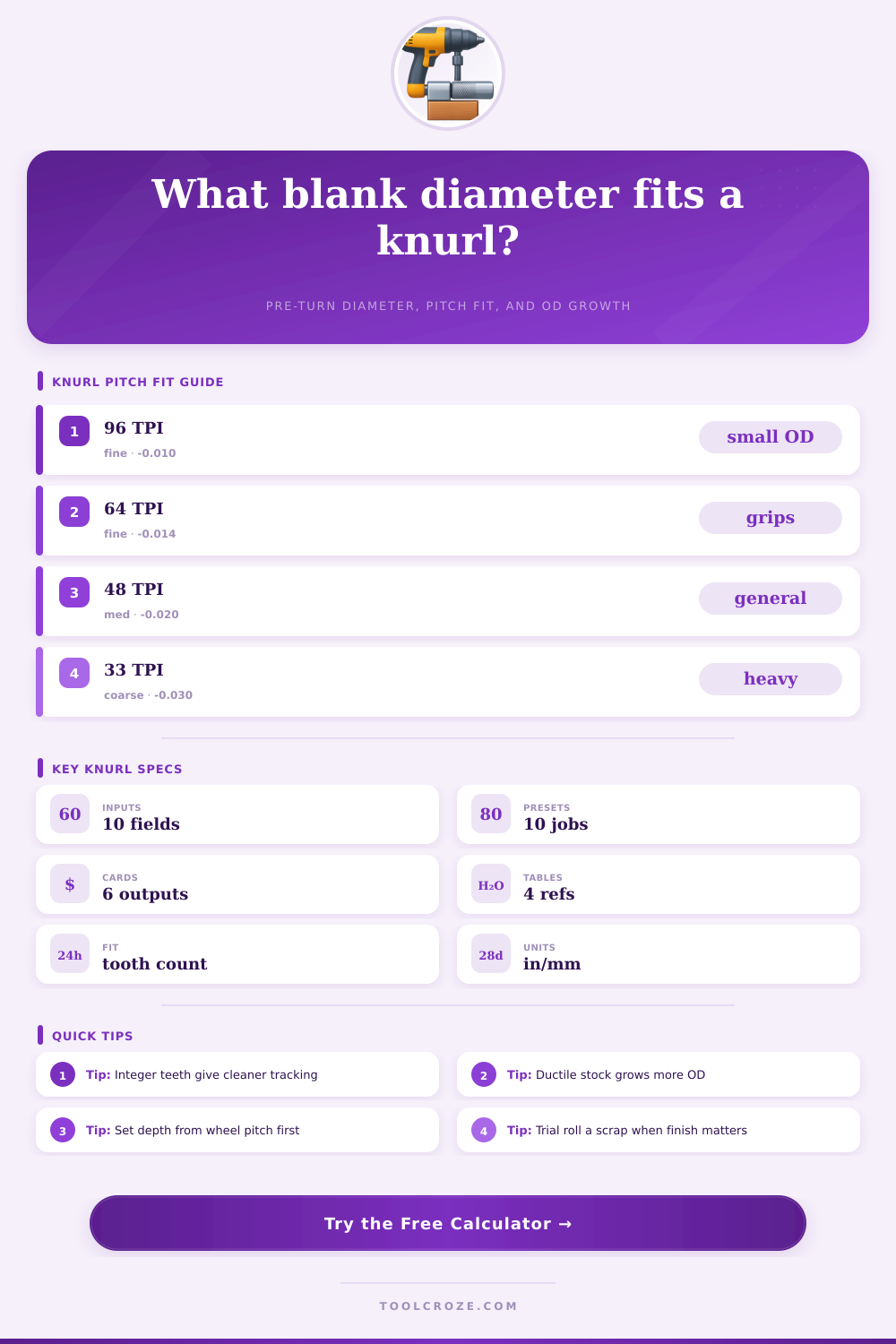
A calculator will handle the relationship between the material, pattern angle, wheel pitch and target finished diameter. So what’s the biggest deal? Pitch. If we look at this same wheel with 48 TPI, it has approximately 0.021-inch pitch per tooth in a circle. Multiply that by the number of teeth that will go on your blank and you arrive at a blank diameter that lets the wheel track cleanly instead of hunting.
Tooth count matter. It matters more different than many would think. It matters because half-tooth errors cause the infamous double-track, which is not only ugly but also impairs grip. This is where most folks miss out, turning to whatever random size they feel like and hoping for the best. Instead, tool provides you with the nearest whole tooth count and how far off you are in choosing your blank.
But it’s not just about material choice; it makes a difference behind the scenes. A ductile mild steel will flow out further than a free-machining 12L14 does. 6061 aluminum wants to smear if you push depth too far. Copper expands hugely. Delrin hardly moves at all and snaps right back. That’s what shows up when you look at how much additional diameter ends up after rolling. The calculator accounts for that displacement, so your estimate of how much will grow is based off reality instead of assuming material is steel.
Respect the depth setting While most of us land within the 35- to 55-percent range in our shops (it varies based on wheel sharpness, lathe rigidity, application of cutting oil vs. Dry roll), each pitch will have its own sweet spot. If it is shallow, the pattern appears weak. If it is too deep, the peaks flattens out. Consider calculated radial depth as a starting place instead of the final word, and avoid over-committing on that initial pass.
And there’s angle. While a 45-degree diamond is most popular, this creates a different axial pitch as well as an altered interaction between two opposing wheels. Teeth running parallel with the axis has straight knurls that behave differently still. The helix can be tweaked slightly to change force required to create a clean pattern and visual density. When it realy matters, experienced hands would of still trial-roll a short band on scrap.
There is no formula to catch all variables: wheel condition, spindle deflection, even the temperature of the workpiece. But you cut the guesswork dramatically if you begin with a calculated blank that already provides integer tracking and a realistic growth prediction. You spend less time chasing size. You have more time to make parts that look and feel intentional.
Ultimately though, it’s all about taking a few minutes to think about the blank before you spin your chuck, because a sharp, professional knurl is so much better than a fuzzy compromise. Get your diameter correct and the wheels will do their job instead of fighting you the entire way through.