
Flat washers look pretty basic. Then you pull one through some soft wood, or it comes loose eventually due to time or bolt action. Now the thing is busted. What went wrong? Most likely it’s that they chose the wrong washer for the job.
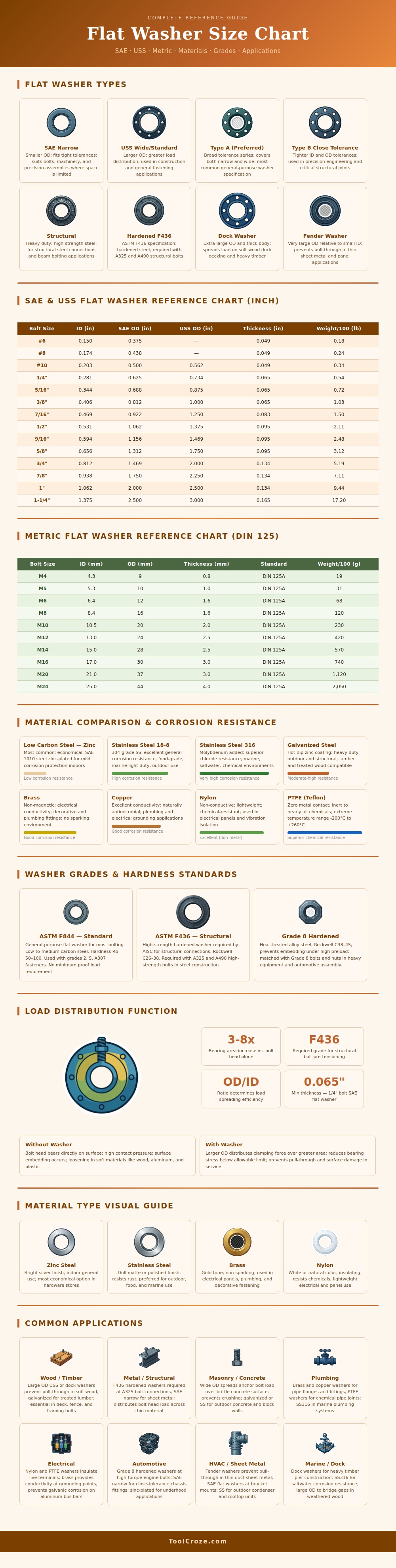
Knowing what to expect from the chart prevents all of this. What do I mean? Well, the chart lays out common families of flat washers next to each other so you can compare them. For example, USS wide washers is bigger than SAE narrow washers on the outside diameter. There are also Type A and Type B washers, structural washers, hardened F436 washers, dock washers, and fender washers.
How to Choose the Right Washer
These exist to provide different amount of surface area coverage depending on job at hand. A washer spreads out the pressure: the broader the washer, the more it spread the pressure load from the bolt head. For example, if you put a washer on a bolt head where it’s going through thin sheet metal or even a softer material such as cedar decking, it will spread out the pressure enough to keep the head from digging down. Hardened F436 washers is used when they’re required for structural steel; they don’t squash flat under extreme tension. This is because A325 and A490 bolts requires this type of toughness in the washer.
And, in a similar way, so does material choice. Here’s an infographic detailing eight common choices, rated from low to very high corrosion resistance. Cheap zinc-plated steel is good indoors but has low resistance. Stainless 316, good in chemical bath, good in salt air; more resistant. Nylon, no metal whatsoever, super-resistant. And PTFE, no metal either, super-resistant too. There is no single best material. Choose the material whose home most closely resembles yours.
The same applies to grade selection. For common bolts, you use standard F844 washers. You want a Grade 8 hardened washer under high-torque automotive or heavy equipment fasteners because they resists embedding. The wrong grade will never hold up under load. Sure, it might appear good enough, but put some pressure on it and …
A lot of folks just grab what’s in the bin and pick a washer about the same size as diameter of bolt. This lasts until it gets exposed to weather or load on the joint. Match your washer to the conditions; not just the bolt. Then match the grade, material, and type of washer. Using the chart makes this clear without guessing or having to remember all those details. You should of use the right specs to keep the joint tight longer and avoid ruining surface below.
