
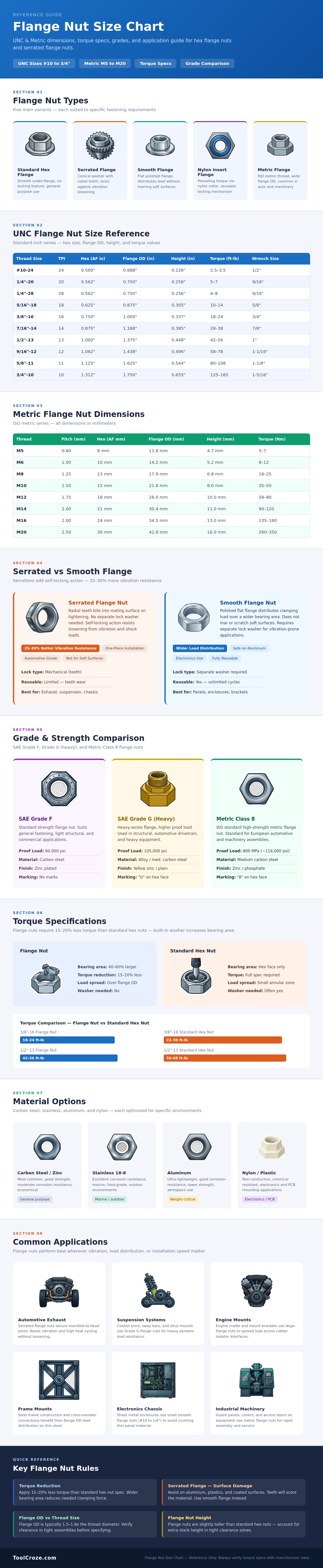
The one thing most folks see after a joint gets loose are flange nuts. Normal hex nuts concentrate pressure on small ring of contact. Thermal cycling and vibration will allow the joint work its way loose. The flange distribute the force over a larger area. So, it require less torque for fastener to stay in place for longer.
That’s broken down nicely in the infographic. The first panel compares serrated version. This version have teeth added under the head that cut into the mating surface to create a mechanical hold, so no lock washer is needed. It’s a neat feature found on many machineries and automotive applications.
How to Choose the Right Flange Nut
The second panel details the smooth version which allow for a bigger bearing surface but prevents scoring on softer surfaces. So you select one or the other depending on if you want a fastener that will mark what’s beneath or if it’s okay to have teeth digging in it.
The graphic shows inch and metric sizes side by side. The chart gives diameter of the thread, across flats measure, flange diameter, and suggested torque range. These numbers allow you to size the nut up with the bolt with no guesses about how high they should of stack or if your wrench will clear enough.
The torque figures are considerably lower then for an equivalent sized hex nut because the flange doubles as a washer. This is important when dealing with lightweight materials like sheet metal or composites that can be crushed at max hex-nut torque.
Because not all flange nuts is alike, they list their strength as grade marks in another place. While general enclosures and brackets uses a standard Grade F, drivetrain and suspension joints that take repeated shock loads require a higher-proof load with Grade G or a metric Class 8. You’ll see this typicaly marked on the nuts, and the chart lists the number for both proof-loads along with typical markings to double-check you get the correct part prior to install.
Same goes with materials. Most construction and shop work uses zinc plated carbon steel; if there’s any salt or moisture involved, go to stainless. And if you’re concerned about electrical isolation or weight, look at aluminum and nylon varieties that don’t have quite as much total strength. You’ll notice none of those affect the basic geometry found in the charts, just how long the joint last in its environment.
Here is the practical takeaway. Measure the bolt and find the matching flange nut on the chart. Make sure it is the right grade and material for the load and surrounding condition. Then, use the lower torque number. The rest is up to the flange.
