
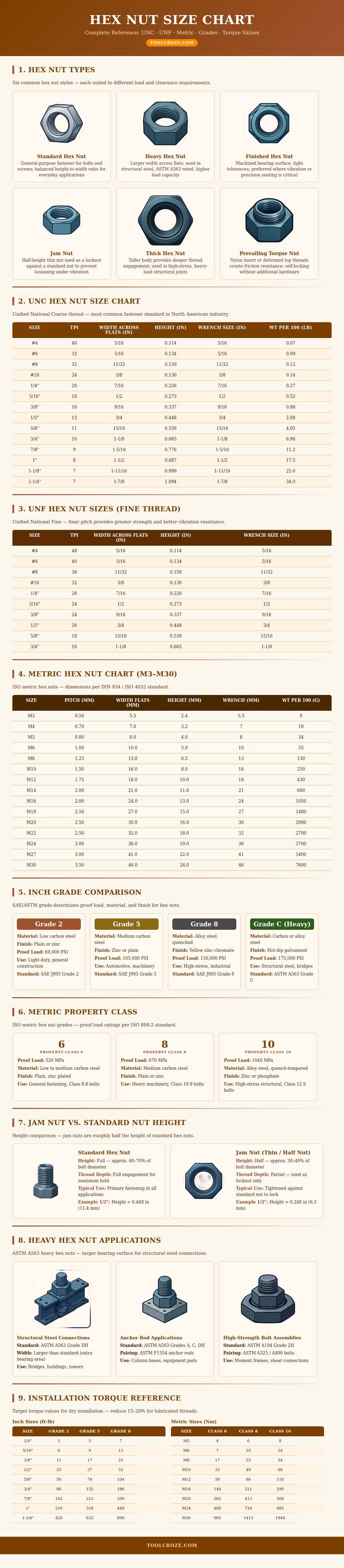
Selecting the proper hex nut is easy, until you’re standing on a ladder, holding a bolt in one hand, and the hardware in the other. The nut must be the correct grade, size, and threading for the task, and it must grips well enough that it won’t back out over time. This sizing chart makes those decisions obvious. Suddenly your heap of like fasteners becomes a collection of planned choices.
There is several types of hex nuts and each type resolves some issue. The normal nut is used for most common fastening applications. A heavy hex nut provides more surface area to spread the load over a larger area (i.e., connecting structural steel). A jam nut are made thin to be able to lock down onto a full height nut without greatly increasing the overall length of the assembled part. Prevailing torque nuts has either a nylon insert or are deformed to thread to provide some anti-vibration properties on their own. The chart shows these options side by side so you can see how height and width change with each style.
Why You Need a Hex Nut Size Chart
Size of thread is important, but also the type. Coarse threads (most UNC) installs quickly and tolerate dirt and minor damage. Fine threads (UNF) is more resistant to loosening with continual vibration and provide tighter tension control. The two charts detail both threading systems for easy comparison by wrench size, height and width across flats without having to guess or memorize each system. For instance, if you get a stripped nut on one of your machines, this will help you know if the next size up is big enough to fit onto your existing wrench.
Then there are metric fasteners which has their own logic. They range in size from M3 to M30. Each has its dimensions of width across flats, pitch, and weight listed on chart. When working from the chart, you don’t mix a fine metric bolt with a coarse metric nut. Even though numbers look close together, they won’t thread correctly if not matched. After you get the pattern, you can quickly visually pick out the right nut instead of trying it out until you find the right one.
The strength of nuts is rated by material grade; the higher the grade, the more weight it will bear without failure. Grade 2 is for light duty. This grade covers machinery and automotiv. Grade 8 and Property Classes 8 and 10 (metric) are high stress connections. As the chart shows, nuts with similar diameters may needs to be stronger to handle the load required in a structural situation. Using a weaker nut in an application where there is high load just doesn’t show itself until something shifts or gives way.
The same applies to torque. For every size in inches or metric, there’s a range of torque listed by grade in the reference tables. They are based off dry, clean threads. Because the presence of lubricants alters this dynamic, that’s where the caveat to lower torque with oiled threads comes from. If you’re too strong, you stretch the bolt. Too weak? Your joint will be loose. The chart allows you a solid center point instead of going by feel only.
So where’s the true benefit in having a size chart handy? It eliminates guesswork out of something that pays off for accuracy. Yes you’re going to have to consider all of these variables, but the chart condenses them down into a short list of viable possibilities instead of an open ended quest for parts in a bin of hardwere. You should of used it earlier too.
