Grinding Wheel RPM From Surface Speed Calculator
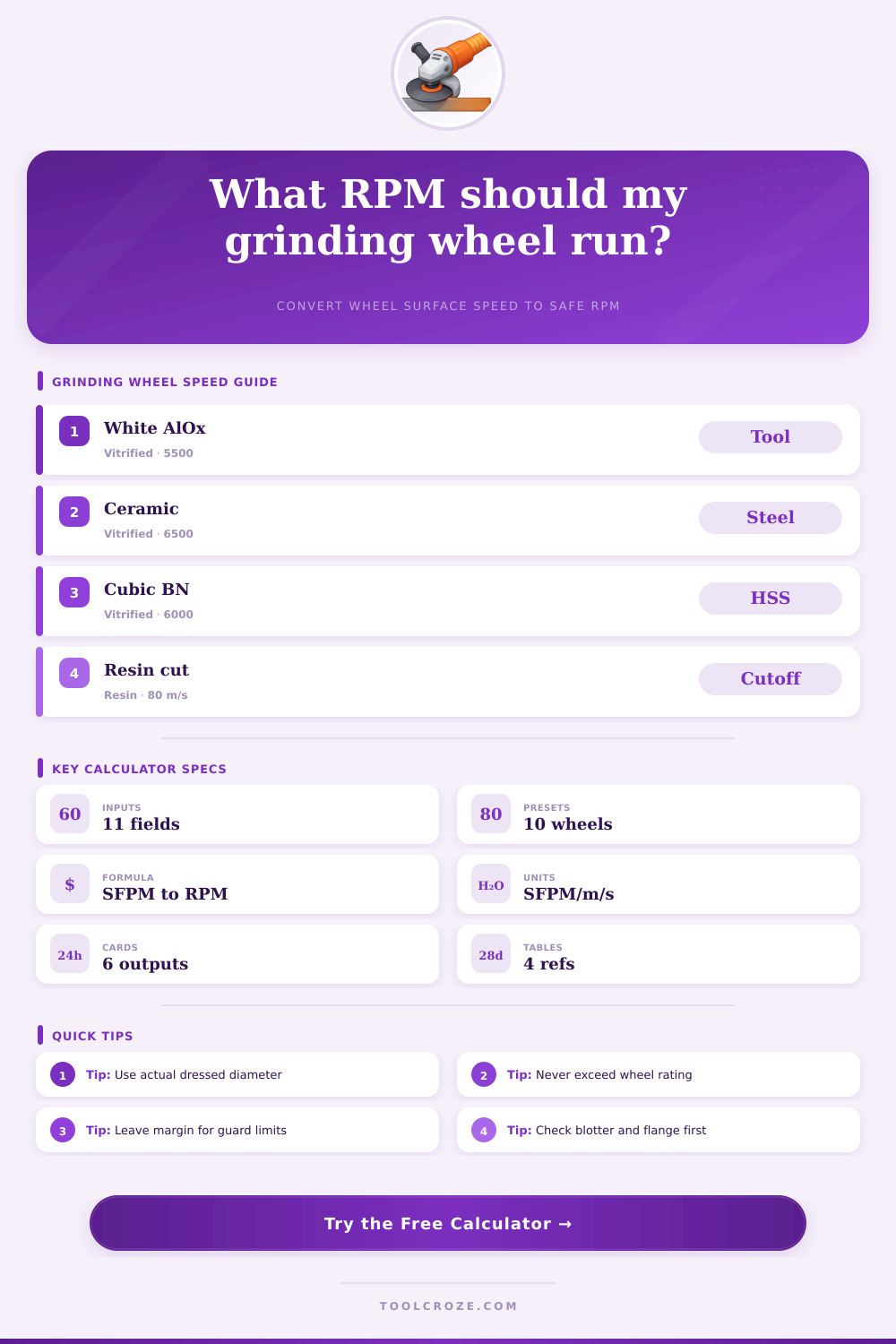
Convert a target wheel surface speed into RPM while checking dressed diameter, wheel rating, bond, operation, guard margin, and spindle cap.
RPM And Safety Check
| Bond or operation | Typical range | Common use | Calculator note |
|---|---|---|---|
| Vitrified bench wheels | 4,500-6,500 SFPM | Bench, pedestal, toolroom | Often limited by 3,450 or 3,600 RPM grinders |
| Vitrified surface grinding | 5,500-7,200 SFPM | Precision surface grinding | Confirm wheel grade, coolant, and machine guard |
| Resin bonded cutoff | 60-80 m/s | Cutoff and portable wheels | Use wheel label rating before any calculation |
| Rubber or shellac bond | 3,000-5,500 SFPM | Finishing and polishing | Soft bonds can heat quickly at high surface speed |
| CBN or diamond wheels | 4,000-7,500 SFPM | HSS, carbide, hardened steel | Use manufacturer data for plated or metal bonds |
| Preset | Diameter | Target speed | Typical operation |
|---|---|---|---|
| Norton 32A white aluminum oxide | 7 in | 5,500 SFPM | HSS tool grinding and light bench work |
| Norton 38A toolroom aluminum oxide | 8 in | 6,000 SFPM | Surface grinding hardened steels |
| Norton SG ceramic alumina | 12 in | 6,500 SFPM | Cylindrical or surface grinding steels |
| 3M Cubitron II precision-shaped grain | 14 in | 80 m/s | Resin cutoff and high energy grinding |
| Radiac ruby aluminum oxide | 6 in | 5,200 SFPM | Bench sharpening and toolroom work |
| PFERD vitrified bench wheel | 8 in | 5,600 SFPM | Pedestal grinder stock removal |
| Norton CBN vitrified tool grinding | 6 in | 5,000 SFPM | HSS tool and cutter grinding |
| Tyrolit resin-bond cutoff wheel | 12 in | 63 m/s | Abrasive chop saw cutoff |
| Weiler Tiger zirconia resin wheel | 7 in | 80 m/s | Portable angle grinder stock removal |
| Cratex rubberized silicon carbide | 4 in | 3,500 SFPM | Deburring, finishing, and polishing |
| Wheel diameter | 4,500 SFPM | 5,500 SFPM | 6,500 SFPM |
|---|---|---|---|
| 4 in | 4,297 RPM | 5,252 RPM | 6,207 RPM |
| 6 in | 2,865 RPM | 3,501 RPM | 4,138 RPM |
| 7 in | 2,456 RPM | 3,001 RPM | 3,547 RPM |
| 8 in | 2,149 RPM | 2,626 RPM | 3,104 RPM |
| 12 in | 1,432 RPM | 1,751 RPM | 2,069 RPM |
| Check | What to enter | Good sign | Stop sign |
|---|---|---|---|
| Wheel rating | RPM printed on blotter | Rating exceeds target RPM | Target exceeds rating after margin |
| Dressed diameter | Actual OD after dressing | RPM recalculated from smaller OD | Using nominal OD after heavy wear |
| Spindle cap | Machine or pulley maximum | Cap is at or below wheel rating | Machine can overspeed the wheel |
| Flanges | Outer diameter of both flanges | Near one-third of wheel OD | Damaged, mismatched, or undersize |
Surface speed is more important than many discussions in the shop acknowledge. You know what I mean; you can tell when a wheel is going too slow or too fast. Too slow and it rubs rather then cuts, glazing over and burning the workpiece. Too fast and the wheel explodes… no one wants that either. Matching your machine capabilities with the job, the wheel characteristics, and the right surface speed is where true magic happens.
In fact, it’s the surface speed that wheels react to. At 3,000 RPM, a seven-inch wheel is not the same as a twelve-inch wheel. For example, at 3,000 RPM the twelve-inch wheel’s outer edge move a greater distance every minute. Old timers discuss this in terms of SFPM; some of us moddern machinists still like our meters per second. Whatever you want, the calculator does that, too and accounts for dressed diameter, which everyone seems to forget about until their numbers don’t work out.
Why Surface Speed Is Important for Grinding Wheels
Small details make big differences, like dressing allowance. Each time you dress and true a wheel, you reduce its diameter. To get the same amount of surface speed, you has to increase the rate at which it spins. Plug in a reasonable dressing loss and tool tells you if your spindle will achieve the desired speed or if printed max rpm on the wheel will be the new limit. This is a reality check that saves lots of cracked wheel.
Then there’s another layer of bond type and wheel grade that most folks ignore. Are you using a resin bonded or a vitrified wheel? Resin-bonded cutoffs is different from other types. Do you use hard grades? They vibrate different and generally require more cautious treatment. The calculator includes all of that in its recommendations.
Still, use what it provides for guidance rather than as absolute truth. You’ll still need to visually inspect things and give them a quick ring test. Guard margin is another protection that seems overkill until it’s needed. If something gives way, then having some ten or fifteen percent headroom between the wheel’s stamped limit and speed you operate will help.
Spindle capacity works the same. Regardless of what the wheel might be rated for, many older pedestal grinders is limited to 3,450 RPM as their top speed. The tool compares your operating speed, the wheel’s stamped limit, and the spindle capacity to let you know who’s really in charge.
You never hear about bore diameter and flange size, yet these determine just how snugly the wheel fit. Trouble begins when the flange is less than one-third the wheel diameter. The calculator shows the ratio. A quick look tells you if your setup follows best practices or needs a new flange set. That’s checked prior to pushing the start button.
There are common mistakes made at every shop. At the top of my list is using the new-wheel diameter after weeks of heavy dressing. Second on the list is running a fresh cutoff wheel at bench-grinder speeds. Both lead to premature wheel wear and wasted time. Best practice is easy: Read the label; write down what you need it to do; measure its current diameter, then run the numbers. That process is made easy with this calculator.
It’s as much science as it is art, and grinding is all about grinding down. It’s about getting the numbers right and letting experience teach you what needs adjusting with which coolant setup or alloy. Get the speed just right and you’ll have cooler temperatures, cleaner cuts and longer lasting wheels. That’s the satisfaction all machinists are chasing, with every calculated RPM.