
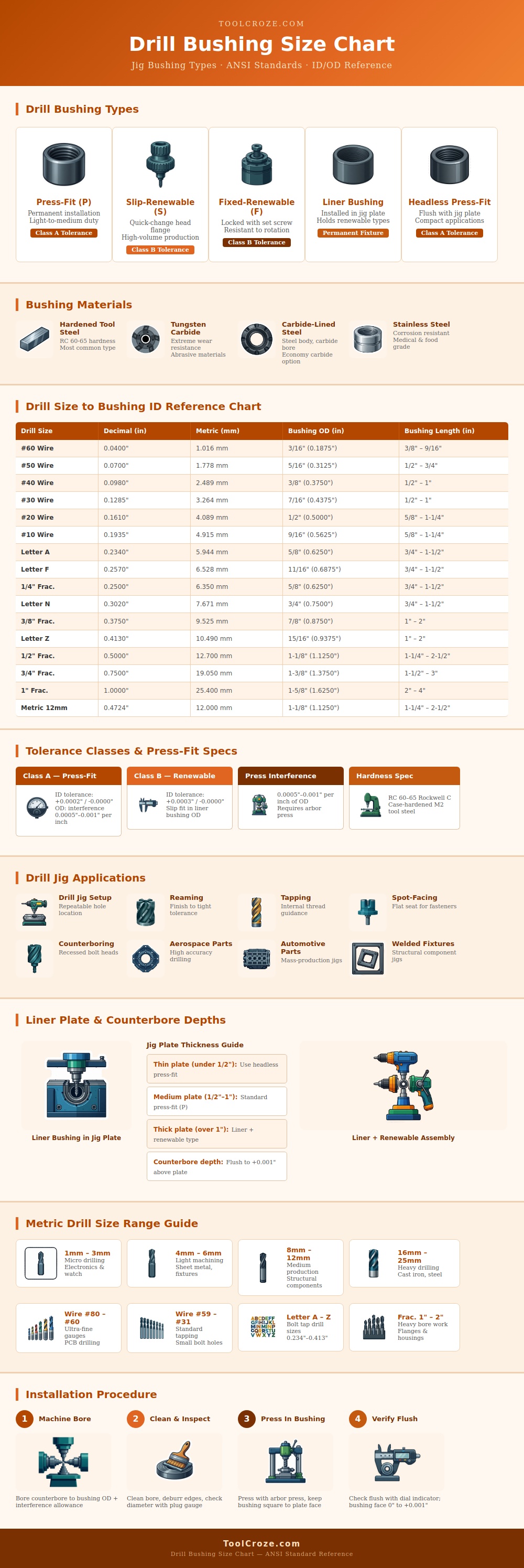
There is such things as drill bushings. You see, metal doesn’t forgive sloppy holes. If you have to drill the exact same spot in the exact same part one-hundred times, a loose hand held drill wander. That little drift becomes scrap real fast. With a properly sized bushing locking the axis of the drill, hole location is consistant and not reliant solely on operator skill.
These are bushing styles. As for various bushing style options (see breakdown in the infographic above), there are several you’ll actualy see, including the press-fit type, which are permanent fixtures on the jig and fit a lighter duty. The slip-renewable style allow for fast-changing bushings where you may have the same jig do several different operation. Fixed-renewable bushings includes a locking screw to prevent the bushing from spinning with the load. Liner bushings go into the plate itself, allowing you to insert renewable bushings into them and get a replacement wear surface without having to machine out another hole in the jig. If your plate has no clearance above it, headless press-fit ones sits flush. Each of these involve a trade-off between ease of installation and how often you need to replace them or change their size.
How to Choose Drill Bushings
The same apply to material choice. Most everything is handled by hardened tool steel, which can be made hard without a lot of cost, yet resist wear well. When something needs to be drilled that will chew through regular steel fast like abrasive materials, it’s tungsten carbide or steel lined with carbide. If you’re going to use this for food or medical uses where corrosion is a factor over sheer hardness, it’ll be stainless steel. After the drill does its job, the correct material help keep the inner diameter consistant and the bore round.
The first decision is what size drill. Table above aligns common bushing inner diameters with standard wire, letter, fractional, and metric drill sizes. This means you don’t have to guesstimate clearances. If it is bound too tight the drill binds. Loose? You give up the purpose of the bushing which is accuracy. The other two columns of interest are the outer diameter and length. That tell you how far into the jig plate the bushing will seat and how much support the drill has before it hits work piece.
More often than not, mistake occurs before the bushing even sees metal. If the bore isn’t perfect (no surprise there); meaning it is off by a few thousandths of an inch, you’ll end up with a crushed bushing or one that won’t set right. It’s easier to clean your bore, measure it with a plug gauge and get it right then it is to replace a damaged bushing later. To complete the task properly, simply press it straight in and confirm it sets flush or maybe slightly proud of surface.
On shop floor, that’s where it really pays off. Holes are consistantly located. This helps fixtures locate quicker reaming passes track true, and tapped holes go on axis. That consistency compounds part after part coming off the same jig. You should of checked measurements too.
