
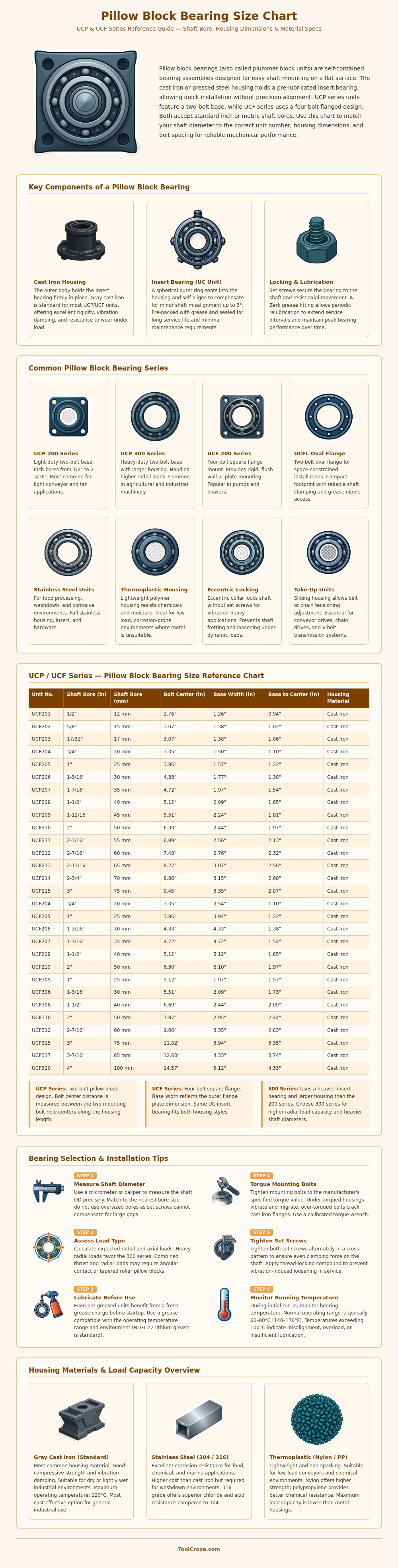
When you spin something, especially when spinning under load, it need support. Something has to hold it in place but not bind or wobble as it goes around. This is where a pillow block bearing comes in. It’s a self contained unit that mounts to a flat surface. Its protective housing contain a pre-lubricated insert bearing.
And yes there is a chart above for sizes. Why? Because selecting an incorrect bore diameter or housing size make a straightforward mounting process lead to repeated failure and downtime. The chart breaks out the issue into working categories. It shows what shaft diameter matches what unit number. How far apart do the mounting bolts sits on the unit? Is the housing the lighter 200 series or heavier 300 series? Are they metric or inch bores? And there’s both in case you don’t know or want to guess.
How to Choose the Right Pillow Block Bearing
The reason for knowing if it’s a 200 or 300 series is that 300 series has thicker wall housing and a larger insert bearing. So it will handle more radial load at any given shaft size then the 200 series. Pillow blocks is made of gray cast iron in most cases. Gray cast iron is cheaper than stainless, and it dampens vibration too. For food contact or washdown applications, you’ll want something like stainless or thermoplastics. These will also take an insert bearing and resist corrosion.
The insert bearing has a self-aligned spherical outside ring that can be off by several degrees without tearing up the bearing right away. Minor shaft misalignment isn’t catastrophic at first. Shaft selection begins with measuring accuratley for the size required. You need to avoid an oversize bore because if it’s too large, there is no positive engagement on the set screws and the shaft will slip under load.
After determining the diameter, consider expected axial and radial forces. Radial loads favors heavy-duty bearings like the 300 series or perhaps a four-bolt flange mount that distributes mounting force across a greater area. Axial thrust might call for a different type of bearing completly.
It is important to know that life expectancy are directly related to installation details. Bolts must be properly torqued, or else the house will creep. Set screws must be alternately tightened using thread locker and should of not back out. Apply compatible grease prior to start-up to remove any air pockets that could cause premature wear. Test housing temperature after a few hours of run time. If you have steady heat over about 176 degrees Fahrenheit, it’s typically a sign of either too little lube or misalignment.
Also notable are the differentiations between four-bolt flanges vs. The chart shows two-bolt bases. For moderate loads and tight spaces, go with a two-bolt base. For a flush mount with rigid performance that won’t rock on pump plates or other vertical surfaces, opt for a square flange. The oval two-bolt flanges fall somewhere in-between with a smaller footprint for situations where bolt spacing limits options.
One thing people miss is it says on there that the insert bearing will fit various styles of housings. What that translates to is you don’t have to stock as many spare inserts on a shelf but can cover several different configurations of machines. It’s also easier if you have to do repairs in the field. Since they are all locked with the same mechanism, whether it is an eccentric collar or a set screw, its the same procedure.
While it might not be necessary to memorize all the dimensions, the chart already groups them in a way that makes it easier to choose the proper pillow block based off the combination of load, environment and mounting limits. If you get those three correct, rather than the next unplanned shutdown being caused by a pillow block, it’ll keep running quietly for years to come.
