
Once in use, shafts don’t always run true. An agricultural auger twist as the hopper loads unevenly. A conveyor belt sag under load on a long span. An impeller on a fan pull the shaft ever so slightly off line. The shaft then moves a degree or two relative to the housing which remains fixed and that slight angular movement overloads a rigid bearing.
For this exact circumstance, self-aligning ball bearings was designed. They feature a concave spherical raceway on their outer ring that lets the inner assembly move angularly without binding against balls.
How to Pick and Use Bearings
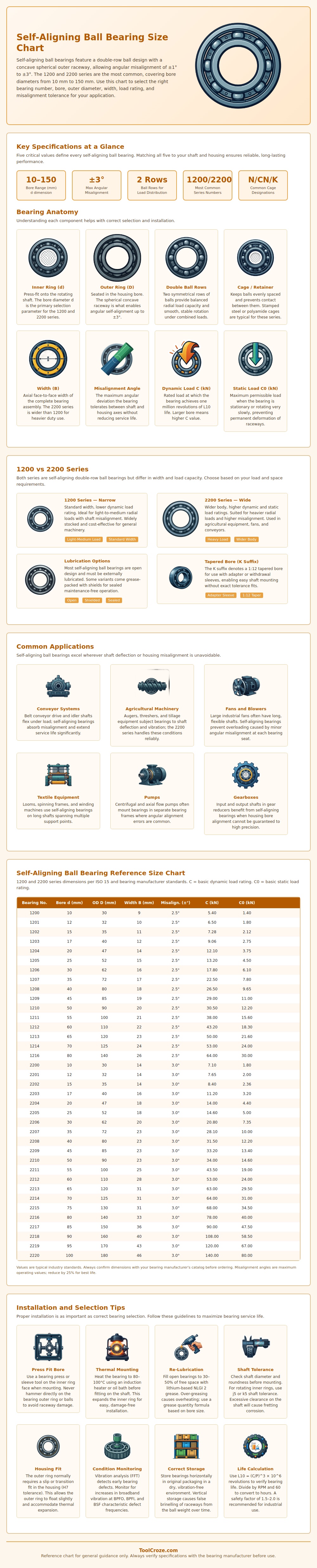
This chart shows the two most popular series (1200 and 2200), which match various shaft diameters and rated loads. As you can see, both are two-row designs, but the 2200 series are wider (hence the name) and rates much heavier duty. So, that leaves it up to you whether the extra width in your housing is worth it or if you just need radial force handling.
The same table also notes the allowable shaft misalignment for each size, typically between two and three degrees. That is as far as you want to go without starting to edge load the bearing and shorten its life.
For example: Shaft size determine first choice, but that’s just the beginning. Is the loading going to be constant or jarring? How frequently will the machine be lubed? Will an adapter sleeve help installation? Once you’ve located the correct capacity bearing, the reference grid displays the dynamic/static capacities at the same time so you can verify that your calculated equivalent load remains comfortabley within their limits.
A conservative safety margin above those ratings pays off quickly in terms of downtime avoidance (if the application is continuous duty). But it is not just about the numbers. It’s also about how you mount it.
Hammering on it cause brinelling (whereas pressing on the inner ring with a sleeve prevents it). Heating it to ~90 °C causes expansion, which is just enough to slip in while not stretching and distorting the raceways. After seating the bearing, there should of still be axial play of a fraction of a millimeter at the outer ring. This allows the spherical seat to function properly if the frame flexes or expands from heat to try to realign the system later.
Until then, it is worth remembering how easily simple storage and handling are overlooked. False brinelling, indentations pressed permanently into bottom raceway by gravity as bearings sit standing on end (below). Happens if they’re left this way for even months. They’ll last longer if kept flat inside their own packaging in a dry cabinet where the grease or other preservative remains intact.
That’s where the reward comes in, years or even months down the road, as that line continues to run and doesn’t stop to have an unexpected bearing swap. The numbers on the chart shows the ratings and sizes, but the decisions made about lubrication, fit, and storage determine how long the parts actualy last.
A few degrees of misalignment can cause issues. Get both pieces aligned correctly, and the problem becomes nothing more then what the bearing is rated for in the first place.
