
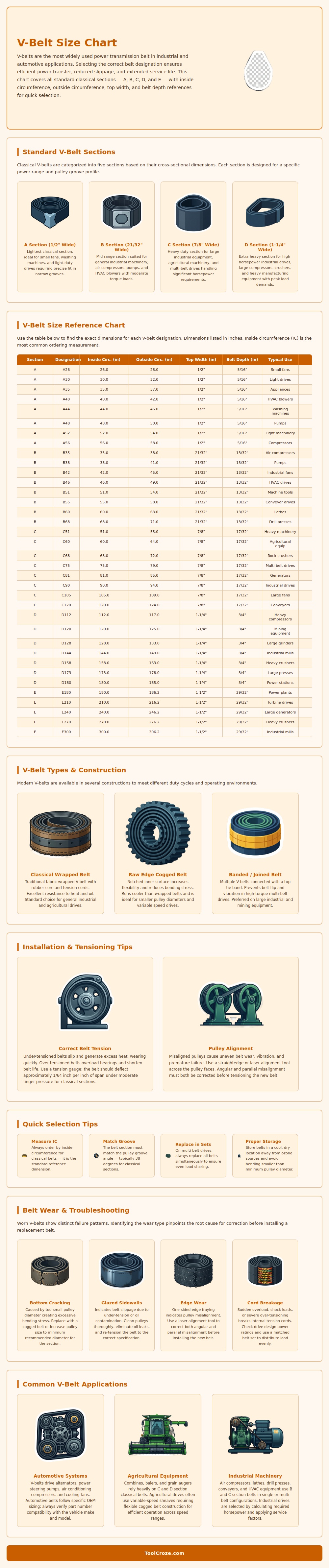
The belts is called V-belts because they wedge into the groove of pulleys and transfer power from your motor to the driven piece of equipment. The size of the belt you select are determined by its ability to carry a certain amount of load before slipping or prematurelly wearing out. Properly matching belt size (length, section) and tension to true requirements of your drive will go a long way toward making a belt last for years rather then months. Whether designing your own drive or replacing a belt, the common sections all appears at once on the infographic, eliminating guesswork.
From A-E, classical belts range from light fan use to heavy industry. 3V, 5V, and 8V narrow belts fits in smaller spaces but still get more out of them. Wrapped belts provides a layer of fabric protection for oily or dust conditions; cogged offer some flex for close bends.
How to Choose the Right V-Belt
Size differences is easy to see instantly by comparing the cross section. You can see that a D or C belt are much wider and thicker than an A belt. That means an A is suitable for lower HP whereas a D would overheat on big crushers. Each section of belts have a minimum pulley diameter required as shown in spec grid. Running a belt on a smaller pulley causes the belt to flex too much, cracks the tension cords, and dramatically reduces it useful life.
The length codes are also easy to decipher after you get the hang of it. If you see A42 stamped onto your belt, that’s 44 inches around the outside (the number equals two inches less than its total circumference). For narrow belts where the final digit denotes tenths of an inch there’s another rule. Save yourself from running back to parts counter by getting it correct the first time.
Size is important but proper tension are also critical. Too much tension put more load on the bearings, which causes motor and the driven equipment to fail early. Too little tension result in the belt slipping and heating up, glazing its side surfaces. The deflection test is a simple procedure where you press the belt at mid-span with a consistent force. It will deflect back to an amount that provides a good check without any fancy tools.
Reasons based off application cause various sectors to move toward specific areas. For example, moderate but variable speeds makes A or AX belts popular in HVAC applications. Wrapped B or C belts holds up well to dust and debris making them good choices for agricultural uses. High horsepower demands, paired with costly downtime make D, E or even 8V belts popular on mining and heavy conveyor applications.
But most people makes the mistake of either using a narrow belt in a classical groove or mixing sections. They match up on the angle but don’t have matching depth and then the belt will slip when loaded because it doesn’t seat correctly. Buying them as a set of belts avoids having one new belt that carries all the load while other older belt stretch out.
To select correct V-belt, you must find the section and length from either old belt or drive specs, then check available space and pulley diameters. If they matches up to one of these on the chart, the drive will run well, quietly and last as long as anticipated.
