
An o-ring seal gone wrong shows itself as a leak at the worst possible time. This could be a leaking hydraulic fitting while under load, or a loss of vacuum in a test chamber. How you cut that groove can make all the difference between a solid, reliable joint and a problem that just won’t go away.
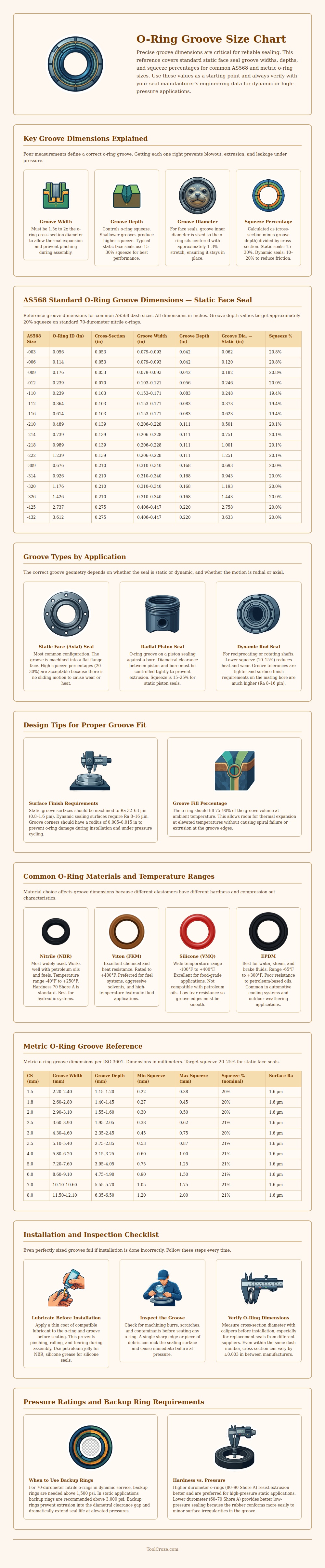
The size of the groove determine how much the rubber expands or contracts with heat. It also determines whether the ring stays seated against the parts when pressure tries to force it out. There are four measurements that enter into this. They are diameter, depth, width, and squeeze percentage. Diameter places the O-ring so it is in the center but not over-stretched or hanging loosely on either side. Depth define how hard it gets squeezed (the amount of compression). Width provide space for the O-ring to prevent crushing upon assembly or heating up. Squeeze just means the difference between the depth of the completed groove and the relaxed thickness of the O-ring. It’s expressed as a percentage of the original size. A small squeeze will leak at low pressures, Large squeezes may cause material to be forced out into the gap or be torn during installation. No slipping surface on static face seal allows it to handle greater squeeze
How to Choose the Right O-Ring Groove
Typical values for common AS568 sizes are shown in the chart above. Listed is depth of the grooves that causes approximately twenty percent compression on a standard seventy-durometer nitrile seal. This amount provides enough sealing while avoiding forcing the material beyond its comfort zone. Lower squeeze is required for dynamic applications where controlling friction and heat are concerns. Rods sliding in glands and pistons moving within cylinders is examples of dynamic situations. This distinction is clear from looking at the same chart (above), which divides types of motions into separate geometries.
The story also shifts with material selection. Softer compounds conform better to slight surface irregularities. This is better for low pressure. Harder rings don’t get blown out more than under higher pressure. Operating temperature is an issue as well. Certain elastomers harden significantly below freezing and will not spring back. A good seal around the groove at room temperature leak under operating conditions.
Consider the finish of the mating surface and groove walls. You don’t see this in basic dimension. If it’s rough, it will cut into ring as assembled or provide leak paths under pressure. The same holds true for sharp corners where the grove meets the edge. Giving them even a small radius prevent the rubber from catching and tearing when the parts are brought together.
Installation is where things really get tested. Even when a ring fits properly on the bench, it may roll or twist out of position as you seat it in the groove, Or debris from cleaning might remain in the groove. Proper lubrication allows the ring to slip into place but not roll. But the lubricant has to be suitable for the system fluid as well as the elastomer. Once assembled, a visual inspection of the joint quickly reveals any improper compression or uneven seating, usually before the system is pressurized.
Ultimately, this groove isn’t just holding a chunk of rubber; it’s defining how that chunk of rubber would of actually do its job.
