Drill Bit Point Length Calculator
Calculate the conical point length, full-diameter depth correction, through-hole travel, and geometry notes for twist drills, split points, and flatter hard-material points.
⚙ Named Drill Presets
📏 Point Geometry Inputs
Calculated Drill Point Setup
🔧 Selected Material Geometry Grid
📊 Point Angle Length Reference
| Drill diameter | 90° point | 118° point | 135° point | 140° point |
|---|---|---|---|---|
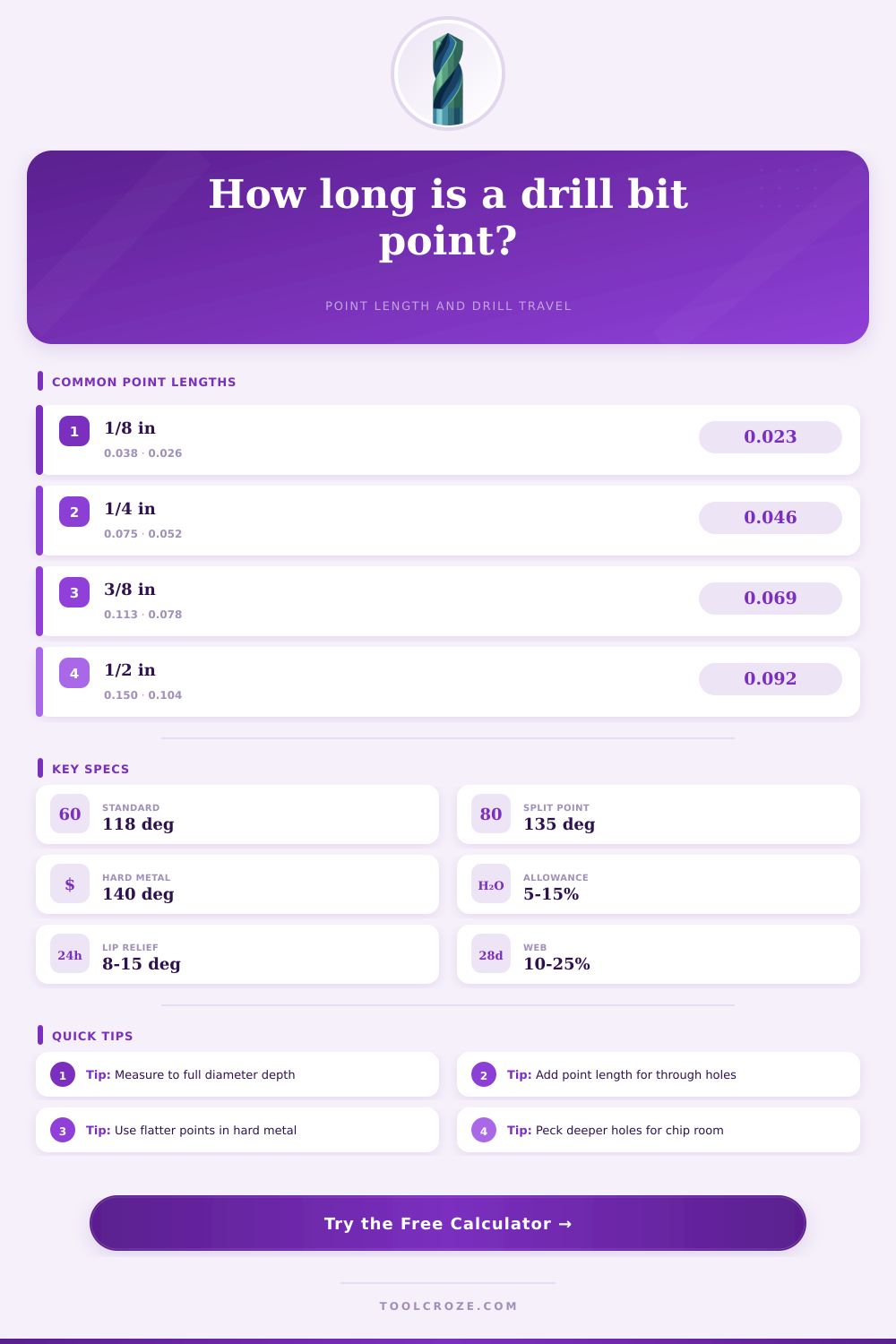
| 1/8 in / 3.18 mm | 0.063 in / 1.59 mm | 0.038 in / 0.95 mm | 0.026 in / 0.66 mm | 0.023 in / 0.58 mm |
| 1/4 in / 6.35 mm | 0.125 in / 3.18 mm | 0.075 in / 1.91 mm | 0.052 in / 1.32 mm | 0.046 in / 1.16 mm |
| 3/8 in / 9.53 mm | 0.188 in / 4.76 mm | 0.113 in / 2.86 mm | 0.078 in / 1.97 mm | 0.069 in / 1.74 mm |
| 1/2 in / 12.70 mm | 0.250 in / 6.35 mm | 0.150 in / 3.81 mm | 0.104 in / 2.63 mm | 0.092 in / 2.32 mm |
| 3/4 in / 19.05 mm | 0.375 in / 9.53 mm | 0.226 in / 5.72 mm | 0.155 in / 3.95 mm | 0.137 in / 3.48 mm |
🧱 Material and Spec Comparison
| Material | Common point | Lip relief | Web / chisel | Depth note |
|---|---|---|---|---|
| Softwood | 90°-118°, brad point | 12°-15° | 10%-18% | Backer board reduces breakout |
| Hardwood | 118° or brad point | 10°-14° | 12%-20% | Use full cone allowance for clean entry |
| Acrylic | 90°-118°, low rake | 6°-10° | 10%-18% | Extra clearance avoids cone imprint |
| Aluminum | 118°-135° split point | 10°-14° | 10%-18% | Chip room matters on deep holes |
| Mild steel | 118°-135° | 8°-12° | 15%-25% | Spot depth should exceed web width |
| Stainless steel | 135°-140° split point | 7°-10° | 10%-18% | Use shorter point, firm feed |
| Cast iron | 118°-135° | 8°-12° | 15%-22% | Dry chips may pack in blind holes |
| PCB laminate | 130°-135° carbide | 8°-12° | 6%-12% | Control exit to limit fiber breakout |
🛠 Bit Style Geometry Table
| Bit style | Typical angle | Point length behavior | Best use | Setup caution |
|---|---|---|---|---|
| 118° jobber twist drill | 118° | Longer cone | General shop drilling | Add full point length to blind depth |
| 135° split point | 135° | Shorter cone | Metals and handheld starts | Split web reduces walking |
| 140° heavy-duty point | 140° | Very short cone | Stainless and hard alloys | Needs rigid feed pressure |
| Brad point wood bit | 90°-118° | Spur extends before lips | Clean wood holes | Spur projection may add travel |
| Spot drill | 90°-120° | Short controlled cone | Locating twist drills | Spot angle should be wider than drill |
| Masonry carbide drill | 118°-130° | Blunt chisel tip | Concrete and brick | Hammer action changes exit quality |
📝 Common Depth Setup Examples
| Scenario | Input diameter | Point angle | Point length | Practical setup |
|---|---|---|---|---|
| #30 aircraft rivet hole | 0.129 in | 135° | 0.027 in | Add 0.04 in for clean exit |
| 1/4 in blind tapped pilot | 0.250 in | 118° | 0.075 in | Drill deeper than thread depth |
| 6 mm stainless clearance | 6.00 mm | 140° | 1.10 mm | Short point helps thin plate |
| 10 mm hardwood dowel hole | 10.00 mm | 118° | 3.00 mm | Use brad spur allowance |
| 1/2 in fixture plate hole | 0.500 in | 135° | 0.104 in | Add clamp and backer clearance |
💡 Shop Notes
One thing you need to keep in mind is that your twist drill has a point on it. That means there’s a little bit of cone at the end. Before it starts cutting all the way around, that point has to clear the material. If not, then the part might not have been drilled deep enough. Or the twist drill punches through and leaves a ragged edge. Those are mis-hits caused by not allowing for the extra travel the point needs to clear. One way to get around that is to know exactly how long the point is.
Its simple math based off trigonometry. Half the drill diameter divided by the tangent of half the included angle tells you how far back from the tip the full cutting lips begin. A 118-degree bit has a noticeably longer point than a 135-degree split-point drill. Small differences in a little hole add up when drilling alot of holes. The calculator handles the trig for you. Plug in the angle and diameter and it will calculate the distance traveled specifically for that job.
How to Drill the Right Depth
Settings vary based on material choice. A sharper point is good for soft aluminum. The other part of that equation is the need for space for chip removal. For stainless, a wider flatter angle like 140 degrees is preferred. That minimizes work hardening. More feed pressure is needed to maintain cutting lip engagement. Different strokes for hardwoods and plastics. Brad-point bits are popular here because they begin their cut with their spurs before the main cutting lips engage the wood. That adds just a little to the travel distance. Test one hole with measurement so you know your set up prior to running a batch.
What about drill width? A wide web at the center does not cut. It pushes. That shortens the effective cutting lips and increases thrust. The wider the web, the shorter the effective length of the cutting lips. The wider the web, the more force required to create a cut. Split-point grinding thins the web, so the drill starts easier and wanders less. Percent web is adjustable on the calc. Both the lip length and chisel length are displayed after the change. That tells you why sometimes a drill feels like its being too sluggish for the right angle.
The Lip relief angle determines how well the cutting edge will cut cleanly without digging in or tearing out. Too little results in digging in on the heel, which not only heats up and work hardens the metal but slows down the process to. Too much results in making the lip brittle, especially on small carbide drills. The calculator includes a ~10% safety factor (for material variation and any fixture flex) and it also flags extreme values so you can catch problems early.
For blind holes, if the drawing calls out depth to full diameter, you must go deeper by the full point length or the feature wont reach design depth. Program depth greater than what is shown. Add in the point length. Through-hole work requires the full material thickness plus the entire point length before the hole is truly broken through, plus a little extra for the exit burr. Too many drawings say just “drill through” which results in scrap.
Spot drill creates starting cone for following tool. Will work if spot drilled deeper than web of larger drill. Bit will walk otherwise.
Clear chips in deep holes, Peck drilling. If left uncared for, chips will weld into the cut. Clearing regularly avoids deflecting. The calculator doesnt specify when to peck. But knowing how much is being drilled (point length) makes cutting zone visualization possible. Think about your drill like this: entry cone, full diameter body, and exit allowance. This mental image decreases the chance of making a depth-related mistake. Often the difference between a clean part and a pile of rework comes down to respecting that small invisible cone at the tip. Measure the entry cone and include it with the travel distance. The maths simple. Define “full depth” correctly to prevent screwups.