Kitchen Hood Static Pressure Calculator
Estimate hood exhaust static pressure from CFM, duct size, duct length, elbows, grease filter drop, roof cap loss, makeup air balance, and hood type.
1 Kitchen Hood Presets
Pick a realistic starting point, then adjust the hood airflow, duct route, and accessory losses to match the actual installation.
2 Hood And Duct Inputs
Calculation Breakdown
3 Hood / Duct Grid
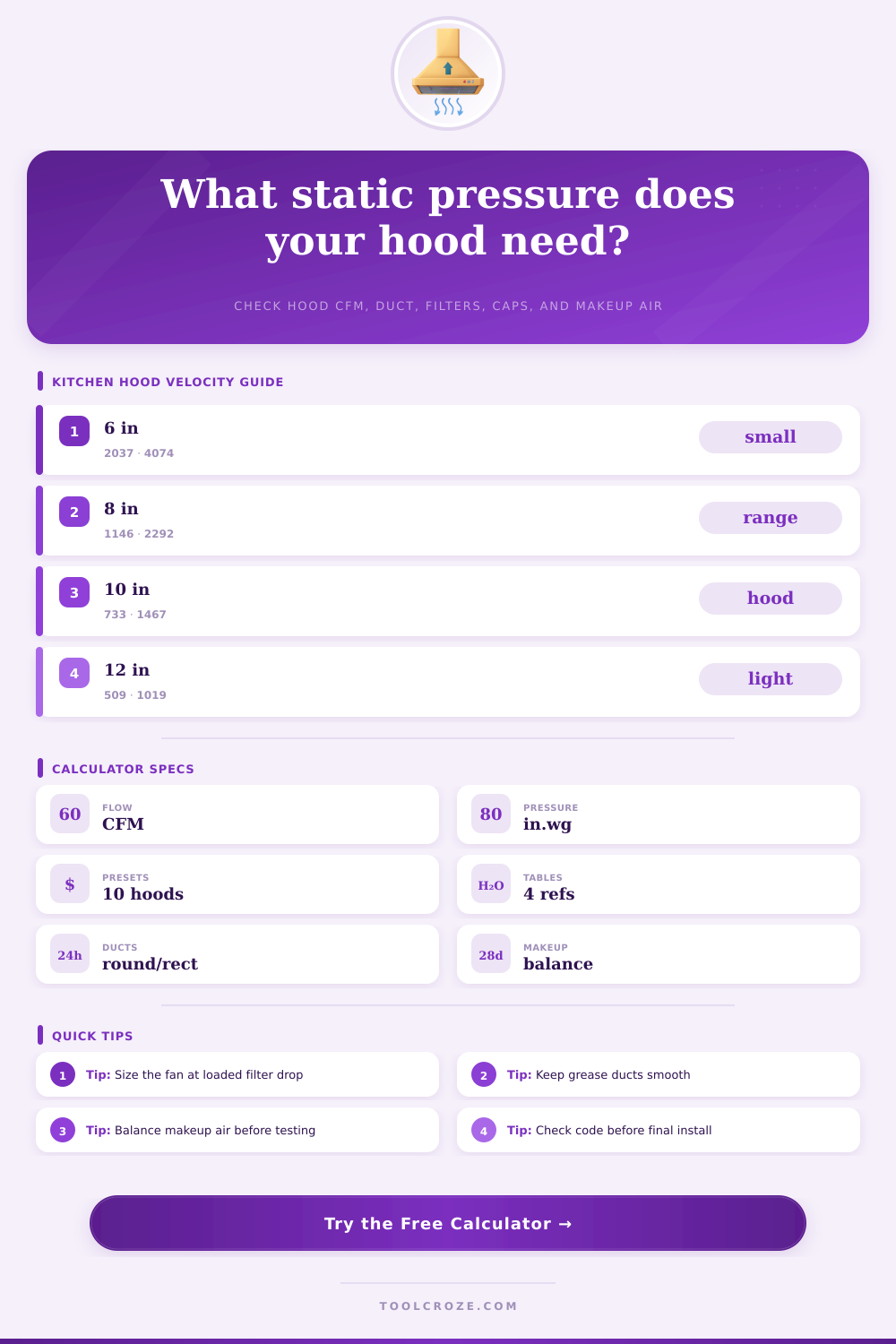
4 Duct Velocity Table
| Duct size | Area | Velocity at current CFM | Kitchen hood note |
|---|
5 Pressure Loss Breakdown Table
| Component | Input or basis | Estimated drop | Share of total |
|---|
6 Hood Type Reference
| Hood type | Typical use | Capture pressure allowance | Design note |
|---|---|---|---|
| Wall canopy | Residential or light commercial line | 0.05 in.wg | Back wall improves capture compared with an island hood. |
| Island canopy | Cooking line open on all sides | 0.08 in.wg | Usually needs more airflow and better cross-draft control. |
| Backshelf / proximity | Low-mounted commercial equipment hood | 0.04 in.wg | Capture is efficient when mounted and loaded correctly. |
| Heavy-duty line | Wok, charbroiler, fryer, solid fuel | 0.12 in.wg | Hot plume and grease loading raise the design risk. |
7 Fitting And Accessory Reference
| Item | Planning value | When to raise it | Field check |
|---|---|---|---|
| 90 degree elbow | 15 duct diameters | Tight radius, mitered turns, or dirty fittings | Count every direction change in the run. |
| 45 degree elbow | 7.5 duct diameters | Back-to-back offsets or compressed flex | Use two 45s for offset pairs. |
| Grease filter | 0.25 to 0.70 in.wg | Loaded baffles, mesh filters, or undersized hood bank | Use the hood data plate or submittal value. |
| Roof cap / damper | 0.10 to 0.35 in.wg | Bird screen, gravity damper, or high discharge velocity | Confirm the cap is rated for grease exhaust where required. |
8 Practical Tips
Using inputs like duct size, elbow count, hood type, velocity, makeup air, hood airflow, and roof cap loss, the kitchen hood static pressure calculator determines exactly how much static pressure your ventilation system need. This mean it will consider all of the resistance from one end of the exhaust path to the other end. Even if your duct is straight and the fan is running, there could still be smoke in your kitchen.
The problem? Most likely it’s caused by improper static pressure. Static pressure is a term that refers to the amount of resistance the fan has to push the air through the exhaust system.
How to use the kitchen hood static pressure calculator
Each element causes resistance in the air path. Duct length, bends, filters and termination fittings all create increased pressure demand. Because proper airflow affects the pressure of the building, the performance of the fan and the cleanliness of the ducts, calculating exact static pressure is critical for a grease hood system.
Without any friction charts at all, the calculator takes those resistance values and cranks through them. You put in the cubic feet per minute needed by the hood. Then you choose a size and shape for your ducts.
There’s a field for how many elbows there will be in the run. And you mark if the grease filters is loaded or clean. It factors in the roof cap resistance, plus the collar loss depending on hood style.
And it factors in makeup air deficits, which lower the pressure in the room and thereby reduce the hoods capture efficiency. That shows up as a penalty on the calculator before you’ve even started building. Beyond static pressure, there’s another key variable to consider.
Pressure isnt the only factor that impacts duct systems; speed of movement (velocity) matters too. Grease particles will drop out onto the duct walls if velocity is low. If it’s high, more friction and noise are created (meaning wasted fan energy).
Home hoods generally run in the range of 700, 1600 feet per minute. Commercial wok lines run higher due to their increased velocity and temperature of the plume. See the velocity table for common duct sizes and their typical airflows.
This should of give you an idea of whether or not your reading falls into a reasonable range. When inputting data on grease filters, keep in mind that they must be treated with care. For example, the pressure drop across a clean filter might be low.
As it gets dirty, the pressure drop rises substantialy. So you want to use the loaded pressure and not the clean pressure. This keeps you operating at full speed in-service.
It also reduces the potential of airflow restriction. Balance controls. Makeup air balances the entire system.
An insufficient supply rate (less than 80% of exhaust volume) causes negative room pressure. Negative pressure decreases hood capture; grease deposits on ceilings rather than in filters. A negative reading from the calculator tells when to increase the width of a transfer grille or install an additional dedicated makeup unit.
The calculator doesn’t account for details in a real installation. For example, code might require stainless duct, which is always welded. Also, the duct runs need to be kept as straight and as short as possible, given your building constraints.
Finally, youll need clean-out doors at all changes of direction. All these rules are intended to create a system that complies with fire safety standards and other codes. The pressure target from the calculator can be matched against fan curves from manufacturers.
This confirms that your fan will meet the actual load. To select fans, the calculated static pressure number is what you are aiming for. Add a safety factor of 10-15% to that number and now you have something comparable to the manufacturers fan curve numbers.
However the fan may be rated on an efficiency point and if used way off that point may see dramatically lower air flow rates. The calculation will help keep you out of selection trouble by giving you a realistic measure of resistance. The right amount of makeup air + right amount of velocity + right amount of static pressure is what makes a hood efficient.
If one of these variables are off, the whole system isnt working as well as it could; however, knowing exactly what numbers youre looking for will help eliminate those errors. That’s where this calculator comes in, plug in the values and see which ones is needed. Also, while using the calculator is helpful, the codes are still important to ensure your hood is operating safely.
Last but not least, once set up properly, the hood works as intended without losing to much airflow or being overly loud.