Linear Feet to Acres Calculator
Convert frontage length, parcel depth, strip width, shape, setbacks, and overlap allowance into acres, square feet, square yards, hectares, and planning benchmarks.
01Land and frontage presets
Load a common fencing, roadway, buffer, or parcel scenario, then adjust the field measurements to match the survey or takeoff.
02Frontage, parcel, and setback inputs
Calculation Breakdown
03Land and shape grid
04Reference tables
| Strip width | Linear feet per acre | Acres per 100 linear feet | Common planning use |
|---|---|---|---|
| 5 ft maintenance strip | 8,712 linear ft | 0.0115 acre | Narrow fence access or edging band |
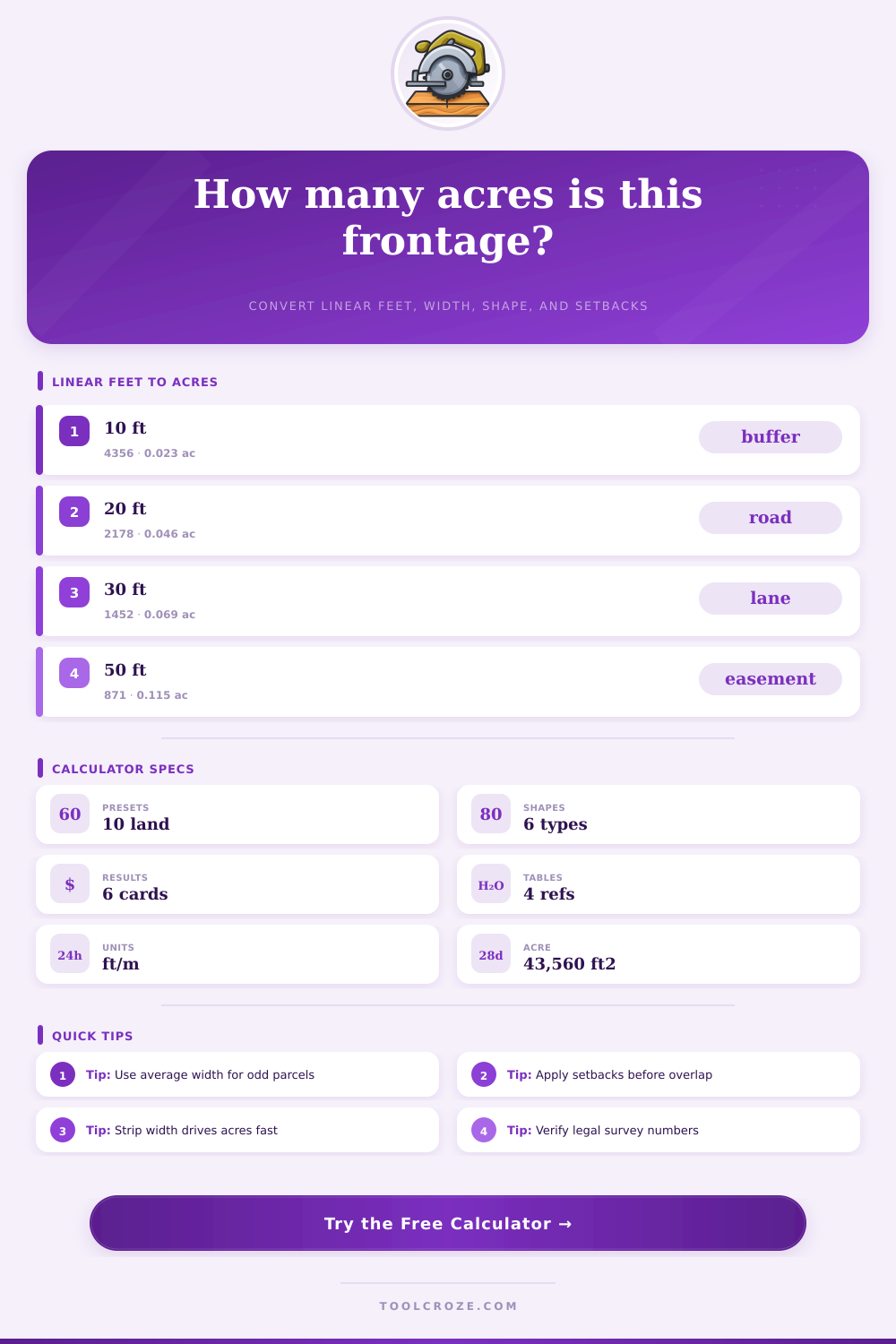
| 10 ft buffer strip | 4,356 linear ft | 0.0230 acre | Landscape strip, small easement, or setback band |
| 20 ft corridor | 2,178 linear ft | 0.0459 acre | Driveway, utility route, or road shoulder planning |
| 30 ft frontage band | 1,452 linear ft | 0.0689 acre | Frontage reserve, lane, or wide right-of-way strip |
| 50 ft easement | 871 linear ft | 0.1148 acre | Utility easement, drainage corridor, or access strip |
| Shape mode | Area formula | Best measurement | Setback behavior |
|---|---|---|---|
| Frontage strip | Linear length x strip width | Route centerline or surveyed frontage | Side setbacks shorten length; front/rear reduce width |
| Rectangle | Frontage x depth | Width and depth from survey or plat | Side setbacks reduce width; front/rear reduce depth |
| Trapezoid | Average front/back width x depth | Front width, rear width, and depth | Side setbacks reduce both front and rear widths |
| Triangle | Base x depth / 2 | Corner parcels and wedge-shaped fields | Setbacks are estimated on the base and depth |
| Oval | Pi x half-width x half-depth | Ponds, wetlands, medians, and rounded areas | Setbacks shrink both axes before area is calculated |
| Use case | Typical allowance | Measure carefully | Calculator note |
|---|---|---|---|
| Fence frontage | 3% to 8% | Gates, corners, jogs, and access strip width | Use strip mode if only a maintained band is needed |
| Roadway shoulder | 5% to 12% | Shoulder width, ditch line, and taper areas | Use centerline length for long roadway runs |
| Utility easement | 5% to 10% | Actual legal corridor width and route length | Keep legal easement acreage separate from work area |
| Whole parcel | 0% to 5% | Front width, rear width, and mapped depth | Surveyed acreage overrides rough shape estimates |
| Field or pasture | 3% to 8% | Irregular edges, waterways, and excluded zones | Average widths can improve quick takeoffs |
| Conversion | Formula | Example | Use in this calculator |
|---|---|---|---|
| Square feet to acres | sq ft / 43,560 | 43,560 sq ft = 1 acre | Main acre result |
| Linear strip to acres | length x width / 43,560 | 1,000 ft x 20 ft = 0.459 ac | Frontage and roadway bands |
| Acres to hectares | acres x 0.404686 | 2 acres = 0.809 ha | Metric land area card |
| Square feet to square yards | sq ft / 9 | 9,000 sq ft = 1,000 sq yd | Ground cover and field layout checks |
05Acreage planning tips
As a land surveyor or property owners, you may encounter a situation in which the measurement provide for a plot of land is in linear feet, but the land owner want to know the measurement of that plot of land in an acres. A linear foot measurement indicate the length of a line, while the measurement in acres indicates the total area of a surfaces. Additionally, knowing the total area of land in acres will help a property owners understand the cost of permits and materials for that plot of land.
Furthermore, knowing the total area of land in acres will allow the land owner to determine if the project will fit on that plots of land. To calculate the acres in a plot of land, you must first determine the total square footage of the land by multiply the length of the strip of land by the width of that strip of land. Once you have determined the total square footage of the land, divide that total by 43,560, the amount of square feet in an acre.
How to Convert Linear Feet to Acres
The width of the strip of land are a critical component in calculating the total area of land in acres. If a strip of land is five feet wide, the area of land will be less than a strip of land that is thirty feet wide. Setbacks is the measurements that must be subtracted from the total area of the land to determine the area that can be used for the project.
Many local governments require setbacks for projects such as building road or constructing buildings on a plot of land. These setbacks are distances that must remain away from the boundaries of the lands plot. These setbacks must be subtracted from the dimensions of the land before determine the area of that plot of land in acres.
Any area that is not subtracted for setbacks will result in the total acreage being greater than the usable area of the plot of land. By subtracting these setbacks, the total area of land in acres will accurately reflect the amount of usable land. The shape of the land impact how the linear feet can be converted into acres.
If the plot of land is in the shape of a rectangle, the calculation of acres is the multiplication of the length of the land by the width of the land. However, if the land is of a different shape, such as a trapezoid, a different calculation must be used to determine the area in acres. The area in acres can also be calculated for plots of land in the shape of a triangle or an oval.
The shape of the land plot must be correctly calculate because any errors in the calculations of the acres will result in the acres determined for that land plot being incorrect. A person should also consider whether the area will be measured for an overlap and waste allowance. The overlap and waste allowance are used to provide extra area to the acre measurement to account for the irregular edges of land and potential construction mistake.
Most land plots has irregular edges, so adding an allowance for waste in the measurement will ensure that the land is measured correctly for real-world conditions instead of ideal conditions. The calculator will determine the acres of land in the plot after calculating the waste allowance so that the waste allowance is added to the most accurate area of land in acres as possible. There are many different use for the linear feet to acres calculator.
One of the most common uses is in planning utility corridor. Another common use is for conservation buffers. Other uses for this calculator include planning road shoulders and pasturage fencing for farm.
Because acres and linear feet are two different units of measurement, certain steps in mathematics must be used to determine the number of acres in a strip of land in linear feet. If a person has determined the length and width of the plot of land in linear feet and the setbacks for the project on that land, then the number of acres can be accurately determine.