Drawer Box Size Calculator
Calculate drawer box width, height, depth, bottom panel size, front/back cuts, slide clearances, and material quantities from a cabinet opening.
01 Cabinet Presets
Choose a common cabinet opening, then adjust the slide, reveal, groove, and material details to match the hardware on your bench.
02 Drawer Box Inputs
Calculation Breakdown
03 Drawer Slide and Material Grid
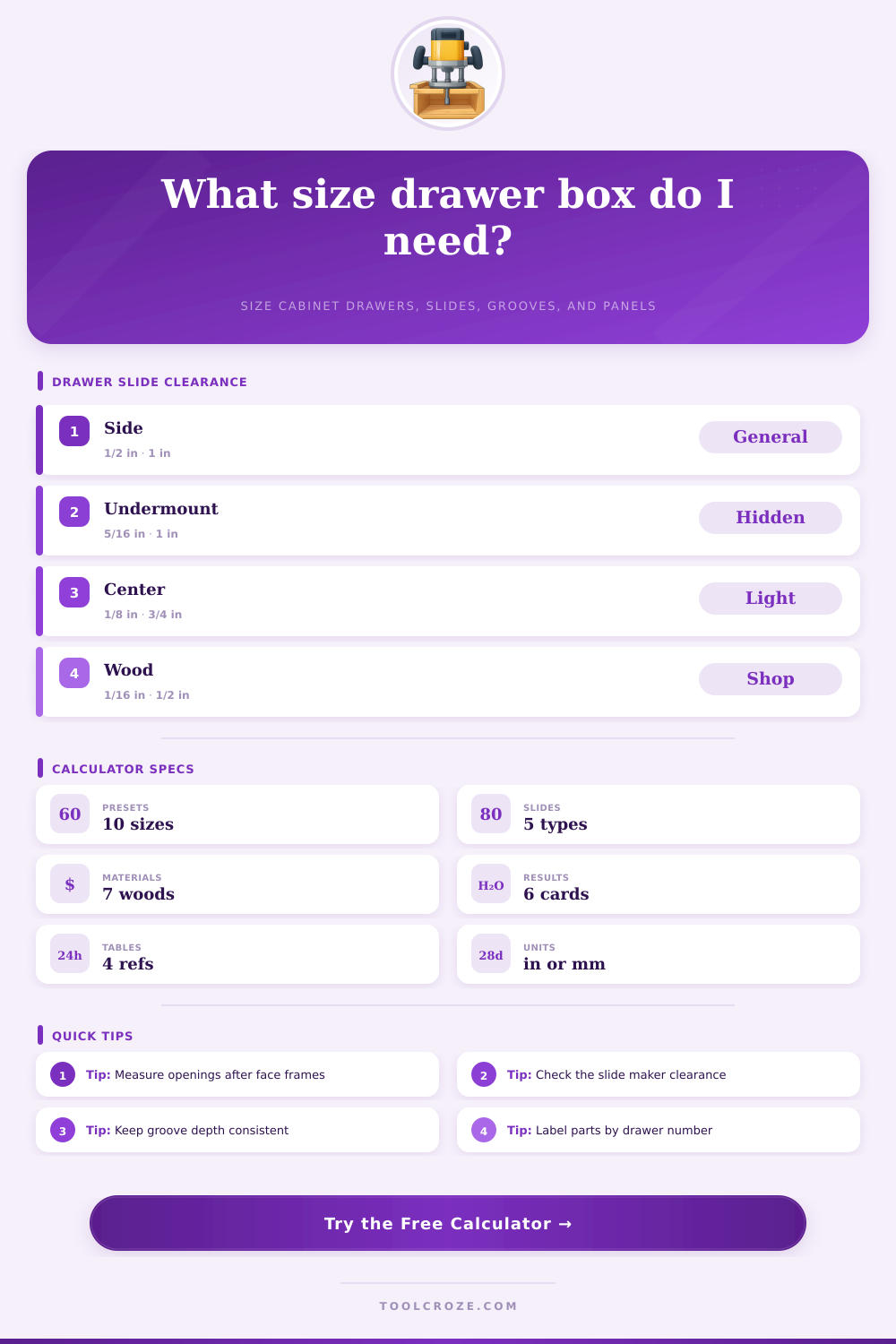
04 Slide Clearance Reference
| Slide Type | Clearance Each Side | Back Gap | Best Use |
|---|---|---|---|
| Side-mount ball bearing | 1/2 in each side | 1 in common | General kitchen, shop, and utility drawers |
| Undermount concealed | 5/16 in each side, verify brand | 1 in plus locking device room | Finished cabinetry with hidden hardware |
| Center-mount slide | 1/8 in each side for side play | 3/4 in common | Light desk and furniture drawers |
| Wood runner | 1/16 in to 1/8 in each side | 1/2 in common | Traditional furniture and shop jigs |
| Custom hardware | Use the maker's spec sheet | Use the maker's spec sheet | Specialty slides, pocket systems, pullouts |
05 Drawer Material Reference
| Material | Density | Screw Holding | Shop Note |
|---|---|---|---|
| Baltic birch plywood | 42 lb/ft3 | High | Stable, strong edges, excellent for dovetails or screws |
| Maple plywood | 38 lb/ft3 | High | Good cabinet default when edges are banded or hidden |
| Poplar solid wood | 29 lb/ft3 | Medium | Light and easy to mill; allow for seasonal movement |
| Hard maple solid wood | 44 lb/ft3 | High | Durable premium box stock for heavy daily use |
| MDF utility drawer | 48 lb/ft3 | Low | Use confirmat screws or reinforcement near fasteners |
| Melamine particleboard | 45 lb/ft3 | Medium | Clean interior surface; predrill to prevent splitting |
| Aromatic cedar | 33 lb/ft3 | Medium | Common for storage drawers and blanket chests |
06 Common Cabinet Presets
| Preset | Opening | Slide Choice | Typical Box Result |
|---|---|---|---|
| 18 in base cabinet | 15 x 8 x 22.75 in | Side-mount 21 in | 14 in wide box, 21 in deep |
| 24 in two-drawer base | 21 x 12 x 22.75 in | Undermount 21 in | About 20.38 in wide, two boxes |
| 36 in drawer bank | 33 x 27 x 22.75 in | Side-mount 21 in | 32 in wide boxes, three drawers |
| Desk pencil drawer | 22 x 3.5 x 18 in | Center-mount 16 in | Wide shallow box with light load |
| File drawer opening | 15.5 x 11 x 22 in | Heavy side-mount 20 in | 14.5 in wide, higher side box |
07 Cut List Rules
| Part | Quantity per Drawer | Formula Used | Build Assumption |
|---|---|---|---|
| Sides | 2 | Depth x box height | Sides run full drawer depth |
| Front and back | 2 | Box width minus 2 side thicknesses | Front/back fit between the sides |
| Bottom panel | 1 | Inside size plus 2 groove depths | Panel is captured in grooves on all four parts |
| Drawer front | 1 | Opening share adjusted by reveal | Face sizing is an estimate; verify layout lines |
| Material area | All parts | Side, front, back, bottom area times drawer count | Waste allowance is added after raw area |
08 Shop Tips
Calculating the correct dimension for a drawer box is a necessary step in the cabinet construction process. Calculating the correct dimension for a drawer boxes will prevent many common error when making drawer boxes. For instance, if the drawer box is too wide for the cabinet opening it will bind against the drawer slide.
Furthermore, if the drawer box is too shallow it will waste space within the cabinet opening. The dimension for a drawer box is difficult to calculate because the dimension of the cabinet opening are not the same as the drawer box dimension. Each of the factor that reduce the size of the cabinet opening must be accounted for.
How to Calculate Drawer Box Size
For instance, a calculator can assist in calculating the correct dimension for a drawer box by entering the dimension for the cabinet opening, the type of drawer slide that will be used, and the type and thickness of the wood that will be used to create the drawer box. By entering these variables the calculator can provide the dimension for the drawer box so that the drawer box designer avoid the guesswork involved in creating a drawer box. The carpenter takes the dimensions of the cabinet opening after the installation of the face frame.
The measurement of the opening will be used as the starting point for calculating the dimensions of the drawer box. The dimensions of the opening will need to have the clearance for the drawer slide subtracted from the opening measurement. For example, side-mount ball bearing slide require a half-inch of clearance on each side of the opening, while undermount concealed slide require five-sixteenths of an inch of clearance on each side.
These different measurement create a difference in the dimension of the drawer box that will be created for each type of slide. Additionally, the back gap of the opening also must be taken into consideration when calculating the dimension of the drawer box. Most drawer slide require that there be an inch of clearance behind the drawer box.
The height of the drawer box present a bit of a challenge in that the height of the drawer box will depend upon the number of drawer that will be included in the opening, as well as the type of drawer front that will be used. For instance, if inset drawer front are to be used the height of the drawer box will be less than the height of the opening. Overlay drawer front will also have a limited height for the drawer box because the opening height divided by the number of drawer will provide the height of the overlay drawer front.
Frameless construction remove the face frame of the cabinet and the height calculation will be changed as a result of the removal of the face frame. The drawer box calculator include modes for each of these different type of construction so that the drawer box calculator can provide the height of the drawer box to the drawer box designer instead of the original height of the opening. The depth of the drawer box must also be calculated by considering the same factor as the height of the drawer box.
The depth of the drawer box is limited by the interior depth of the cabinet opening. The length of the drawer slide minus the back clearance will determine the depth of the drawer box. For instance, if a cabinet opening is twenty-three inch deep and a twenty-one inch long slide is used the depth of the drawer box will be twenty inch.
This depth of the drawer box will determine the length of the side length of the drawer box and the size of the bottom panel of the drawer box. Additionally, the groove depth of the drawer box may reduce the depth of the drawer box; shallow drawer box may appear to be even shallower when assembled. The material to be used for the drawer box can impact the calculation of the dimension of the drawer box.
For instance, Baltic birch plywood hold screw well and does not warp, while solid poplar is lighter in weight but move if the humidity changes. MDF is a very dense material and stable but weak near the area where screw are driven into the wood unless confirmat screw are used. The reference table that is provided with the calculator provides the density of each type of wood.
This weight is an important measurement for file drawer or other cabinet that will contain file of importance to the organization. Finally, an allowance must be made for the amount of wood that will be waste when cutting the drawer box from sheets of material. A defect in the sheet of material or the need to grain match the drawer box to the remainder of the cabinet opening can result in losing some of the material when cutting the drawer box from the sheet of wood.
Many error are committed by drawer box designer. One of the most common error is measuring the cabinet opening before the installation of the face frame. Another error is assuming that the length of the drawer slide will be the depth of the drawer box, without subtracting the back gap measurement for the slide.
The depth of the bottom panel of the drawer box can also be forgotten; because the bottom of the panel is to sit within groove within each of the four side of the drawer box, the designer must allow for the depth of the groove within the panel; otherwise the panel will not properly fit within the cabinet opening. Such error may be made when crafting bank of six or eight drawer box. The reference table list the different clearance for different type of drawer slide, the property of the different type of wood, and the weight of each type of wood once it is cut and planed for use as a drawer box.
These table provide the designer with the information necessary to understand the parameter of the drawer box. When the opening of the cabinet, the slide and the material are all entered into the calculator the calculator will output the outside dimension of the drawer box, the length of the front and back of the drawer box, the size of the bottom panel of the drawer box, and the total area of the material necessary to create the drawer box. This information will allow the drawer box designer to determine whether the drawer box will fit within the opening of the cabinet.
When the cabinet opening, the drawer slide and the material to create the drawer box are all balanced properly the drawer box will run smooth within the cabinet opening and will evenly distribute any load placed upon the drawer box.