LTL Linear Feet Calculator
Estimate trailer floor length from pallet count, footprint, stackability, overhang, spacing, side-by-side rows, trailer width, and freight density class.
Load a typical freight setup, then adjust the dimensions to match the actual bill of lading and dock measurements.
Calculation breakdown
| Preset freight | Typical footprint | Stackability | Layout watch point |
|---|---|---|---|
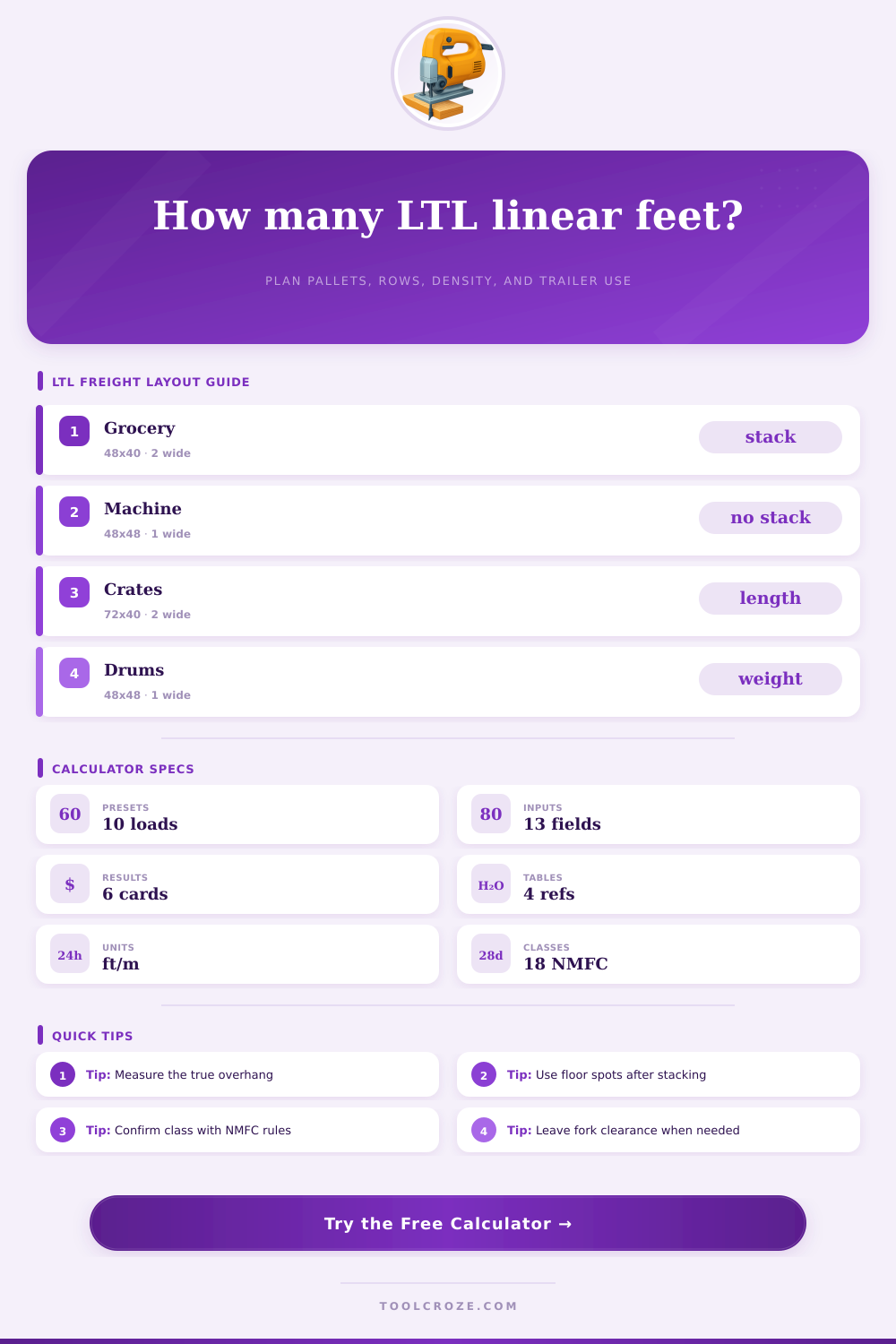
| Grocery pallets | 48 x 40 in | Often 2 high | Two-wide dry van rows |
| Machinery skids | 48 x 48 in | Usually no | Square skids may single row |
| Long crates | 72 x 40 in | Case specific | Length drives floor footage |
| Furniture cartons | 60 x 48 in | Limited | Cube can exceed density class cue |
| Density class | Density range | Typical freight behavior | Calculator cue |
|---|---|---|---|
| 50 to 65 | 22.5+ lb/ft³ | Dense, compact freight | Check weight per spot |
| 70 to 100 | 9 to 22.5 lb/ft³ | Common mixed pallet freight | Cube and stack matter |
| 110 to 175 | 5 to 9 lb/ft³ | Lighter bulky freight | Linear feet may dominate |
| 200 to 500 | Below 5 lb/ft³ | Very low-density freight | Confirm dimensions closely |
| Pattern | Across trailer | Best use | Watch point |
|---|---|---|---|
| Lengthwise | - | - | Calculate to compare |
| Rotated | - | - | Calculate to compare |
| Trailer basis | Available length | Your use | Remaining length |
|---|---|---|---|
| 28 ft pup | 28 ft | - | - |
| 40 ft container | 40 ft | - | - |
| 48 ft van | 48 ft | - | - |
| 53 ft van | 53 ft | - | - |
When a shipper book a Less Than Truckload (LTL) shipment, the shipper must consider the linear feet of the shipment. The linear feet of a shipment is a measurement of the floor space that the freight will occupy in an trailer. The linear feet of a shipment will determine the cost of the shipment, whether or not the shipment will be subject to a linear foot minimum charge, and whether or not there is enough spaces in the trailer to accommodate any other shipments.
Thus, the linear feet is a critical measurement for any shipper. There are many factor that can contribute to the linear feet of a shipment. One of the factors are the number of pallets in the shipment.
How to Measure Linear Feet for LTL Shipments
The number of pallets, however, is not the only factor that will impact the linear feet of the shipment. For example, another factor is the stackability of individual pallets. If the individual pallets is stackable, then they wont take up as much floor space as the pallets that are not stackable.
Additionally, the overhang and spacing of the pallets will impact the amount of floor space in which the individual pallets will use, as will the orientation of the individual pallets. For instance, if the stretch wrap on a pallet create a bulge, that bulge may increase the width of the individual pallet, which will increase the linear feet of the shipment. Another factor is the density of the freight, which will impact the freight class of the shipment.
The density of the freight is the relationship between the weight of the freight and the volume of that freight. A shipper can use a calculator to calculate the density of the freight. For instance, the calculator can help the shipper to determine if the chosen density class for the freight is accurate in relation to the actual density of the freight to be ship.
Additionally, other important factors are the width and length of the trailer in which the freight will be transported. The width and length of the trailer will impact the amount of freight that can fit in the truck. Not all trailers is the same in terms of both the width and length of the trailer.
For example, a trailer loading calculator can help to track the amount of width of the trailer that the shipper is using, and how much of the length of the trailer remains to be used for other freight. For example, if a load of freight are added to a trailer that leaves usable space within that trailer, another shipment may be able to be loaded onto that same trailer. Many people make errors when calculating the linear feet of their freight.
For instance, many people use the dimensions of the pallets (such as 48 inches in one dimension and 40 inches in the other) instead of the dimensions of the loaded unit (such as 50 inches in one dimension and 42 inches in the other due to the stretch wrap on the pallet). Additionally, many people dont account for the amount of space require for forklift clearance between pallets. Such errors in calculation can lead the linear feet of the shipment to be higher than that which was calculated.
Another mistake that people may make is to assume that the height of the freight will be the same for all of the different shipments. For example, some freight is top-heavily in relation to other freight, or the freight may not be as readily stackable as other freight. For instance, if the pallets are not readily stackable, the freight may take up more floor space than if the freight were more readily stackable.
Therefore, a trailer loading calculator will assist the shipper in making such adjustment to the freight to determine if the repacking of the freight is worthy of the extra effort. Another factor to consider in relation to the calculation of linear feet is the complexity of the different types of freight within a single shipment. For instance, a shipment may contain both palletized freight and freight within crates.
Furthermore, there may be different types of freight with different orientations of the individual pallets. For instance, testing different types of orientations in the trailer will allow the shipper to determine in what way the freight will use the least amount of linear feet. Using the least amount of linear feet for the freight will help to ensure that the freight will be under the threshold for the trailer.
Finally, another mistake that many people make is to treat the linear feet of a shipment as a non-variable. For instance, changing how the freight is stacked, spaced, or even rotated within the trailer can make changes to the linear feet of a shipment. Thus, small change to these variables may lead to a reduction of the linear feet that is used by the freight, which can, again, lead to cost and space savings for that shipper.
Its more better to plan ahead because small changes could of saved alot of money.