Soft Wash Mix Calculator
Calculate sodium hypochlorite, water, surfactant, downstream dilution, final tank strength, and surface-applied strength for common exterior cleaning mixes.
1 Cleaning presets
Load a real soft wash starting point, then tune source strength, batch size, downstream draw, surface target, and margin for your setup.
2 Batch, SH, water, and dilution inputs
Mix Breakdown
3 Mix and surface grid
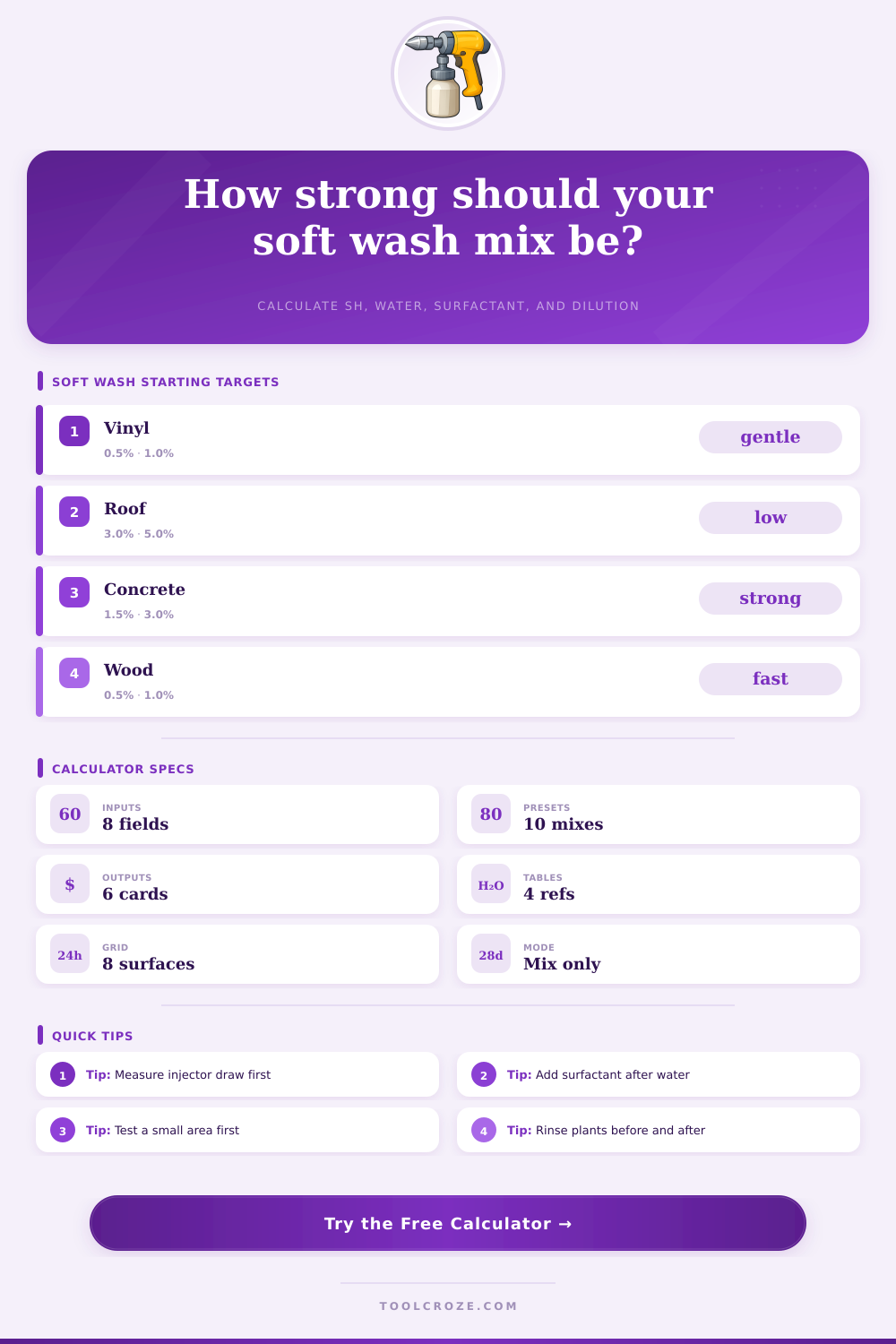
4 Surface target reference
| Surface | Common starting range | Heavy organic range | Calculator note |
|---|---|---|---|
| Vinyl siding | 0.5% to 0.8% | 0.8% to 1.2% | Low pressure rinse and protect landscaping. |
| Asphalt shingles | 3.0% to 4.0% | 4.0% to 5.0% | Use low pressure and control runoff carefully. |
| Painted stucco | 0.8% to 1.2% | 1.2% to 2.0% | Patch-test paint, sealers, and oxidation first. |
| Concrete driveway | 1.5% to 2.5% | 2.5% to 4.0% | Porous slabs may need dwell and second pass. |
| Brick or masonry | 1.0% to 2.0% | 2.0% to 3.0% | Check mortar condition and metal nearby. |
| Wood fence or deck | 0.5% to 0.8% | 0.8% to 1.2% | Rinse quickly and avoid raising fibers. |
5 SH source and direct batch table
| Source SH | 1% direct in 5 gal | 3% direct in 5 gal | 5% direct in 5 gal |
|---|---|---|---|
| 6.0% laundry bleach | 0.83 gal SH | 2.50 gal SH | 4.17 gal SH |
| 10.0% liquid chlorine | 0.50 gal SH | 1.50 gal SH | 2.50 gal SH |
| 12.5% fresh SH | 0.40 gal SH | 1.20 gal SH | 2.00 gal SH |
| 15.0% strong SH | 0.33 gal SH | 1.00 gal SH | 1.67 gal SH |
6 Downstream dilution table
| Injector ratio | Dilution factor | Tank mix for 1% surface | Practical read |
|---|---|---|---|
| Direct apply | 1x | 1.0% tank | Tank strength equals surface strength. |
| 3:1 water:mix | 4x | 4.0% tank | Useful for masonry and stronger siding work. |
| 5:1 water:mix | 6x | 6.0% tank | Common moderate downstream planning number. |
| 10:1 water:mix | 11x | 11.0% tank | Needs strong fresh SH for a true 1% surface. |
| 20:1 water:mix | 21x | 21.0% tank | Too diluted for strong surface targets. |
7 Surfactant and dwell reference
| Rate | Typical use | Foam behavior | Mixing note |
|---|---|---|---|
| 0.25 oz/gal | Light downstream siding | Low cling | Good when rinse speed matters. |
| 0.5 oz/gal | Routine siding wash | Moderate wetting | Often enough for vertical vinyl. |
| 1.0 oz/gal | General soft wash mix | Visible cling | Balanced starting point. |
| 2.0 oz/gal | Roof or steep surface | Heavy cling | Avoid over-foaming injectors. |
| 3.0 oz/gal | Difficult roof streaks | Very heavy foam | Check pump and hose compatibility. |
8 Tips
Getting the strength of a soft wash mix correctly is another important part of the process of pressure washing exteriors. The strength of the soft wash mix will determine how well the soft wash mix clean the surface that is being treated. Using too little sodium hypochlorite will cause the algae or mildew that are on the exterior of the treated structure to remain on that surface.
Using too much sodium hypochlorite, however, can lead to siding damage or the death of plant outside of the treated area. The strength of the soft wash mix must be match to the job that is being performed; if the soft wash mix is too weak, it will not be able to clean the exterior of the structure effect, and if it is too strong, it can damage that exterior. A variety of variable can impact the concentration of the soft wash mix.
How to Choose the Right Soft Wash Strength
The strength of the sodium hypochlorite that is contained in the soft wash mix can differ according to the source strength of that sodium hypochlorite, the size of the tank in which it is stored, and the amount of surfactants that is added to the tanks. Sodium hypochlorite weaken over time, so using an older batch of sodium hypochlorite will lead to a weaker soft wash mix. Surfactant is added to allow the soft wash mix to adhere to vertical surface, but if too much surfactant is added, it will create foam that can lead to clogging of the injector of the soft wash mix.
The third variable is whether the soft wash mix is dispense from the soft wash tank or from a downstream injector. If a downstream injector is used, the concentration of the soft wash mix will be diluted, so the sodium hypochlorite that is added to the tank must be stronger then desired. Different strength of the soft wash mix are required for different surfaces.
Surfaces like vinyl siding are thin materials, so lower percentage of sodium hypochlorite are required. Asphalt roofs may have black streaks in the granules of the roofing material, so higher concentrations of sodium hypochlorite is required for those treatments. Concrete driveway are porous materials, so the sodium hypochlorite will soak into the driveway.
Two pass of the sodium hypochlorite may be required. Care should of been taken when treating driveways with sodium hypochlorite, however, because the runoff from the driveway may damage the landscaping area. A calculator may be use to determine the measurement of each ingredient in the soft wash mix.
The calculator accounts for the source strength of the sodium hypochlorite that is to be used, the batch size of the soft wash mix that is to be prepared, the percentage of sodium hypochlorite that is required for the particular job, and the dilution ratio at which the sodium hypochlorite will be dispense. Skipping the step in which the water is adjust to the desired amount will lead to incorrect percentage of the sodium hypochlorite in the nozzle of the soft wash mix. Using a safety margin for the age of the sodium hypochlorite allow for the possibility of slight variation in the chemical strength of the product that is dispense from the injectors.
Many people make mistake when mixing the soft wash chemicals. For instance, some individuals use high percentage of sodium hypochlorite in every job. However, different job require different percentages of sodium hypochlorite in the soft wash mix.
Additionally, some individuals often forget to measure the injector draw with plain water prior to adding the sodium hypochlorite and surfactant. The percentage of the soft wash mix will not be accurate if this step are skipped. Some even add the surfactant prior to mixing the sodium hypochlorite.
Adding the surfactant too early in the mixing process can create foam that makes it difficult to accurately measure the chemical. Finally, the overspray from the soft wash mix can impact the plant outside of the job site, especially on warm days when the stomata of the plants are open. Lastly, reference table can be used to determine the strength of the soft wash mix.
The reference tables show the range of percentages of sodium hypochlorite for different job and different types of surfaces. Additionally, the reference tables provide information regarding the impact of downstream injectors on the strength of the soft wash mix. These reference tables should not be used in place of the decision of the individual soft wash technician, but can be utilized as a means of ensuring that the strength of the soft wash mix remain within the workable limit for the technician and the environment.
Thus, mixing the chemicals is about matching the chemistry of the job to the surface that is to be treated, and matching the chemistry to the method in which the soft wash mix is to be dispensed from the injector.